
Crete botanising
2 to 17 May 2026
Bursary Report by Charlie Hunt
Thanks to Mediterranean Plants and Gardens, Bentham-Moxon trust, and RHS for helping with the costs of this trip.
Thanks to John Fielding, co-author of “Flowers of Crete”, for generously sharing his time and knowledge of the island whilst I was in the planning stages of the trip. Thanks Graham Walters for suggesting some floral hotspots.
Thanks to Chara Papailiou of the Psiloritis Geopark Information Centre for the impromptu hike in the Ida range and the knowledge shared.
Introduction to Crete climate and flora
Crete is the fifth largest island in the Mediterranean Sea, and the largest in Greece. Spanning 260km east to west, and between 12 to 60km north to south, it has an area of 8336 sq km and a coastline of 1046km.
The mountainous island has six mountain ranges. The ranges and their highest points are as follows: the Ida Range (Psiloritis) 2456m, the White Mountains (Lefka Ori) 2453m, the Dikti Mountains 2148m, Kedros 1777m, Thrypti 1489m, and the Asterousia Mountains 1231m. With the numerous mountain ranges come plateaus, gorges, and caves, with Samaria Gorge being one of the most famous.
Crete is mostly within a (Csa) hot-summer Mediterranean climate, however, there are areas in the south and east belonging to the a (BSh) hot semi-arid climate. At higher elevations there are (Csc) cold-summer Mediterranean climates and (Dfb, Dfc) continental climates. Typically, the humid rainy season lasts from November to March, with the hot dry season lasting June to August. See below for climate data taken from Heraklion (central Crete):
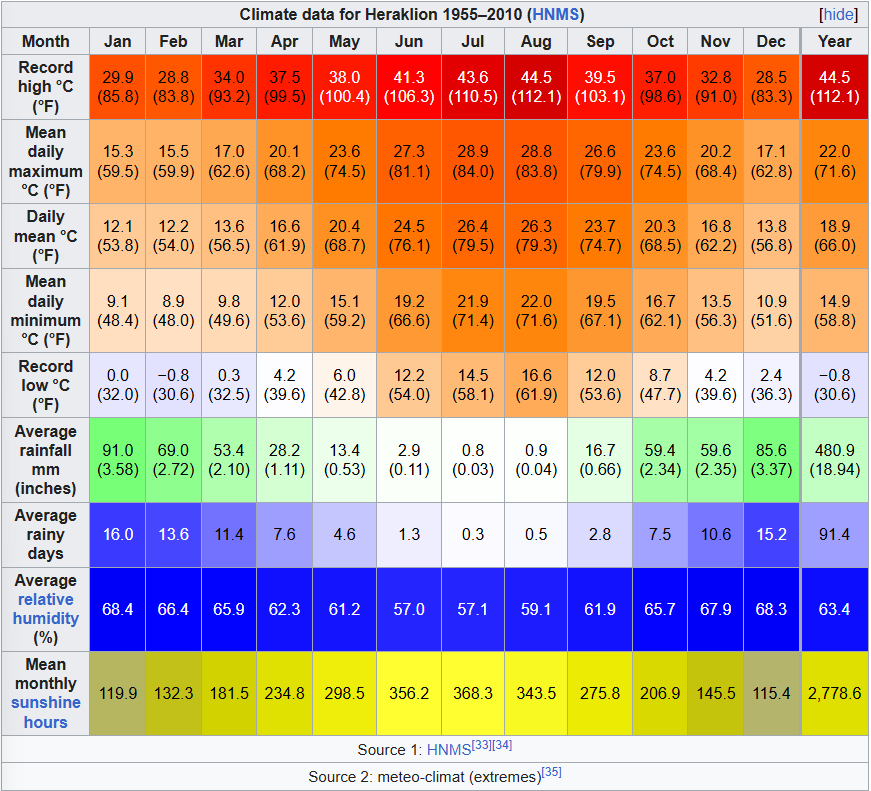
Source: Hellenic National Meteorological Service (HNMS/EMY). Reproduced with attribution under the HNMS Terms of Use.
Flora
Crete is situated fairly equidistant from Africa, Asia and Europe, and has been physically connected to all three at certain points in the past. Because of this, the Cretan flora has parts from all three of these continents and, when separated from them, evolved a flora high in endemism due to the long-term isolation over 5.2 million years. Crete is home to two endemic genera: Horstrissea (Apiaceae) and Petromarula (Campanulaceae).
In the past, Crete was a heavily wooded island, with mentions by Theophrastus (372 – 287 BC) of extensive forests housing cypress, oak, maple and plane trees. Over millennia, and the development and expansion of the Minoan civilisation, the forest cover decreased. This was further exacerbated by arrival of later civilisations such as the Arabs, Byzantines, Romans, Turks and Venetians. The previously mentioned trees still remain but are much fewer in number and more fragmented. This brings us to the vegetation communities of Crete. For this report, I will keep it to the areas that I personally visited on the trip, and keep the following descriptions brief, as they will be explained in more detail further in the report.
Garigue: A stage of degrading woodland formed and kept in its state by factors such as browsing, burning, and wood cutting. Trees here such as Quercus coccifera and Acer sempervirens typically take on a stunted and deformed habit due to browsing, and shrubs such as Pistacia lentiscus grow between 0.5-1.5m in height. Spiny and resinous shrubs exist here, such as Euphorbia acanthothamnos and Berberis cretica, which manage to escape the ever-present browsing by goats and sheep.
Phrygana: Where forests have been greatly degraded, phrygana exists. Expansive low-growing, partly open communities of therophytes, herbs, geophytes, shrubs and thorn-cushion shrubs. Shrubs typically do not grow above 0.5m and have some degree of anti-herbivory, be it resin or spines. These thorn-cushion shrubs will act as nursery plants for geophytes, which are protected from grazing by growing amongst the shrubs.
Thorn-cushion communities: Typically appearing between 1500m and 2500m, these high-altitude communities appear throughout the mountain ranges of Crete and are susceptible to extreme winds and snow cover. These communities can exist on extremely rocky areas as well as those with a buildup of soil. As the name suggests, these shrubs are incredibly thorny, but also compact, tough and moderately open.
Sandy coastal vegetation: Dunes and islets (such as Elafonisi) harbour coastal vegetation. Perennial herbaceous, halophytes, Juniper, Pistacia, bulbs and parasitic plants exist here. Grasses stabilise dunes, giving way to further herbaceous development and stabilisation. These mobile communities house much of the same flora as other European and Mediterranean coastal dune communities.
High mountain vegetation: The tree-line in Crete is likely determined by frost, ranging from around 1450m to 1800 m. At higher altitudes on the limestone or dolomite ranges, Cupressus sempervirens can be seen, growing in old, gnarled sculpture-esque forms. Above the tree line is a mix of Asian and Mediterranean mountain flora, along with Cretan endemics. Thorn-cushion communities exist here, along with bulbs, compact cushion herbaceous flora, smaller alpine grasses such as Festuca, and the ever-present cushion-forming Trifolium uniflorum.
Gorge: Crete is home to many gorges. These deeply-cut gorges bear steep rock faces. These are home to many chasmophytes shrubs, orchids, trees and even palms. The sheer cliffs of the gorge provide shade, and combined with the watercourses running down the gorges, a relatively moist area exists. These are some of the most endemic-rich habitats of Crete.
Aims and objectives of trip
The aims and objectives of this trip were simple: I wanted to visit Crete over two weeks during May 2026, to gain an understanding of the flora and vegetation communities that exist there. Before the trip, my only experience with Cretan flora was through a couple of books, websites, flora databases such as GBIF and iNaturalist, and limited interactions with Cretan flora at RBG Kew. I wanted to study their morphology, distribution, and what flora associations exist. I wanted to expand on my field botany experience by developing identification skills, as well as work on my ability to focus on and notice patterns and changes in flora, and to record plants for the sake of information/data, and my personal benefit. As a horticulturist with a preference for nursery work, another goal was to take notice of how these plants were growing: how are their growing conditions, and what good ways are there to recreate this ex-situ? Sometime in the future I intend to take part in the running of botanical tours in various places of interest, and trips like this add to the skill pool and confidence required to do so.
The trip

Map above: points visited during the trip (2 to 17 May 2026).
© Google 2026.
The trip was somewhat limited by my lack of a driving licence; however, I attempted to get to a decent number of interesting places without one. Areas visited were, in order: Chania, Omalos Plateau, Lefka Ori (White Mountain) range, Sougia, Elafonisi, Elos, Preveli, Heraklion and the Psiloritis (Ida) range. I worked around the lack of driving license by using public transport, taxis, the occasional kindness of shepherds and restaurant workers offering me lifts, and walking. The areas picked allowed me to see the communities / habitats previously mentioned in this report within the two weeks I had. With another week, I would have ventured to the eastern point of Crete.
I will write this part of the report in sections of the natural areas I visited instead of a day-to-day diary, and as mentioning every plant seen on the trip would be overkill, I will include a table of personal observations at the end. Of course, there would have been many plants I did not see or was not able to identify and also those not in season.
Omalos and Lefka Ori
After arriving in Chania, my next step was to get to my accommodation on the Omalos Plateau where I would stay for three nights. There are no shops in the plateau, it is properly out in the sticks, so I found a supermarket and after stocking up on food and essential liquids got my taxi up into the mountains. It took an hour and a half to get up to the plateau, my driver Ioannis carefully climbing the roads which wound in a serpentine fashion. The weather was cold, overcast and misty, Ioannis had said there’d been a cold and wet spell recently and was getting increasingly excited about every degree drop in temperature, whilst I was enjoying the moody scenery of the green hills draped in the shifting greys. After arriving at the deserted hotel, as tourist season had not yet kicked in, it was time for dinner and an early night before heading into the mountains the following morning. I had my first taste of Cretan hospitality, with a hearty meal and obligatory complimentary ouzo to finish.
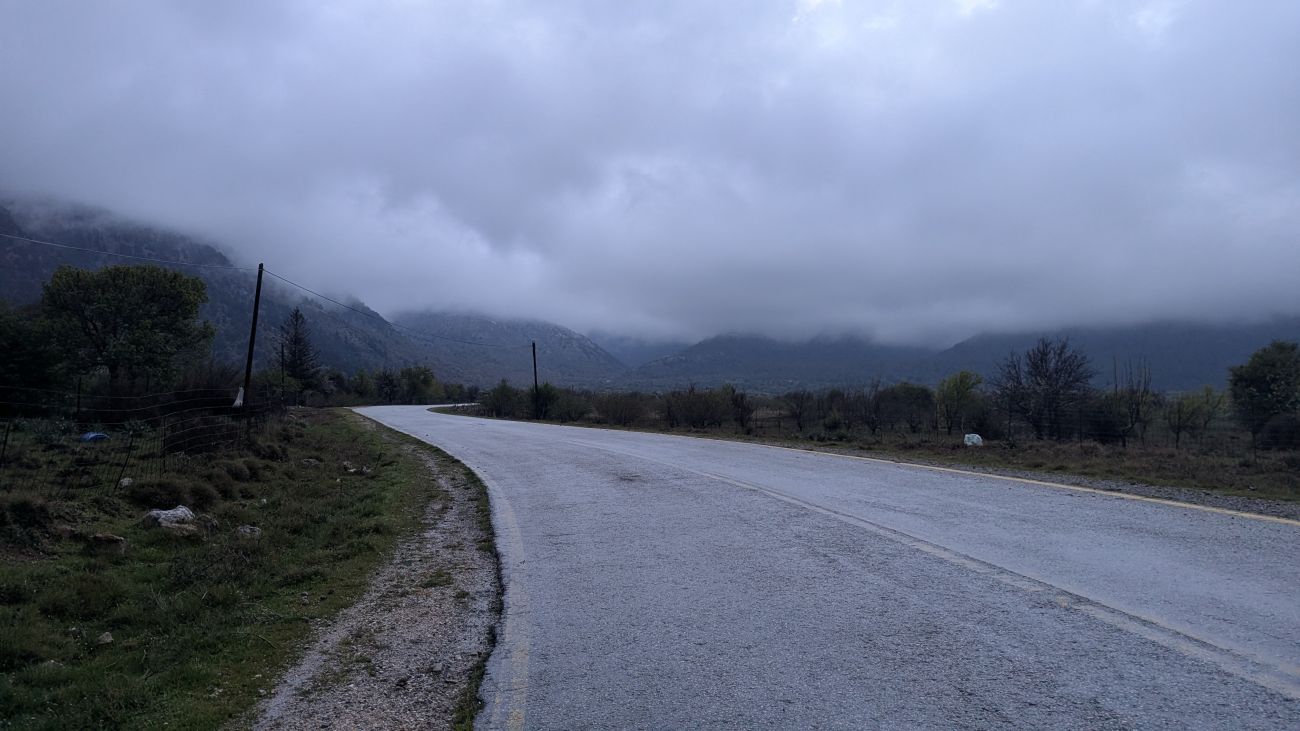
The moody view on the Omalos Plateau from outside my hotel, Lefka Ori ahead.
The original plan for the first full day on Crete was to summit Gingilos, a 2080m peak in the west of the Lefka Ori range. However, after rechecking local forecasts of -5C to -8C, high winds and snow for that day, and being a solo traveller outside the tourist season, I decided it was not sensible to do so. Instead, I opted to reach Kallergi Mountain Shelter at 1700m and decide from there whether or not to go higher. Kallergi has electricity, running water and wood stoves, so I could use there as a checkpoint, before deciding if it was safe to carry on into the mountains, having a point to come back to should the weather worsen.
I left the hotel at 6am to make the most of the light, so it was an early start to the day. A brief half-hour walk through the plateau, accompanied by the chiming chorus of sheep bells would get me to the start of the road to Kallergi shelter. Of course, I came to look at plants, so a “half hour” walk inevitably gets extended due to the attention demanded from roadside flora, specifically, my first lucid endemic encounter, Arum idaeum, right at the start of the route to Kallergi. A. idaeum is restricted to the western Lefka Ori range, the Psiloritis and the Dikti range.
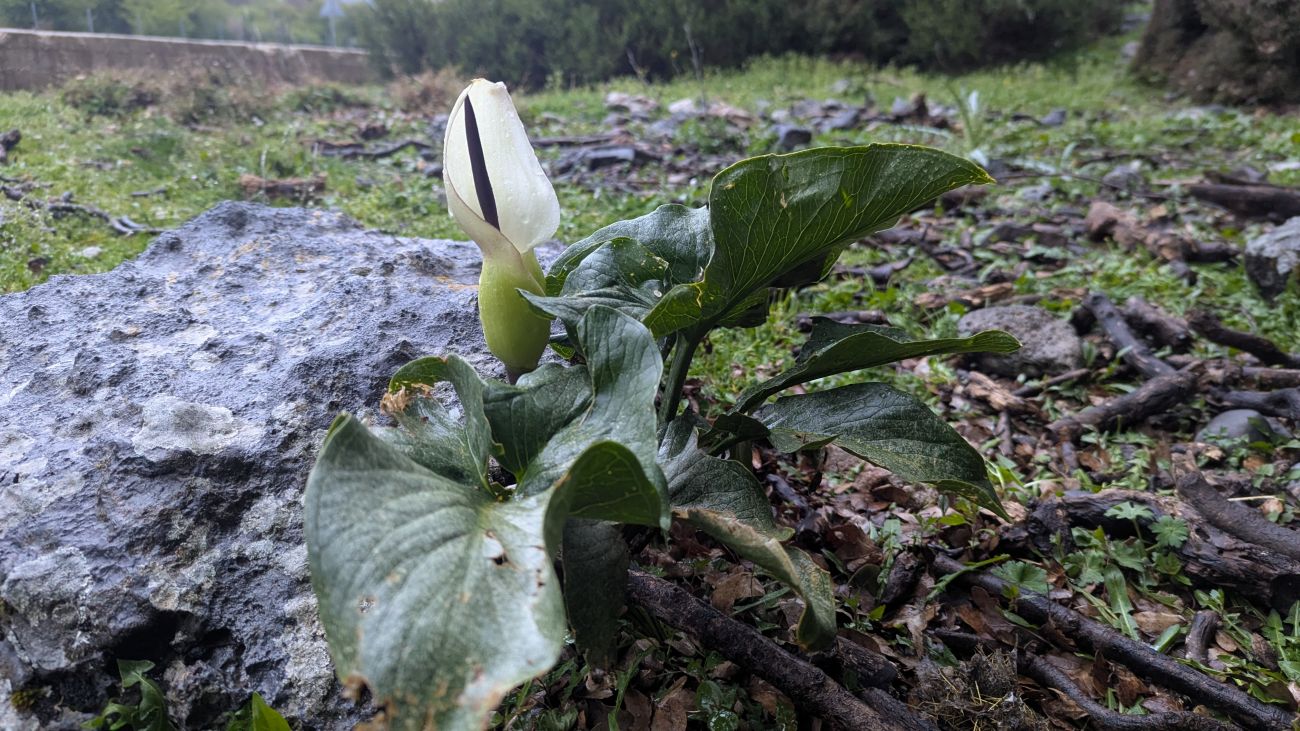
Arum idaeum
So began the walk up to Kallergi shelter. It began as a tame walk to the shelter, passing through the upper threshold of woodland consisting of Acer sempervirens, Quercus coccifera, Crataegus monogyna and the endemic Zelkova abelicea. Everything was wet, drizzle was in the air, cloud quickly rising up the hills. The woodland felt dark and deep somehow despite its actual small size and sparsity, maybe due to the rock formations (primarily limestone, dolomites and marble) seemingly forcing through the understory of the trees, or maybe due to the trees gradually becoming more deformed with elevation to the point of my initial unrecognition of some Quercus coccifera.
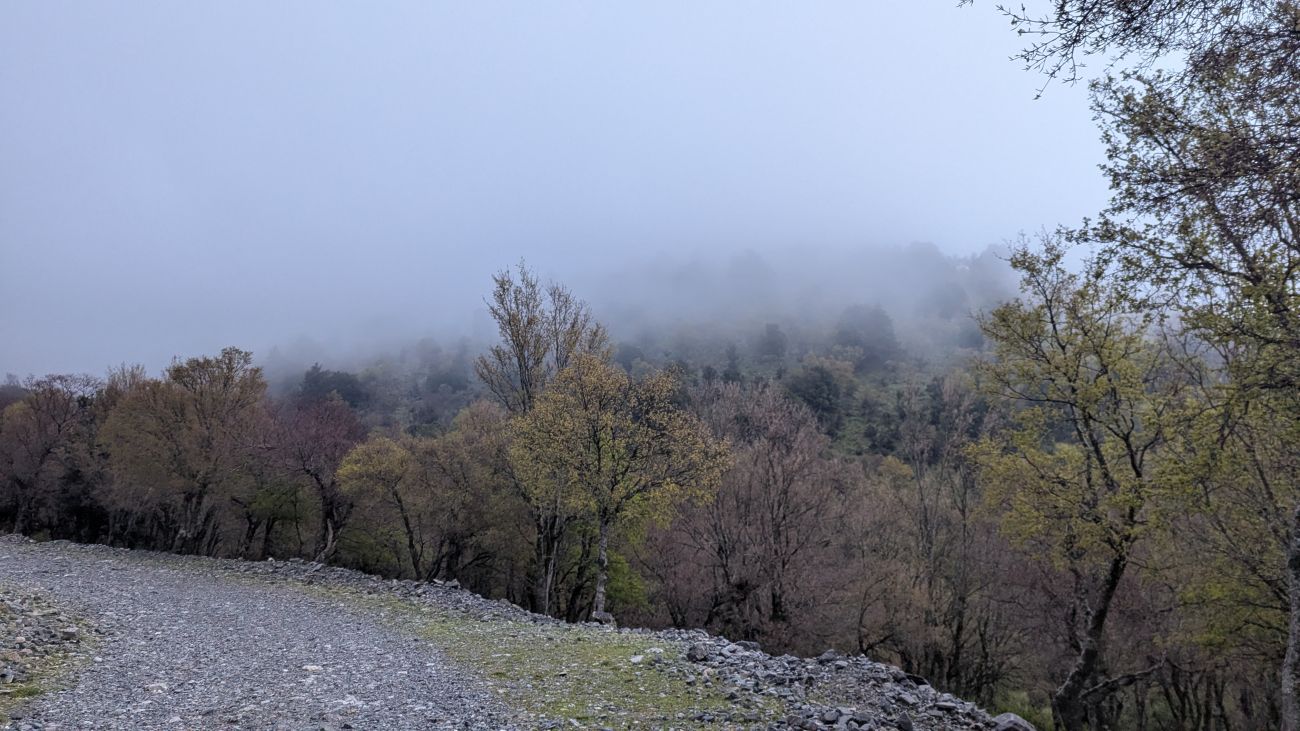
Aforementioned woodlands
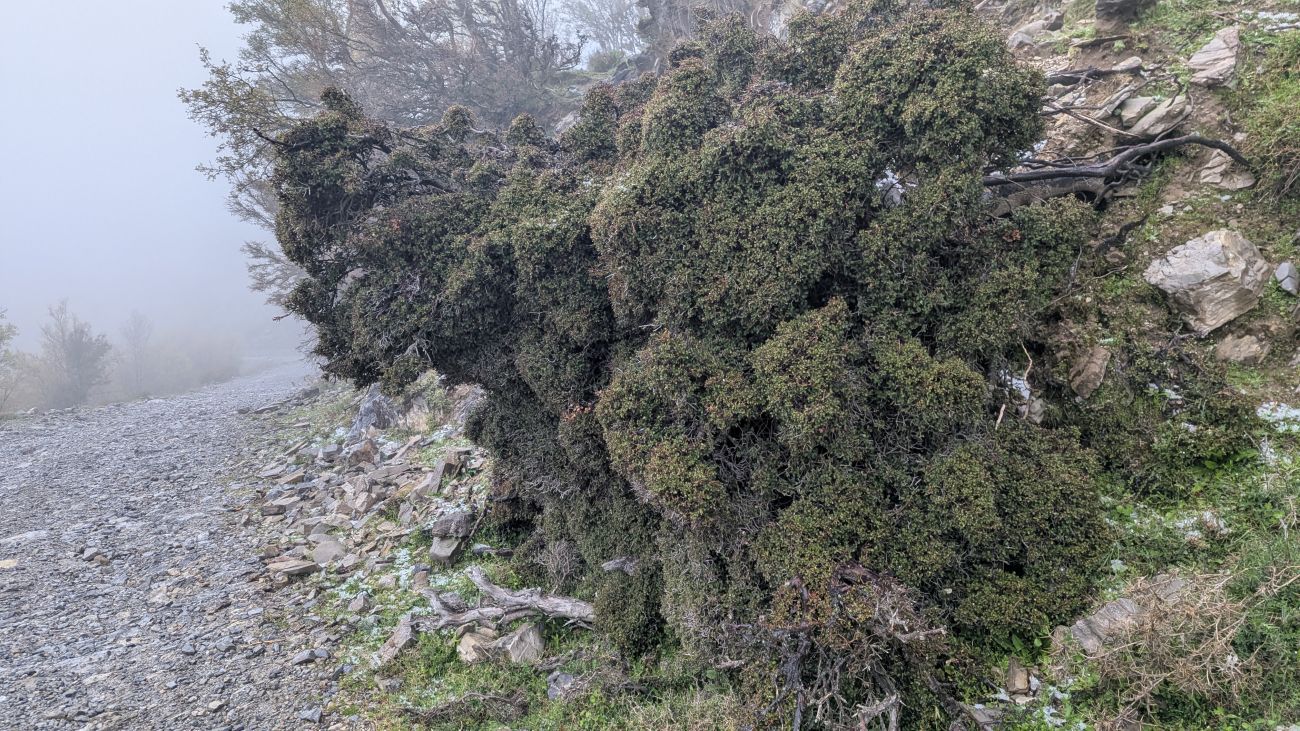
Quercus coccifera beginning to enter its deformed habit
As the trees began to dwarf, the canopy opened up and the route began to hug the mountains more, passing by more exposed and vertical rock and cliff. Hereon the flora became more herbaceous, succulent, and shrubby. Quercus coccifera was still present but fewer in number, and Cupressus sempervirens made more of an appearance. Thorn shrubs such as Euphorbia acanthothamnos and Berberis cretica began to appear much more frequently. The cliff edges, wet to the touch, were adorned with Trifolium uniflorum, Centaurea raphanina, Cerastium scaposum, Aubrieta deltoidea, and Sedum spp. to name a few. These plants were the most frequently occurring from the edge of the forest up until the high mountain zone near Kallergi shelter around 1680m. It is worth noting a lot of the flora found at the lower elevations here in flower, were just about coming into flower on the mountain tops.
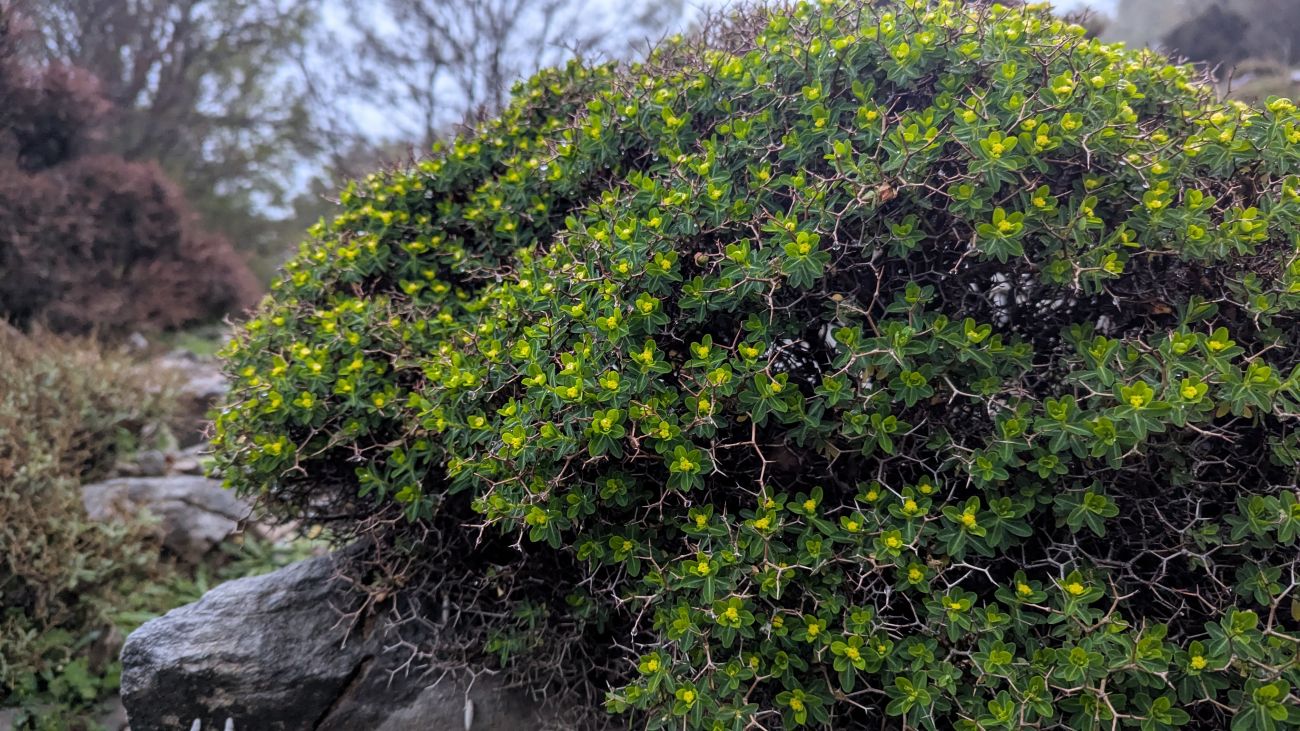
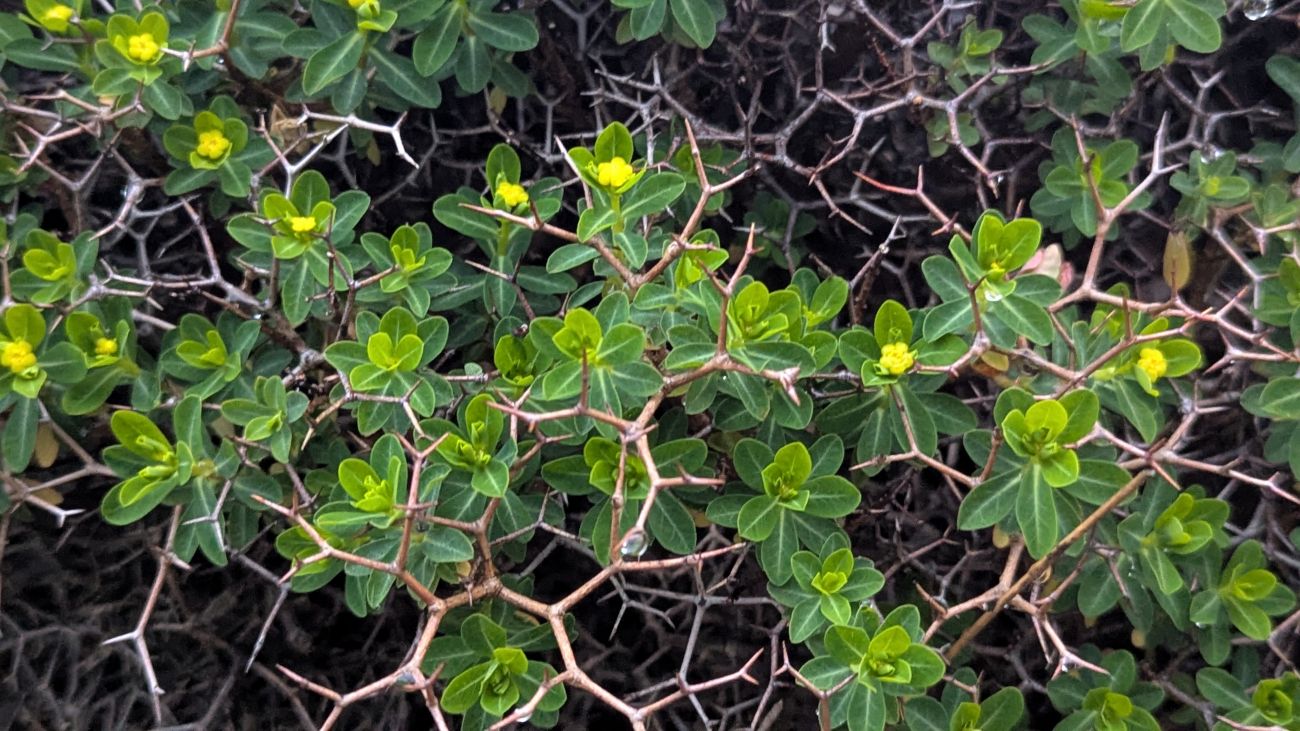
Euphorbia acanthothamnos
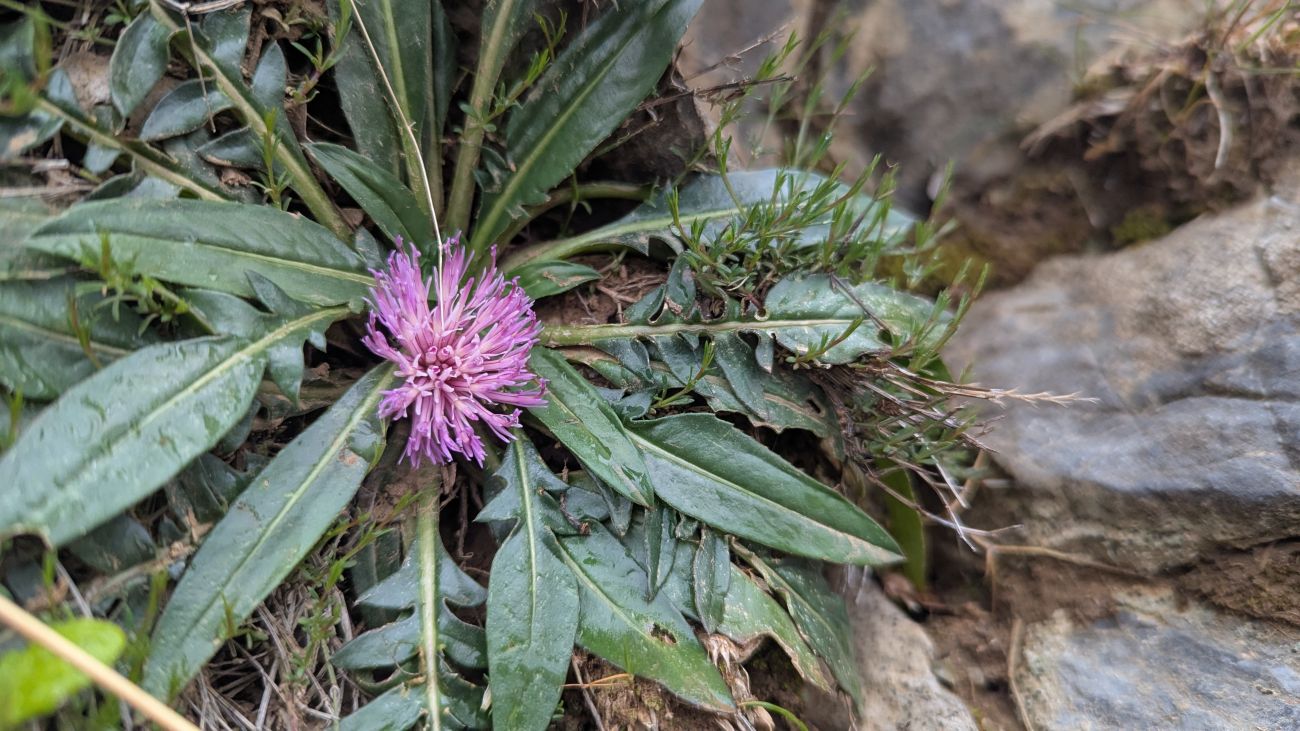
Centaurea raphanina (lower elevations <1300m)
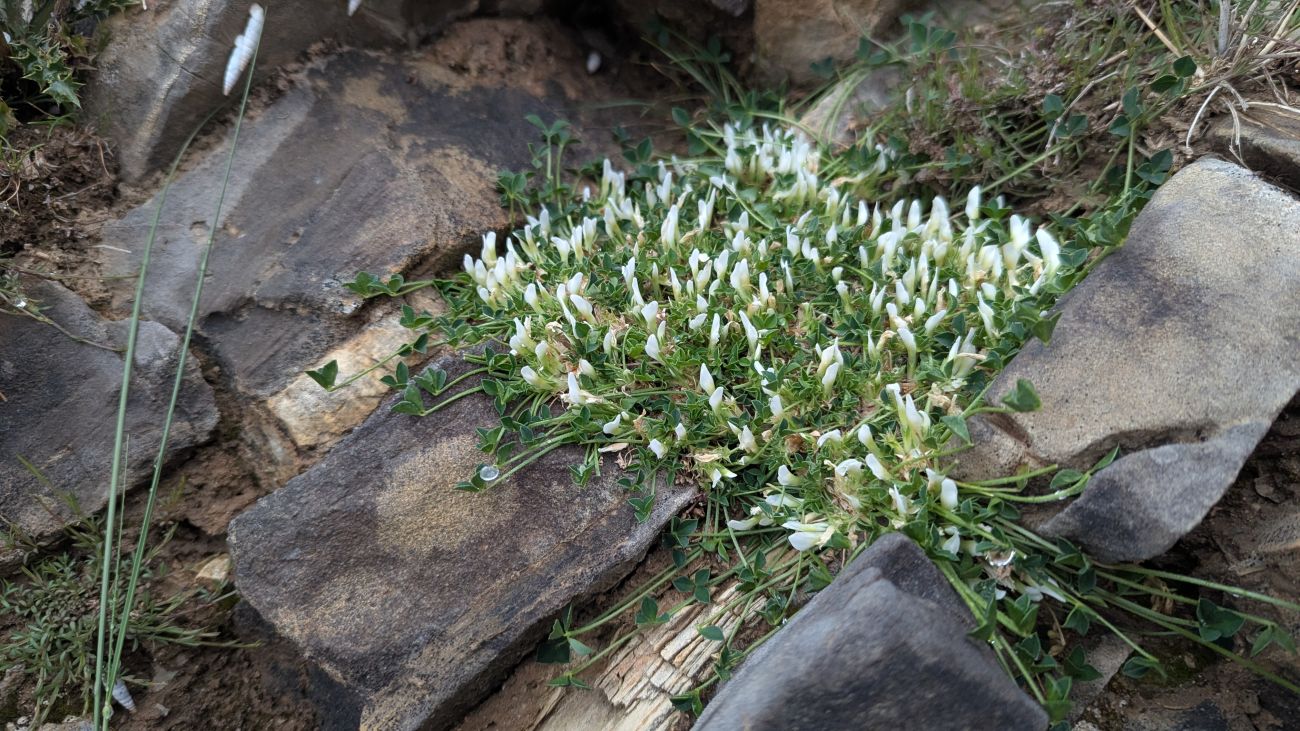
Trifolium uniflorum (lower elevations <1300m).
On the walk up, the expected snowfall hit. This, combined with the snow already present on the mountains, made the next stretch of botanising challenging but entertaining. Whilst it was hard to determine the texture of the soil, it was clear there was not masses of organic matter, this was a well-drained and coarse soil. Here, rocks dominated the landscape. Plants found their niches between or on the rocks where soil did accumulate, often sheltered from the harsh elements by the surrounding rocks. Plants such as Anchusa cespitosa make their way by growing in dense, low-growing cushions, with reduced thick tomentose leaves. A. cespitosa grows in the Lefka Ori range and SW Anatolia, at altitudes of 1400-2300 m. The low-growing compact form along with the hairy leaves protect the plant from harsh winds, lowering transpiration and avoiding wind damage to the branches due to the compactness.
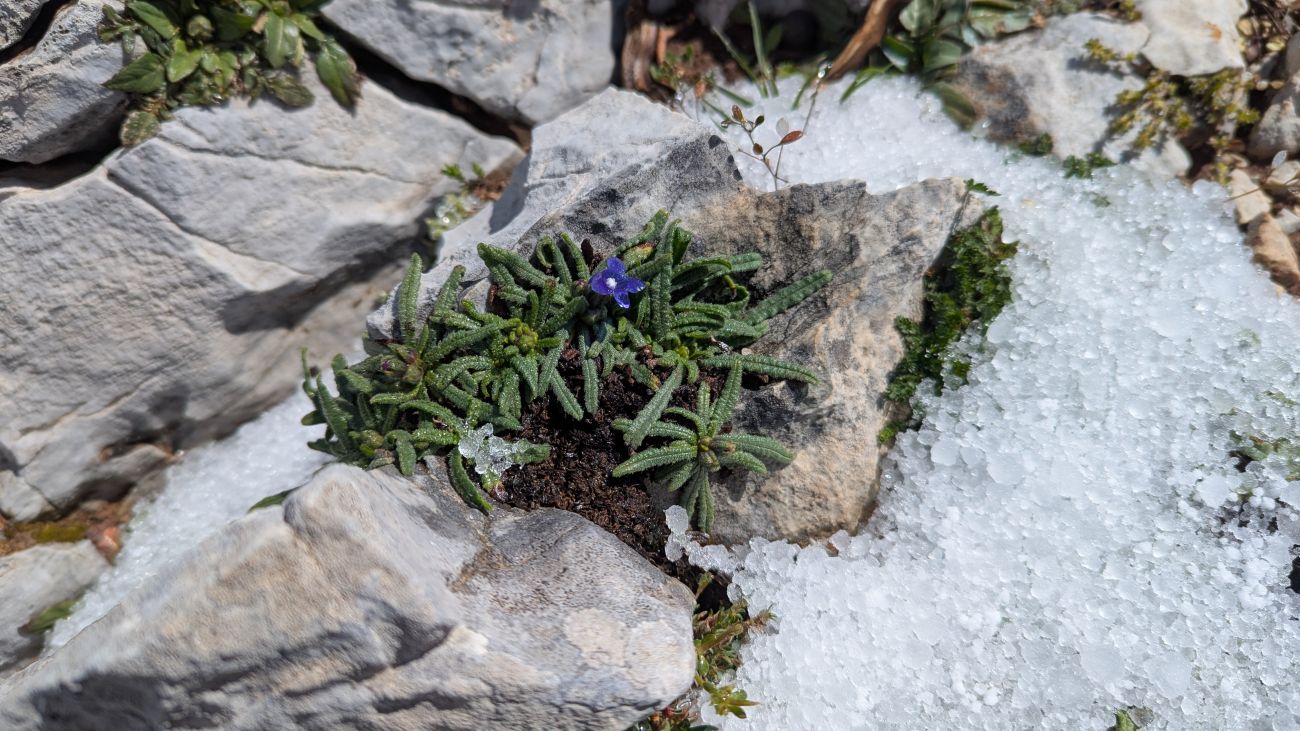
Anchusa cespitosa
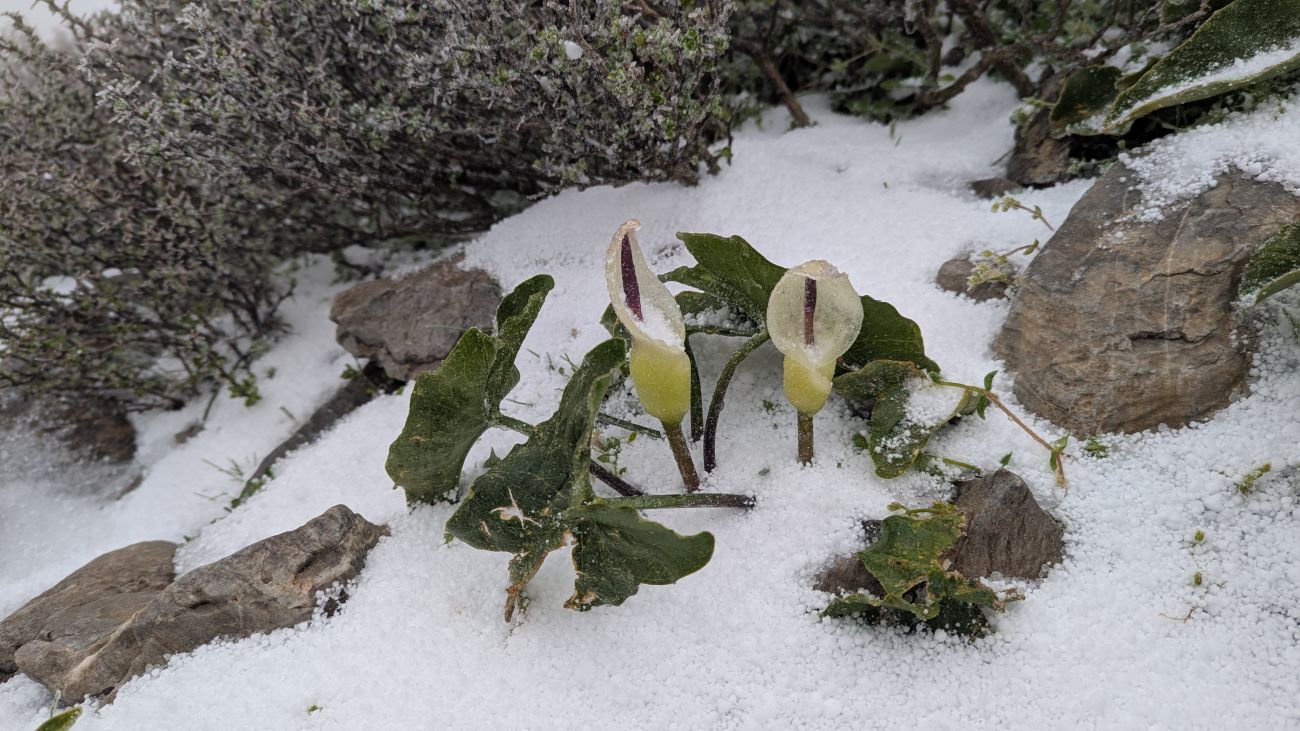
A snow-laden Arum idaeum
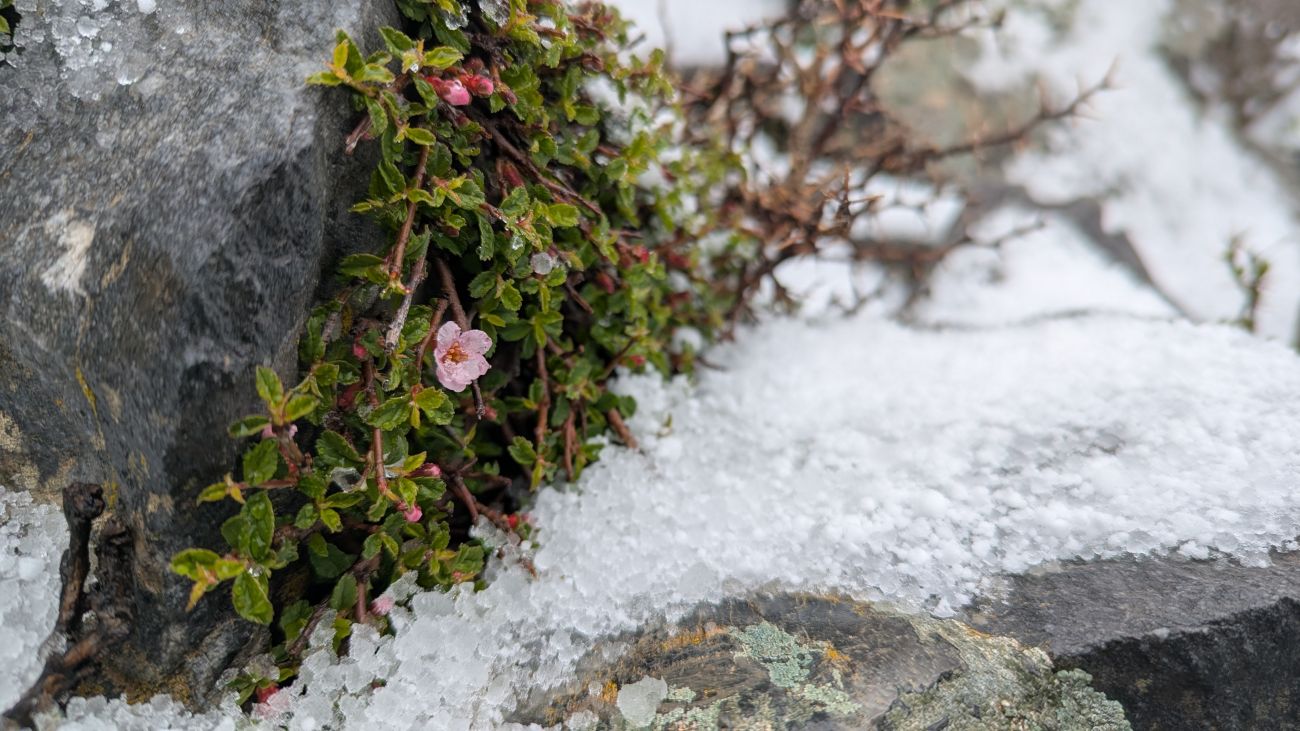
A weathered Prunus prostrata
After having some coffee at the shelter, I headed slightly further into the range to reach the trail headed north and back down to the plateau. Here it was extremely rocky and very exposed. Plants seen here were more of the previously mentioned, but Prunus prostrata featured more heavily and much more compact. The thorn-cushion community also came into full force, the compact, rugged and ungiving nature of these plants with their exposed rocky habitat was a match made in Elysium. Euphorbia acanthothamnos, Berberis cretica, with the addition of Acantholimon androsaceum and Astragalus angustifolius, sparsely peppered with low-growing Juniperus deltoides, Anchusa cespitosa, Aubrieta deltoidea, Trifolium uniflorum and many Asteraceae I have not yet identified. At this point, I noticed Aethionema saxatile subsp. creticum began to appear in the karstic segments of limestone, taking shelter in the holes in the rock, with their pink flowers poking out, nodding in the wind. This plant exists between 200m and 2300 m in the Lefka Ori, Psiloritis and Dikti ranges.

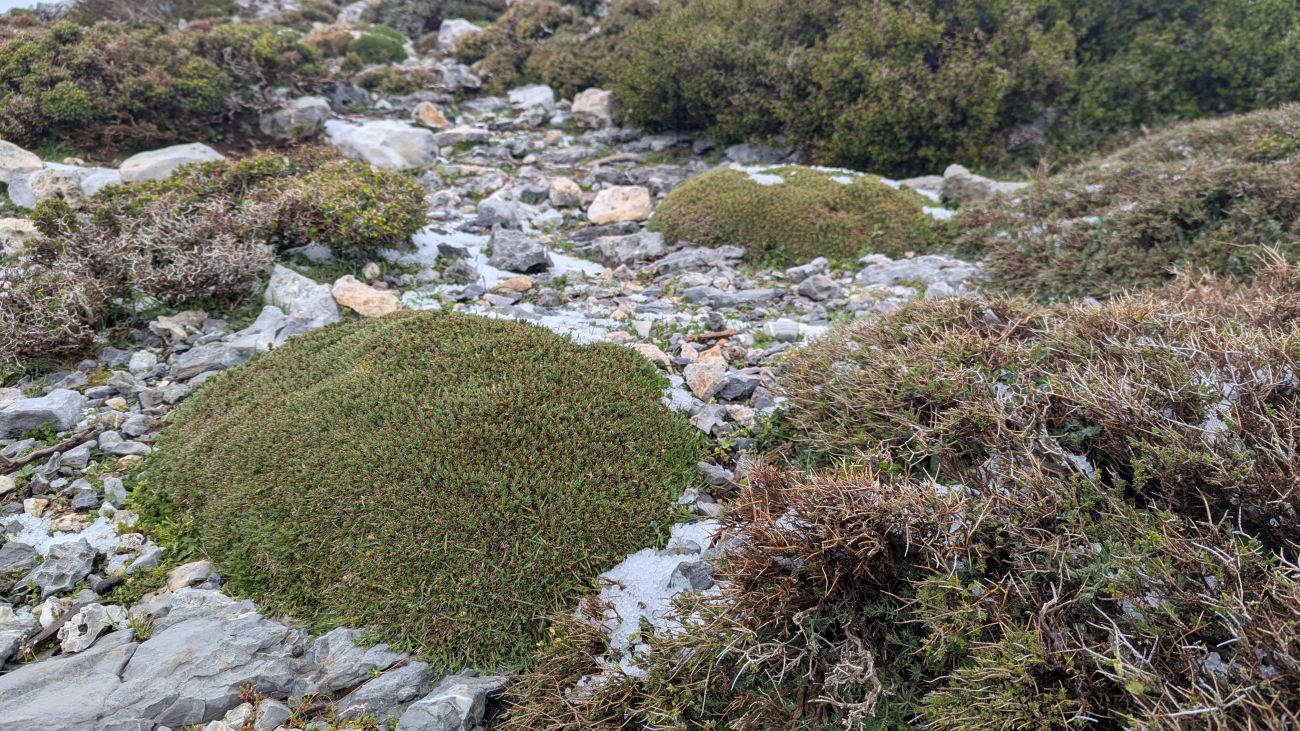
Thorn-cushion community

Acantholimon androsaceum close-up


Aethionema saxatile subsp. creticum
Beginning the descent, the snow had stopped, and quickly the ground was far less covered, making botanising easier. The soil deposits became much more frequent and of a finer texture, holding onto much more moisture. Trees began to look like trees again, also providing shade and depositing organic matter in the form of shed leaves, fruits and wood into the developing soils here. The first orchid of the trip, Orchis quadripunctata was seen. Annuals were more prevalent.
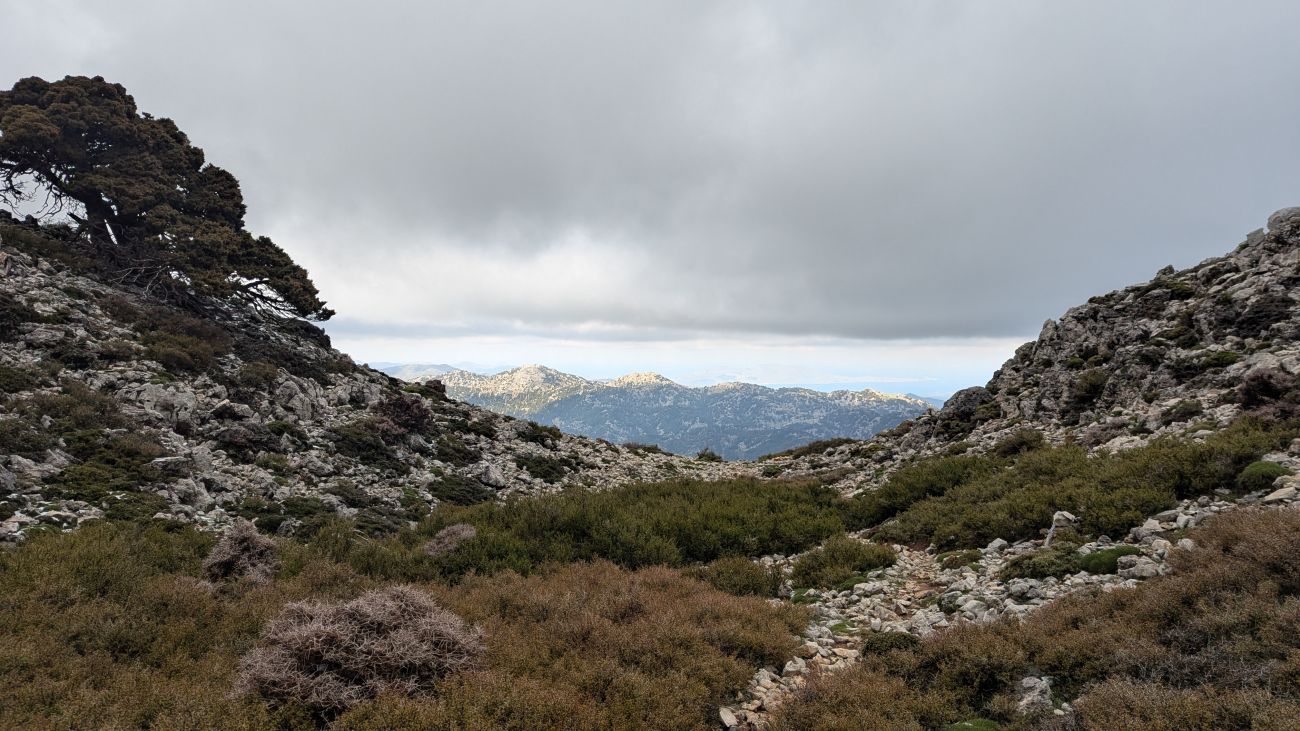
on the descent, peering through and over Omalos Plateau
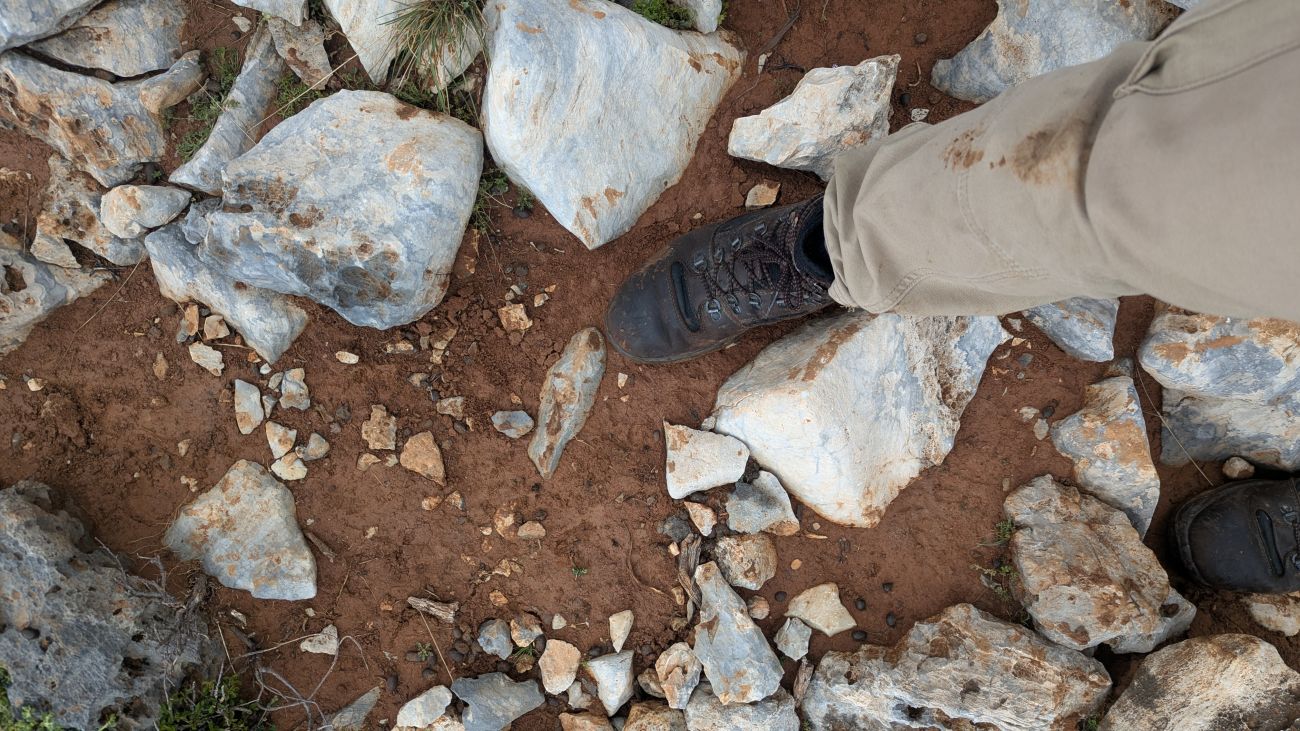
Red soil holding more moisture
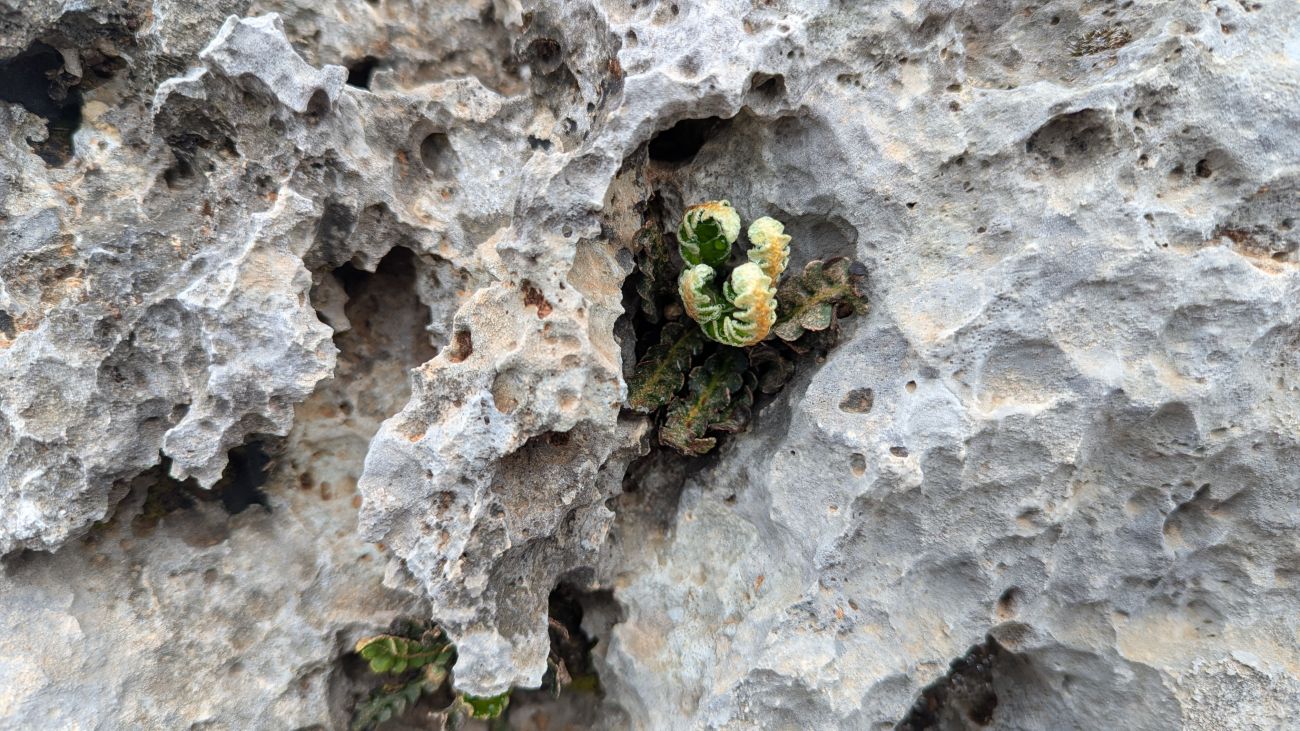
Asplenium ceterach was ever-present here

Orchis quadripunctata
Eventually, a Quercus, Cupressus, Juniperus, Pinus and Acer woodland was met at around 1100m – 1200 m. This area had a deeper layer of soil with relatively better water retention, in part due to the organic matter constantly added to it from the tree layer along with the bryophytes growing atop the soil. It felt much moister in this area, shaded by the mountains and trees. It was here I went off-piste a little, which ended up being the right move, as I stumbled onto a large population of Cyclamen creticum growing under a bryophyte and lichen-draped arborescent Quercus coccifera. A few metres away were a small group of Daphne sericea growing in a semi-shaded depression surrounded by steep rock faces. This marked the end of the day of botanising.
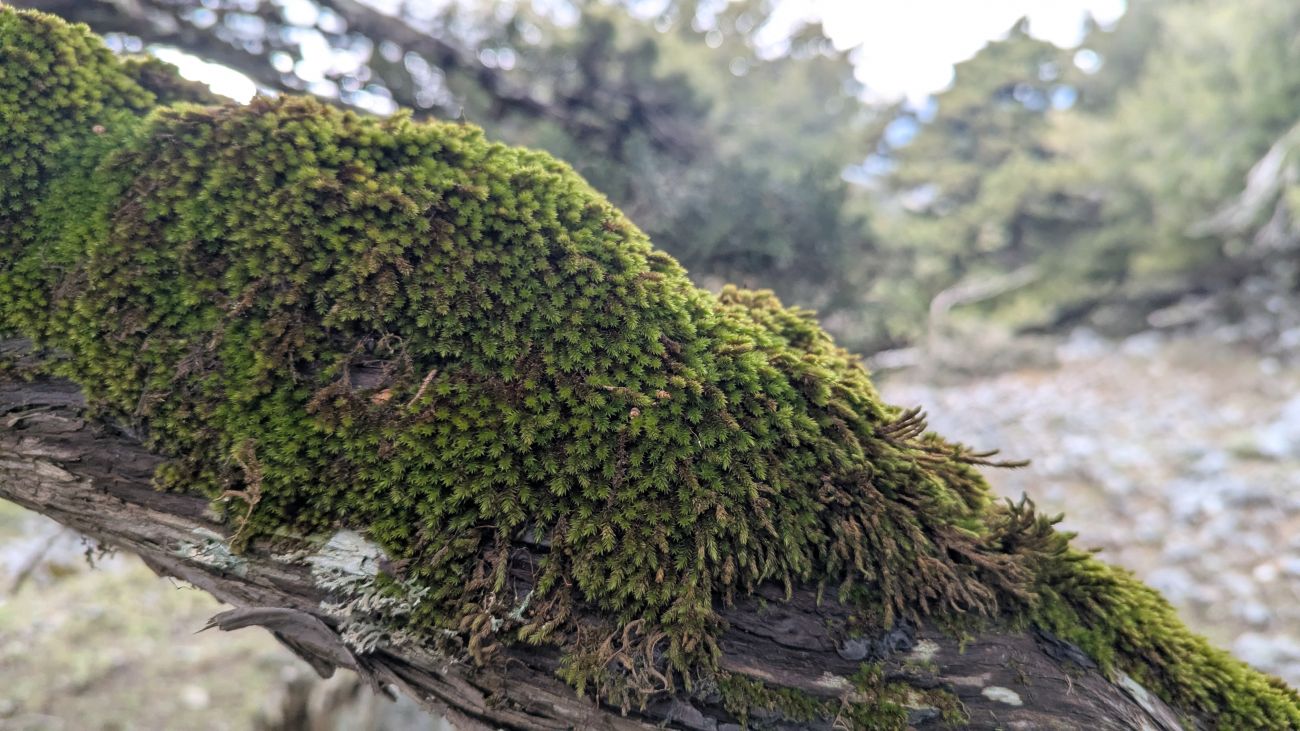
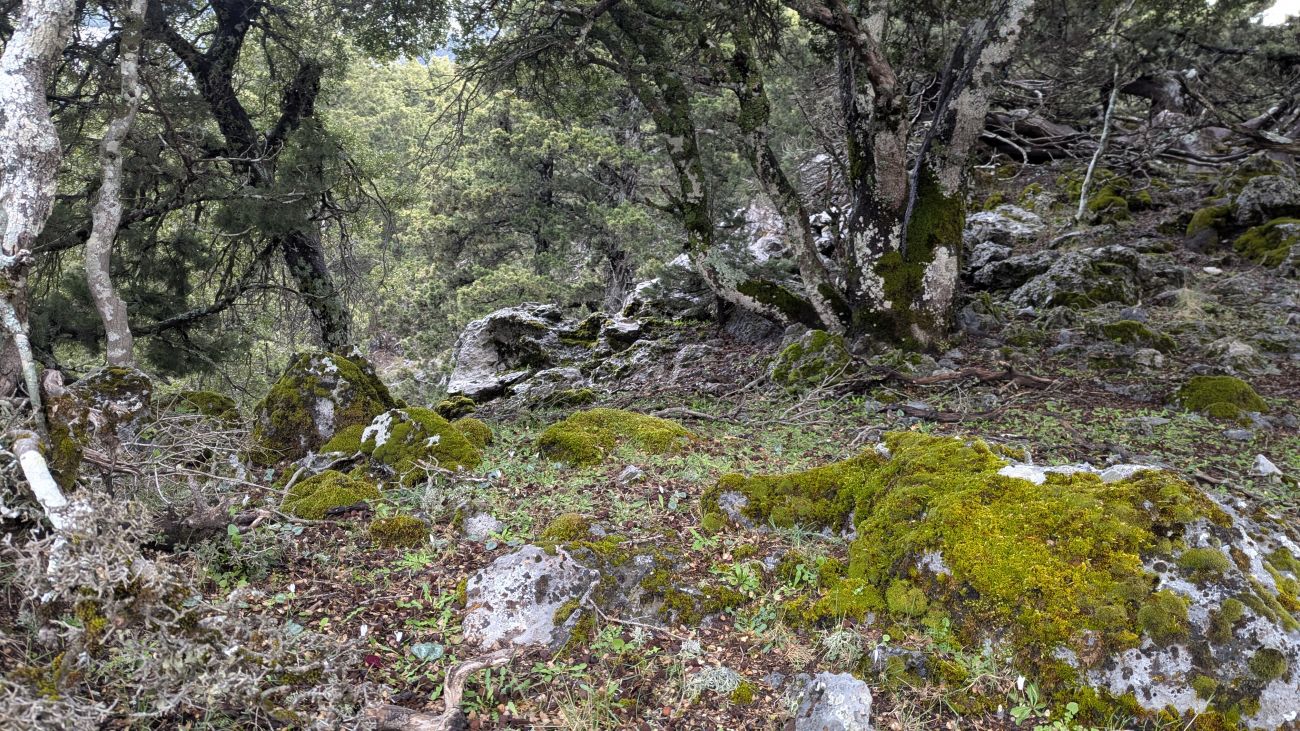
Bryophyte and lichen haven in the foothills of Lefka Ori
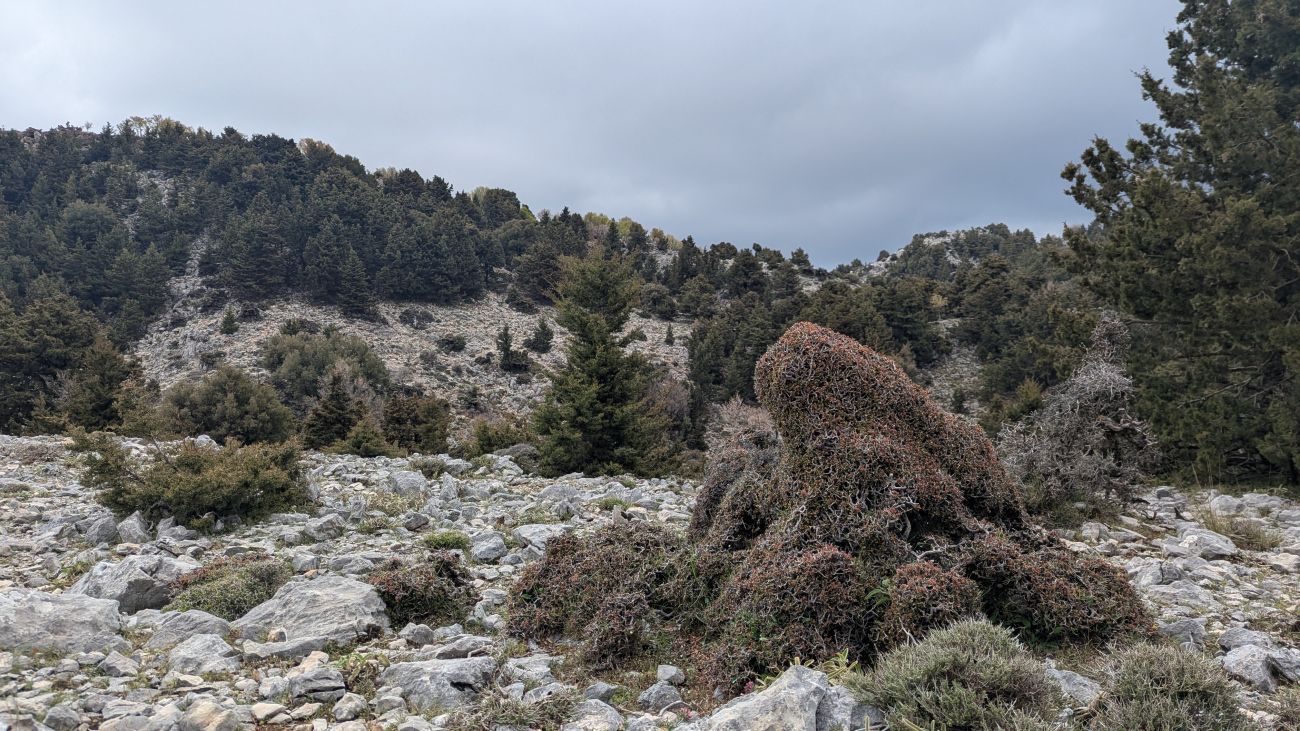
Nature’s Topiary – further deformed Quercus coccifera
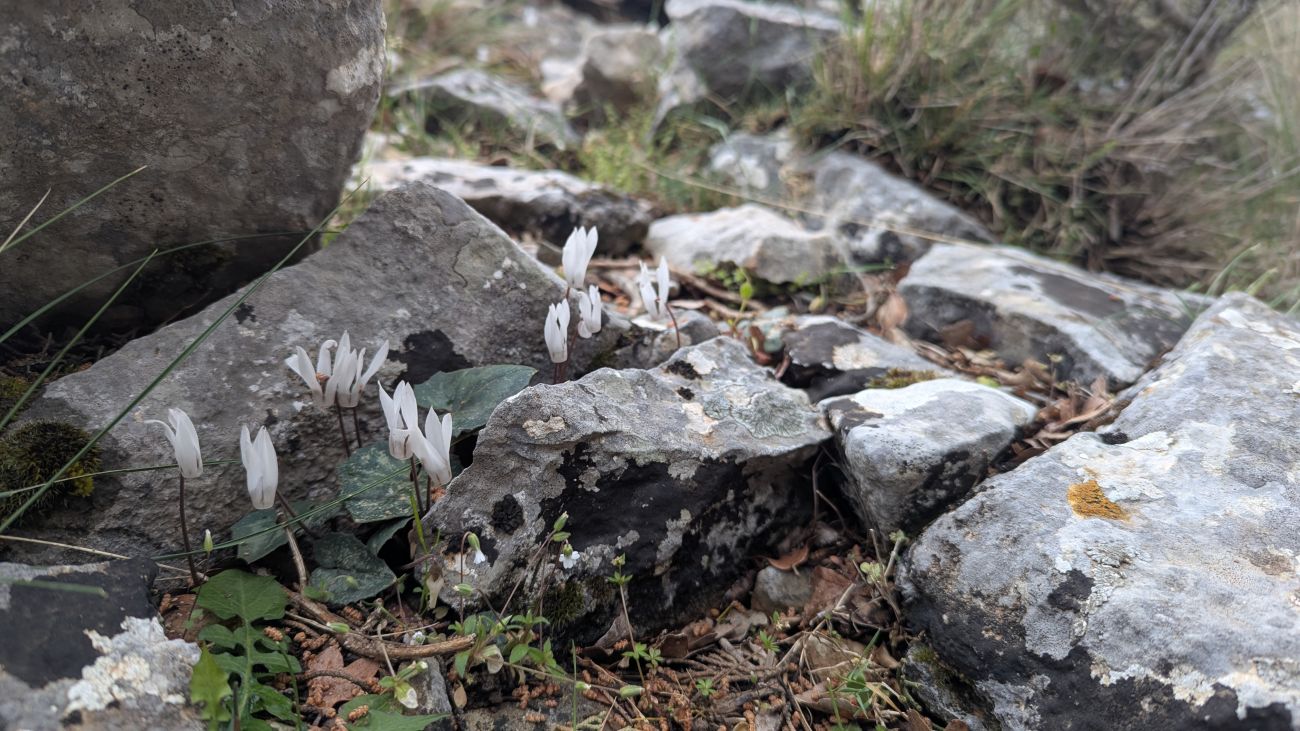
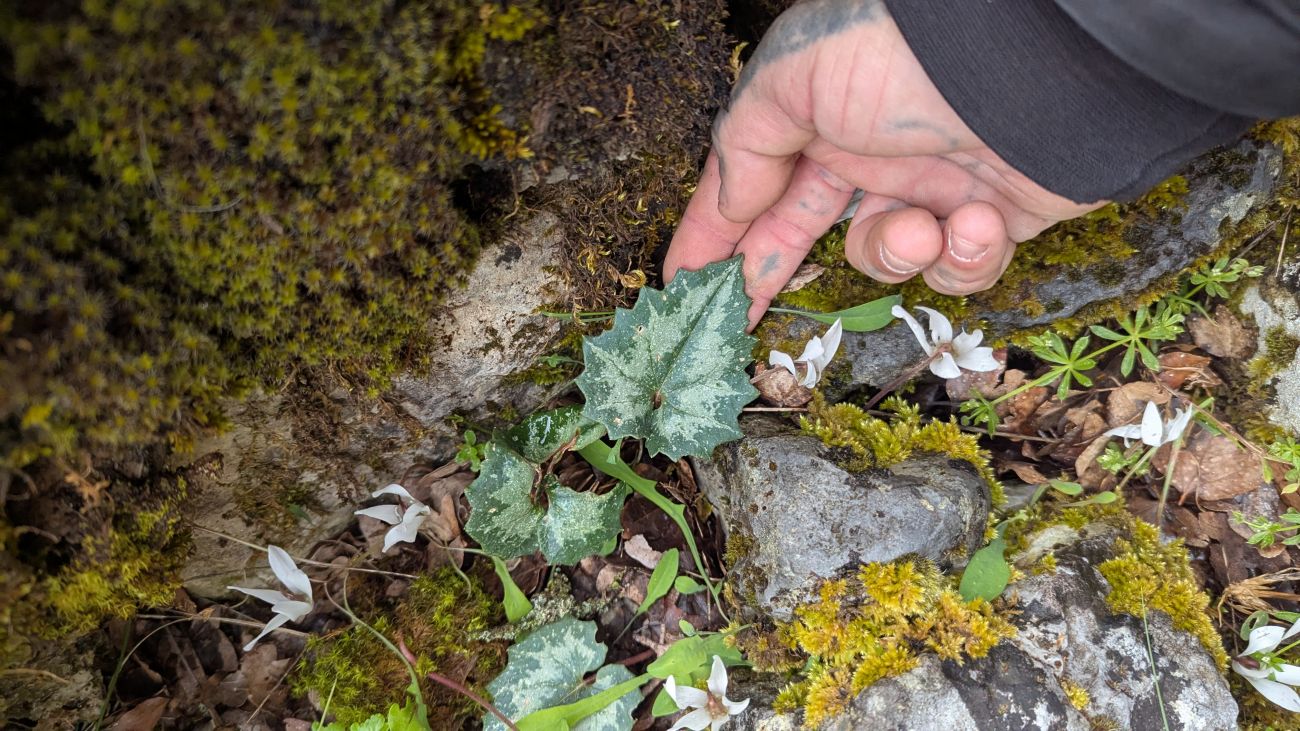
Cyclamen creticum underneath an arborescent Quercus coccifera
The next day’s mountain forecast was more hopeful, with a relatively higher minus 1 – 2 ºC predicted at the peak of Gingilos. The plan for this day was to head up Gingilos (2080m) before descending back into the plateau, then head north of the plateau to check out a cave, then a botanising spot recommended by John Fielding. With the previous day’s experience, I was aware it may not be wise to go to the peak. The flora seen on this day was fairly similar to that seen on the previous day. This hike had a much steeper incline with rockier ground along with a large scree to ascend.
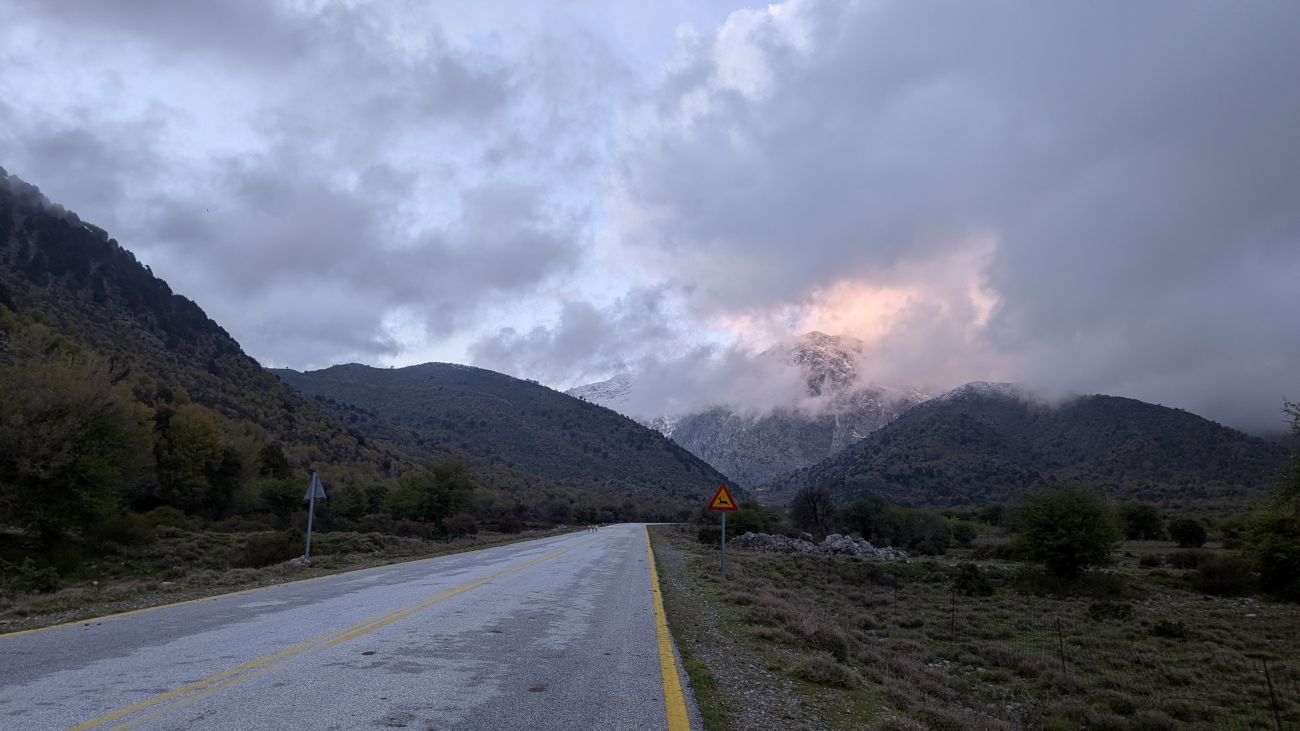
: Gingilos peak searing through the clouds on the walk towards it
The official start point of the hike up Gingilos was a steep winding north-facing path. Soil was very rocky and well-drained, but more soil than rock at this point. Tree cover here was sparse but arborescent, and reminiscent of the previous day only with more Pinus brutia. Immediately, I was met with herbaceous and geophytic flora such as Gagea graeca, Saxifraga rotundifolia, Arum idaeum, Cerastium scaposum, Trifolium uniflorum, and Sedum spp. The dew was still clinging to the plants, delicately balanced like diamonds flickering in the morning light, before being reluctantly spent by the day. Thorn-shrubs were present but not overwhelming the landscape. The view down to Samaria Gorge to the east served as a beautiful reminder that I was botanising higher than the peak of Snowdon back home, and there was still a good bit to climb.
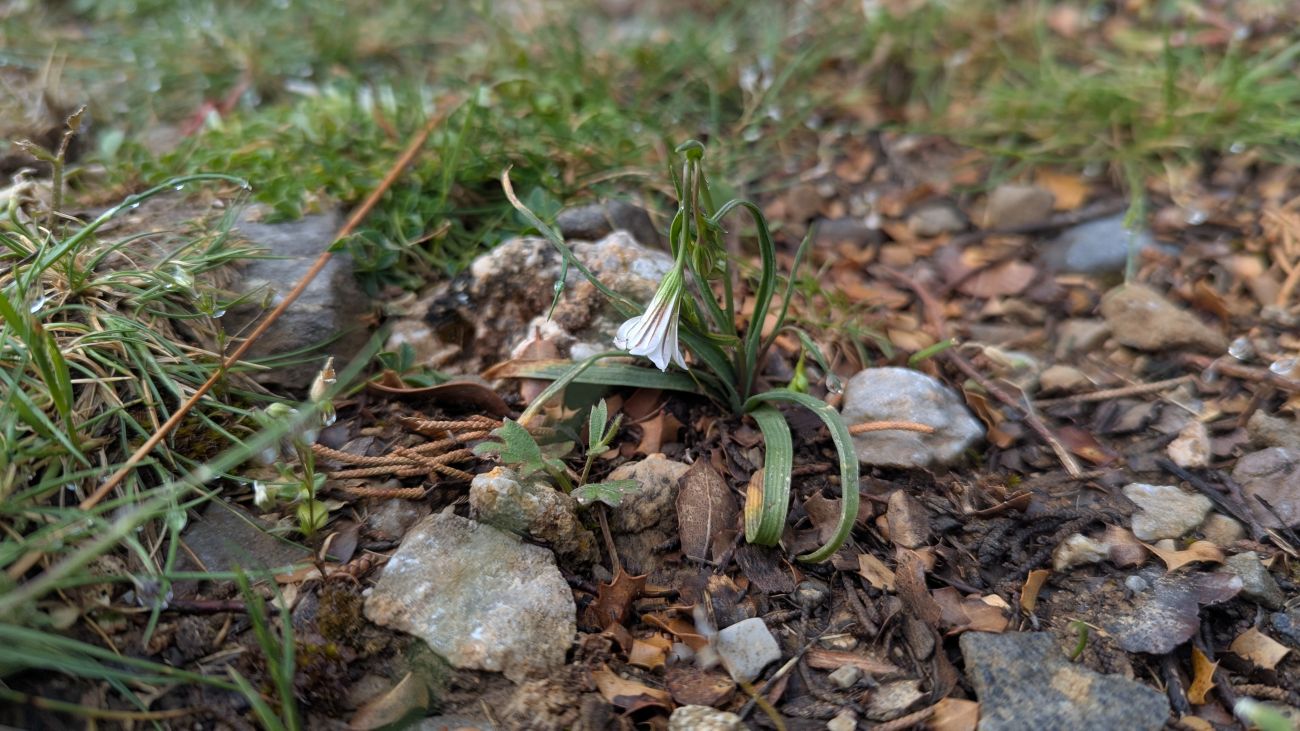
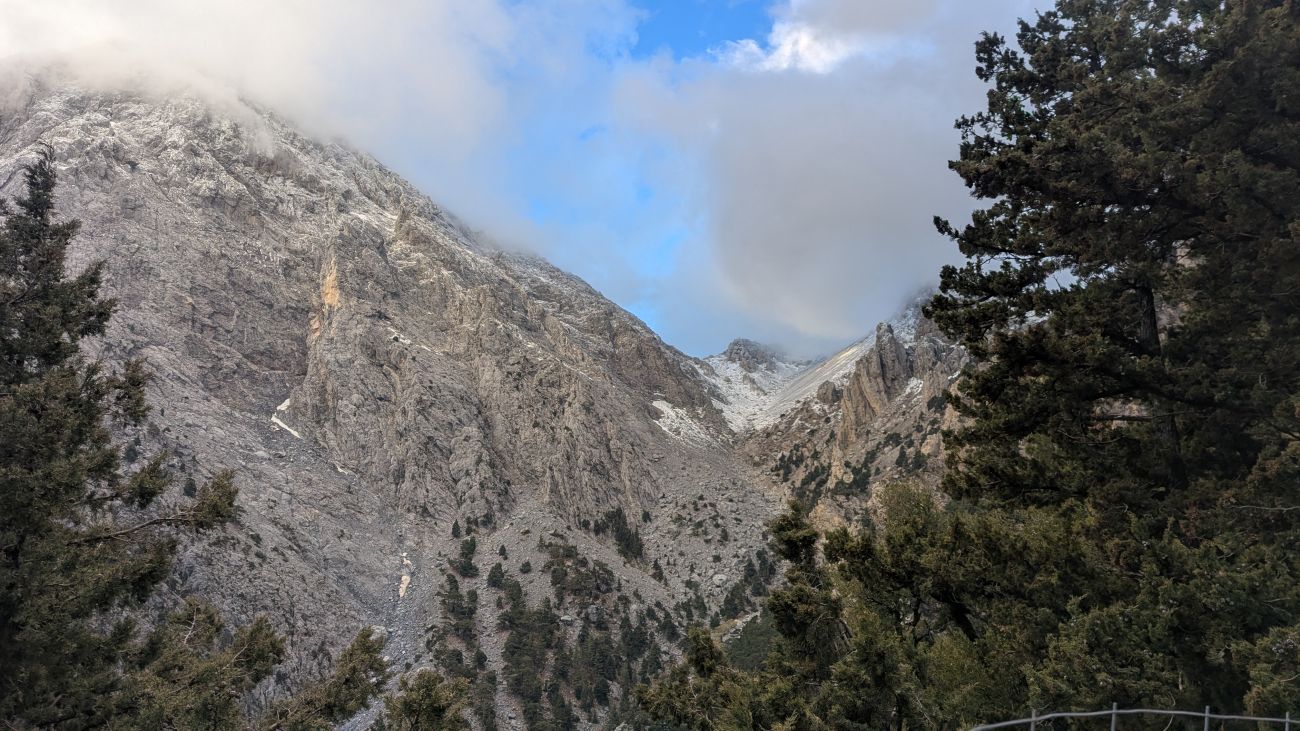
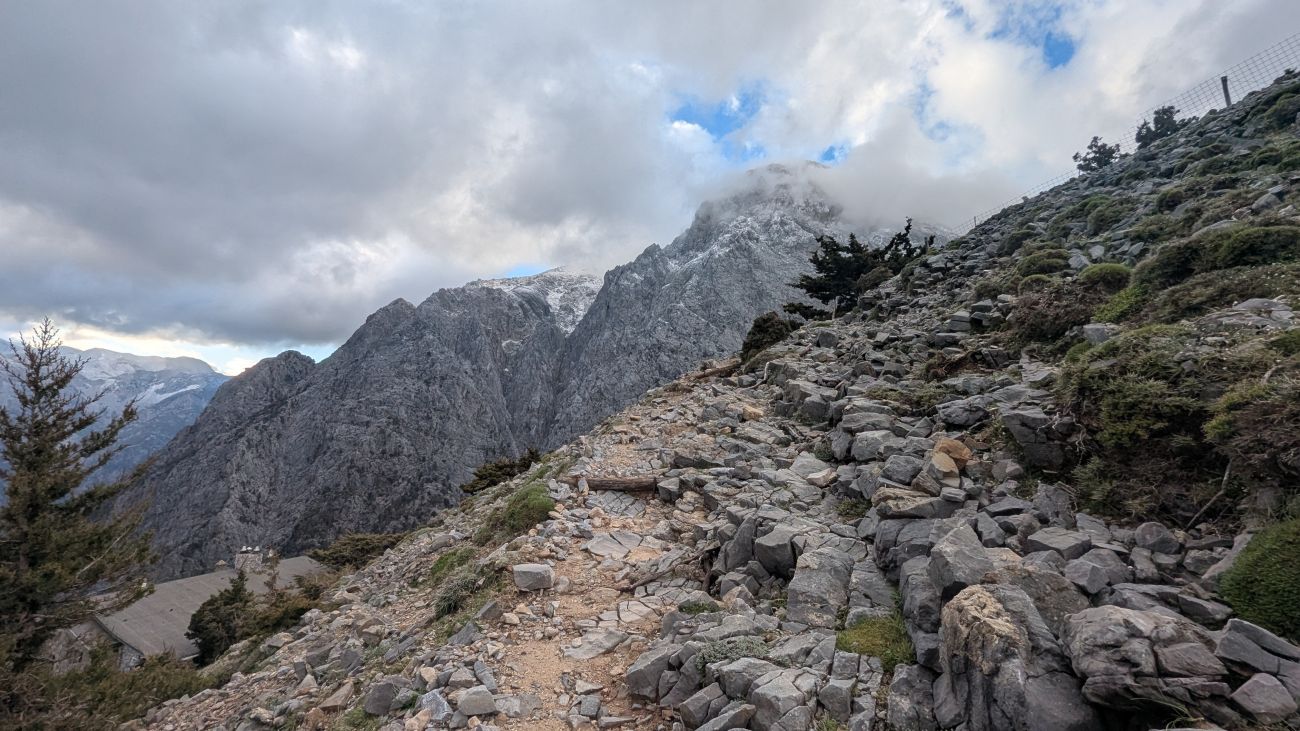
Gagea graeca and views of the hike ahead
Heading higher and hugging the mountainside, Cupressus and Juniperus began to dominate with a shrub layer of Euphorbia acanthothamnos, Berberis cretica, and Prunus prostrata. Again, flora to the day previous here, with the addition of Muscari heldreichii, Teucrium sp., and Thymbra capitata. The paths and hillsides ascending were east-facing and fairly exposed due to the gorge below. Evidence of consistent rock falls was present, indicating high disturbance of flora. Roots of large conifers held onto soil on the rocky slopes, forming natural alcoves with exposed roots which held onto soil. These alcoves provided moist and sheltered microclimates, housing Saxifraga rotundifolia, Noccaea perfoliata, Bellis sylvestris, Ranunculus spp., and many bryophytes including the liverwort Targionia sp. Snow cover began again, lightly dusting the low-growing expanse of conifers and thorn shrub.
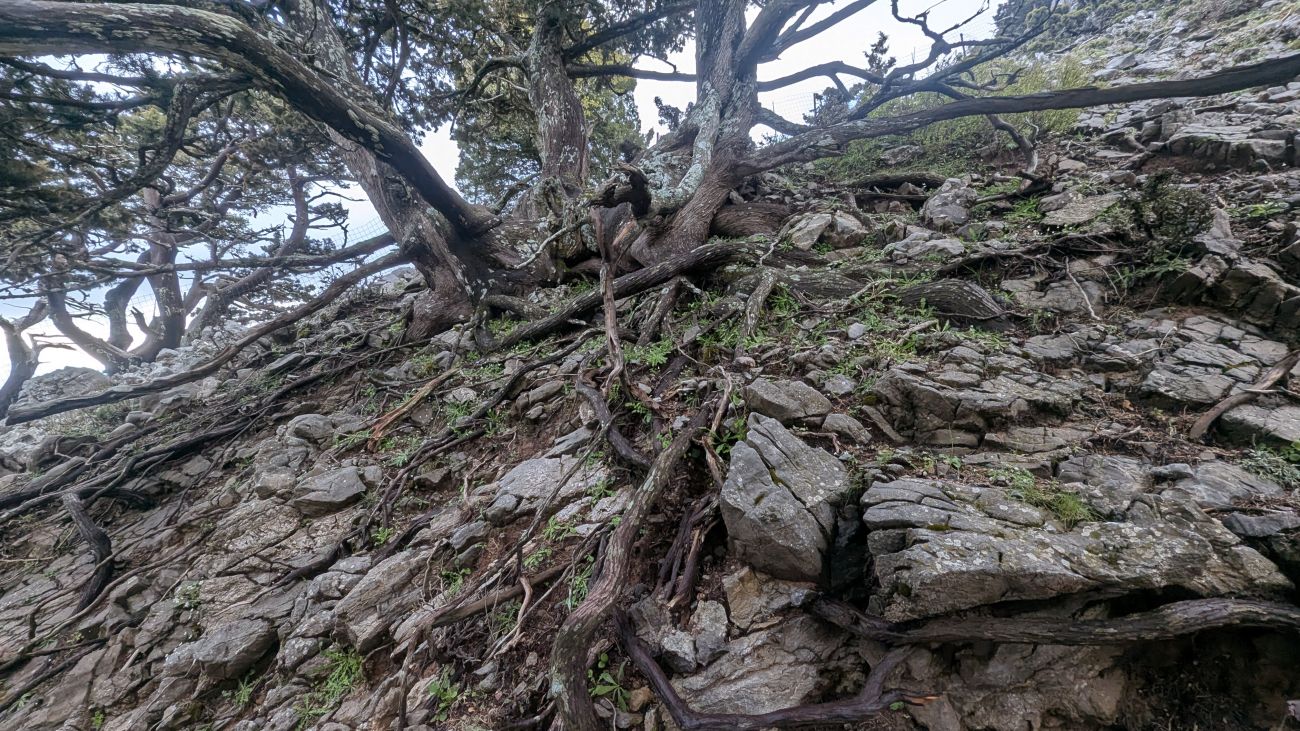
Conifer roots encircling rock made for a nice microclimate for herbs
The next stretch I will separate with a large stone arch, which was fairly barren of vegetation apart from some unidentified Asteraceae and what I believe to be Arisarum vulgare, sheepishly poking out of the rocks. The view, however, was one worthy of a quick sit down and appreciate your surroundings moment. Following the arch was a walk along a thin path, steep limestone cliffs to my right and a potential final “hurrah” down the gorge to my left. Carrying along the path it was hard not to spot two Platanus orientalis growing less than two feet from each other in opposing directions. A romantic might say they appeared to be partaking in the ultimate slow dance, mirroring the other’s growth almost perfectly, forming a sort of pseudo-crown between themselves. Alas, a rock divided them at the base, and their crowns had not yet met. The planes were just coming into bud, later than previously seen broadleaf trees, due to the climatic conditions at this altitude.
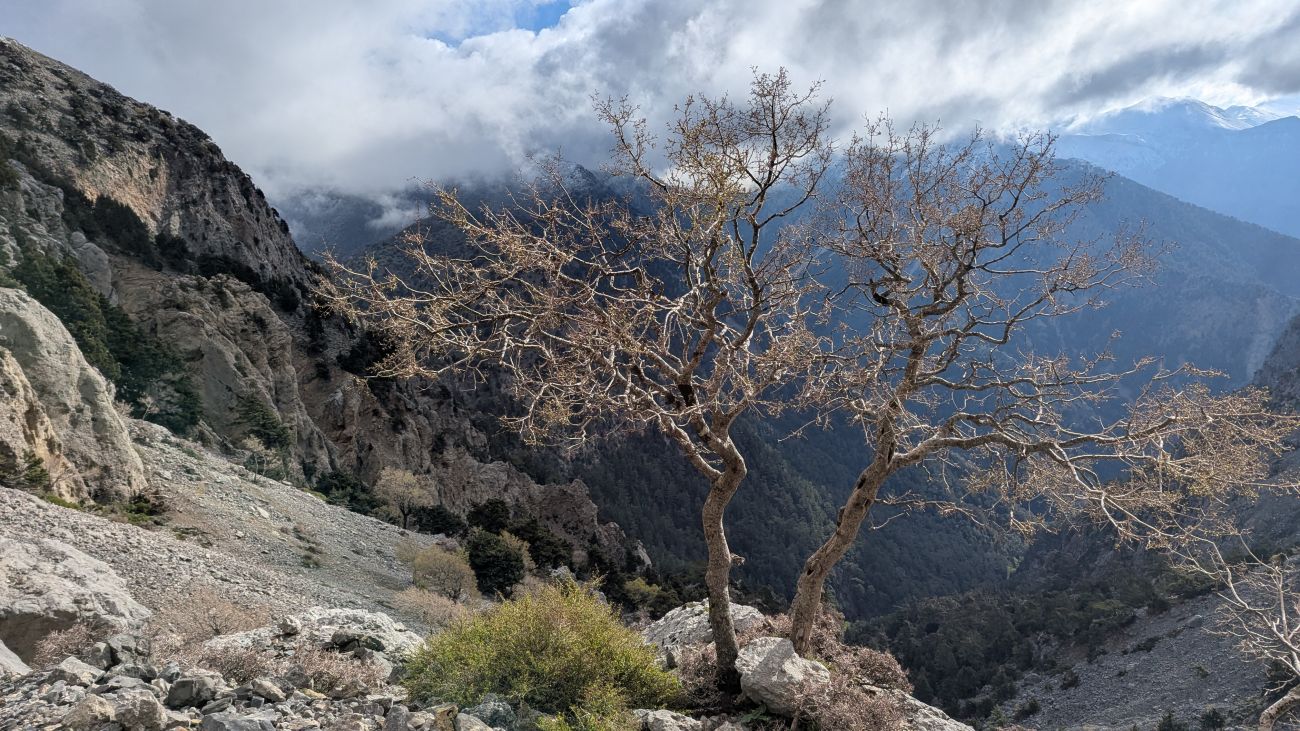
The dancing plane trees (Platanus orientalis)
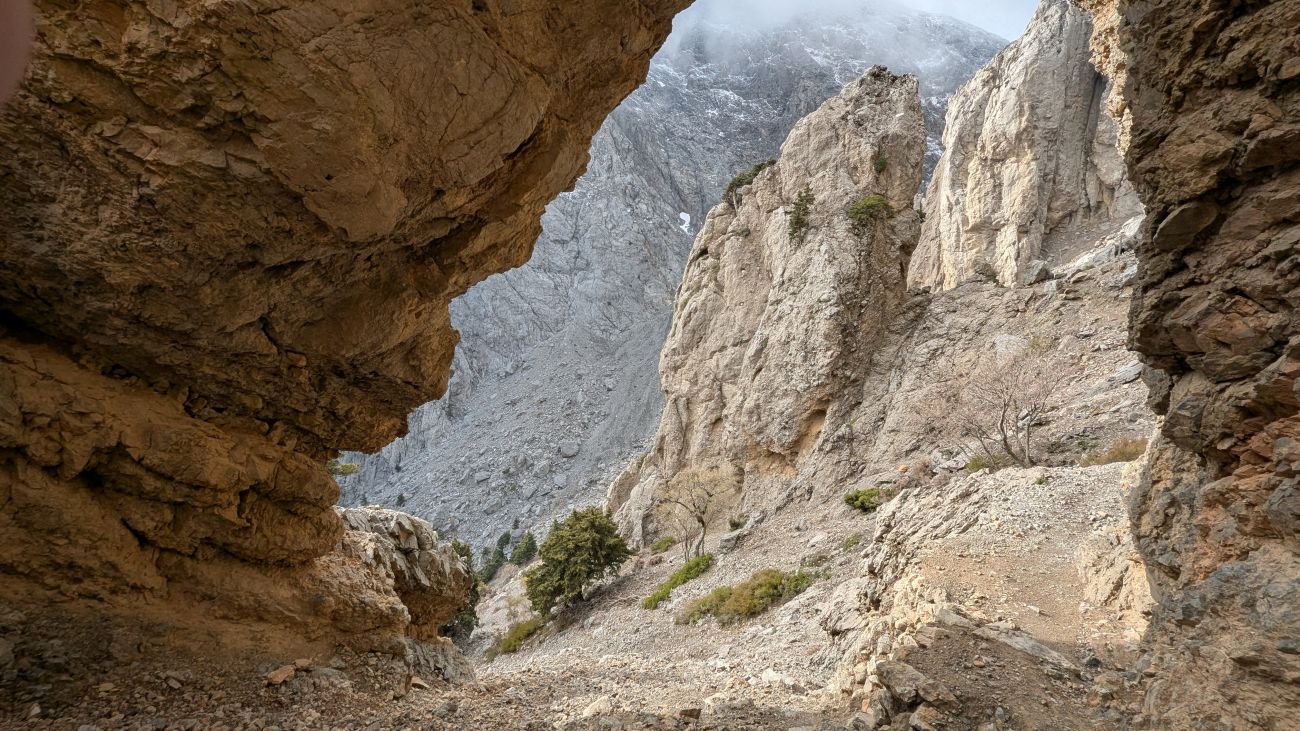
A view to Gingilos through the arch, with much left to climb
Following this arch the landscape became much more dramatic with the snow cover gently increasing. Anchusa cespitosa were met again, here forming larger cushions than previously seen near Kallergi. Cheilanthoideae ferns, Oeosporangium acrosticum were seen nestled in the nooks of the limestone, tough as nails fronds protecting them from the elements which bypassed their sheltered locations. The trail soon turned to a steep snow-covered scree which led to the “saddle”. The saddle was my point of decision to either carry on to the Gingilos peak or wrap it up and continue the day at lower elevation.
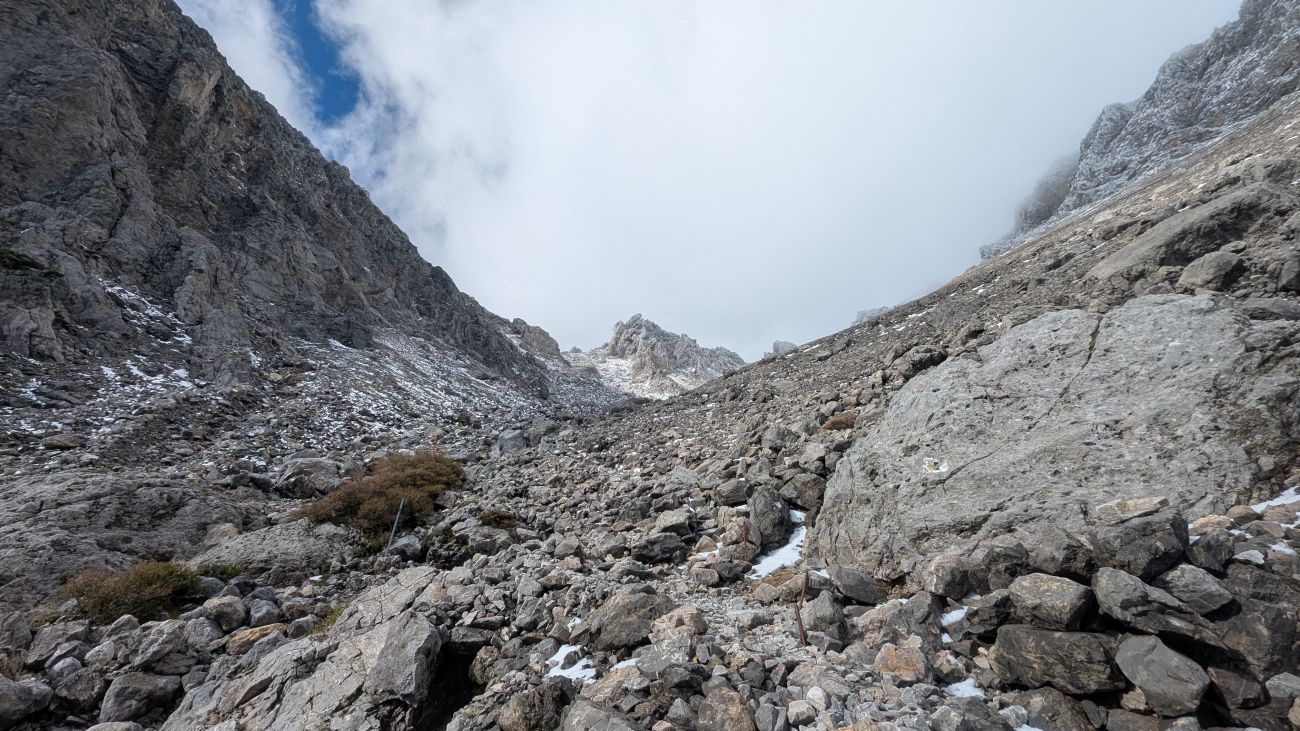
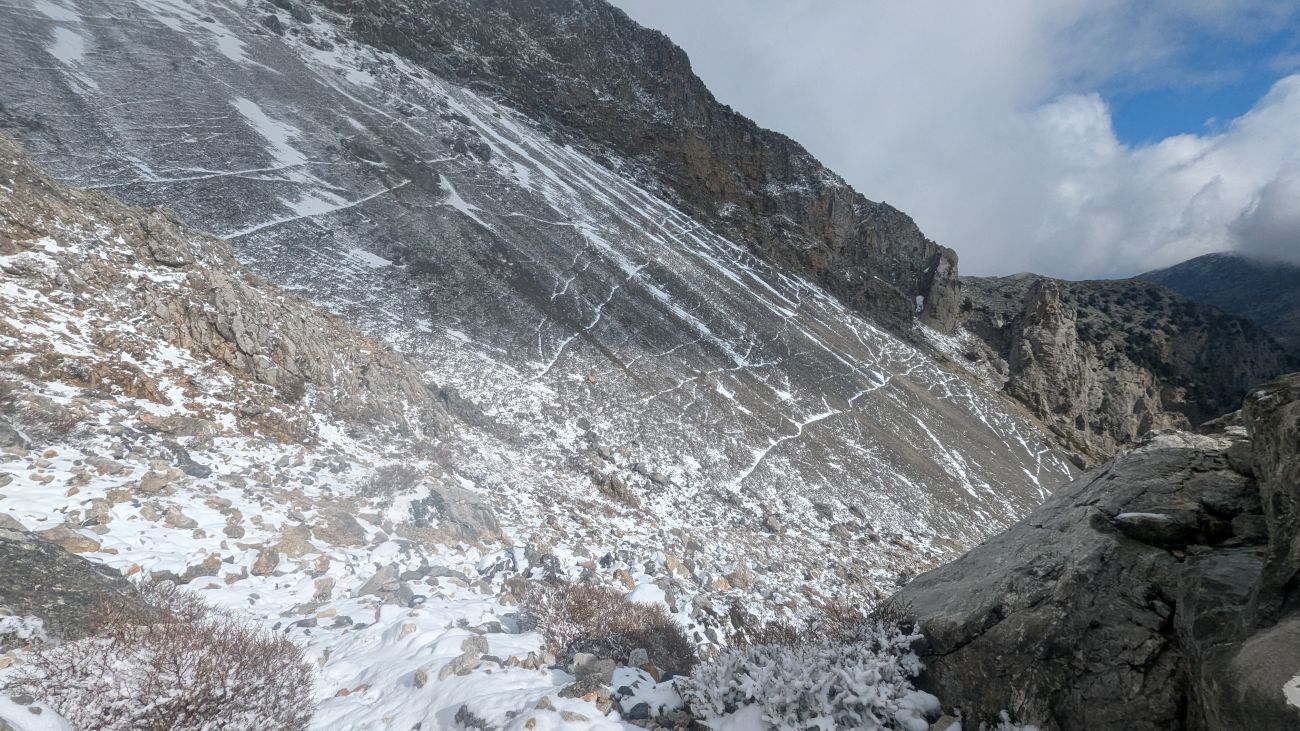
View up and down the scree up to the saddle
Heading up the scree was good fun. Finding trail cairns on a scree should be an art in itself. In better weather it would have been OK to simply walk towards the saddle in a roughly straight line. However, with the snow cover, I did not want to risk stepping into a snow-covered hole on the third day of a two-week trip. Flora encountered on the walk up included Arabis caucasia, Thymbra capitata, Viola fragrans, Prunus prostrata, Ranunculus spp., Buglossoides incrassate, Aethionema saxatile subsp. creticum, Festuca spp., and the notorious thorn-cushion trio of Euphorbia acanthothamnos, Astragalus angustifolius and Berberis cretica. Of all the variety of plants seen on this day, I was most taken by the sheer brawn and beauty of B. cretica, adorned with icicles frigidly pointing in whichever direction the harsh winds froze them. A lovely Sedum tristriatum was encountered on the walk down from the scree, this Sedum so far only known to exist in the Lefka Ori, Psiloritis and Ditki ranges of Crete, and Sparta on mainland Greece. Another rarity, the Muscari heldreichii was seen on the way down, another Greek / Cretan native not often observed.
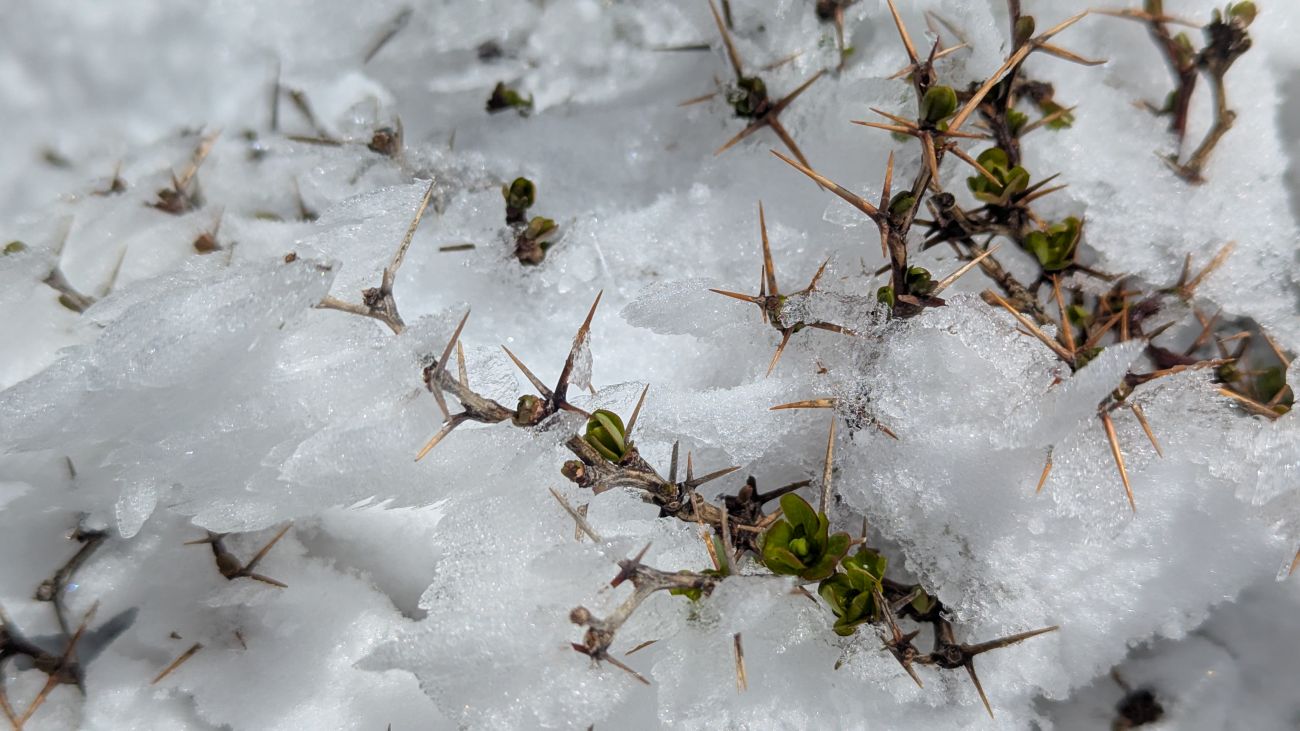
Snow-draped Berberis cretica
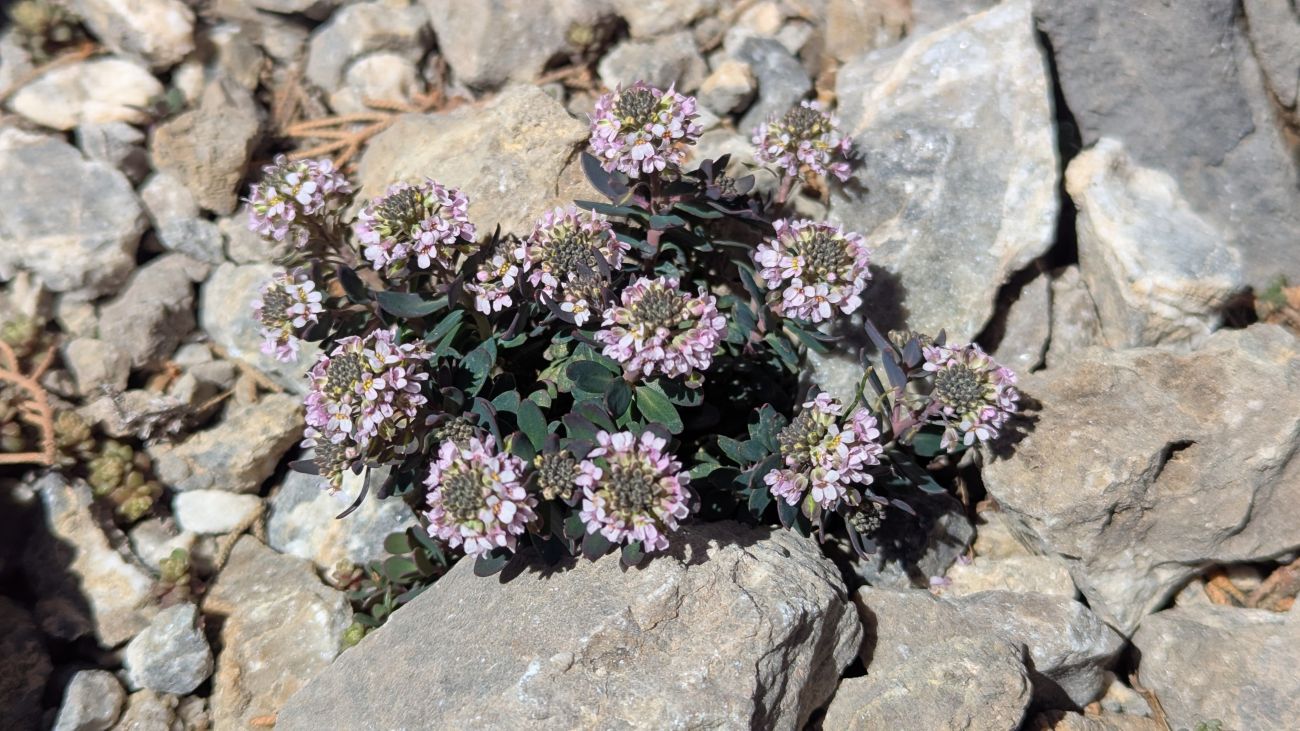
Aethionema saxatile subsp. creticum
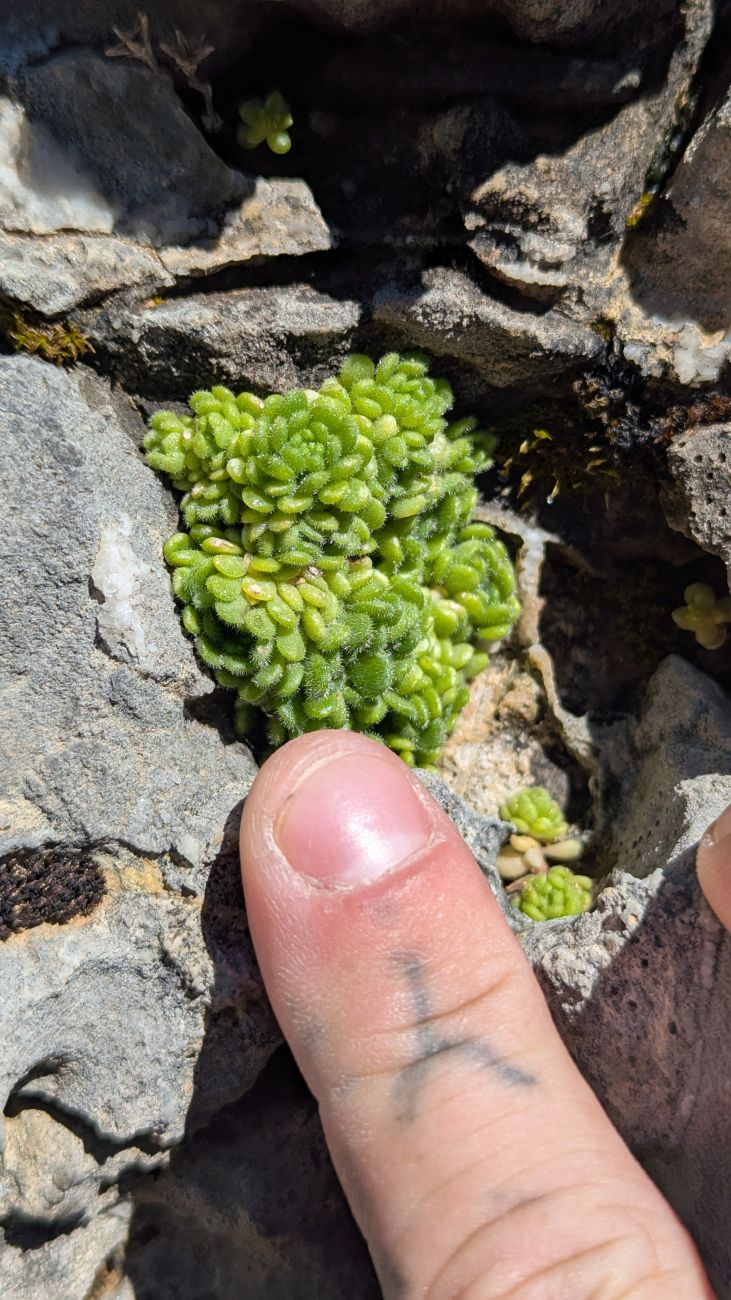
Sedum tristriatum (finger for scale)

Muscari heldreichii
After a quick break at the saddle of Gingilos, I decided that with the extreme wind and snow cover, that it was not worth the last couple of hundred metres of elevation to likely see no further flora. On the descent I took another break to admire an ancient Cupressus sempervirens, bearing such beauty against the powerful landscape of Lefka Ori. This was an ample finish to botanising in the western Lefka Ori.
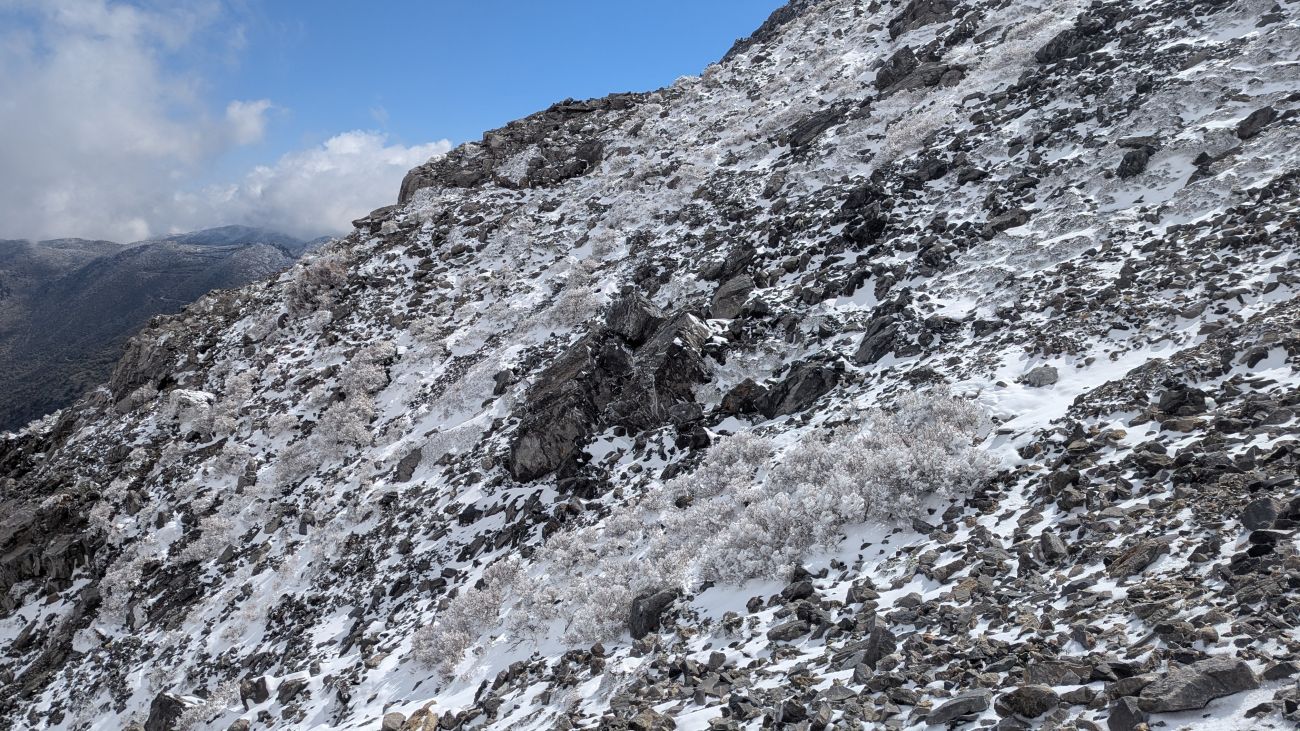
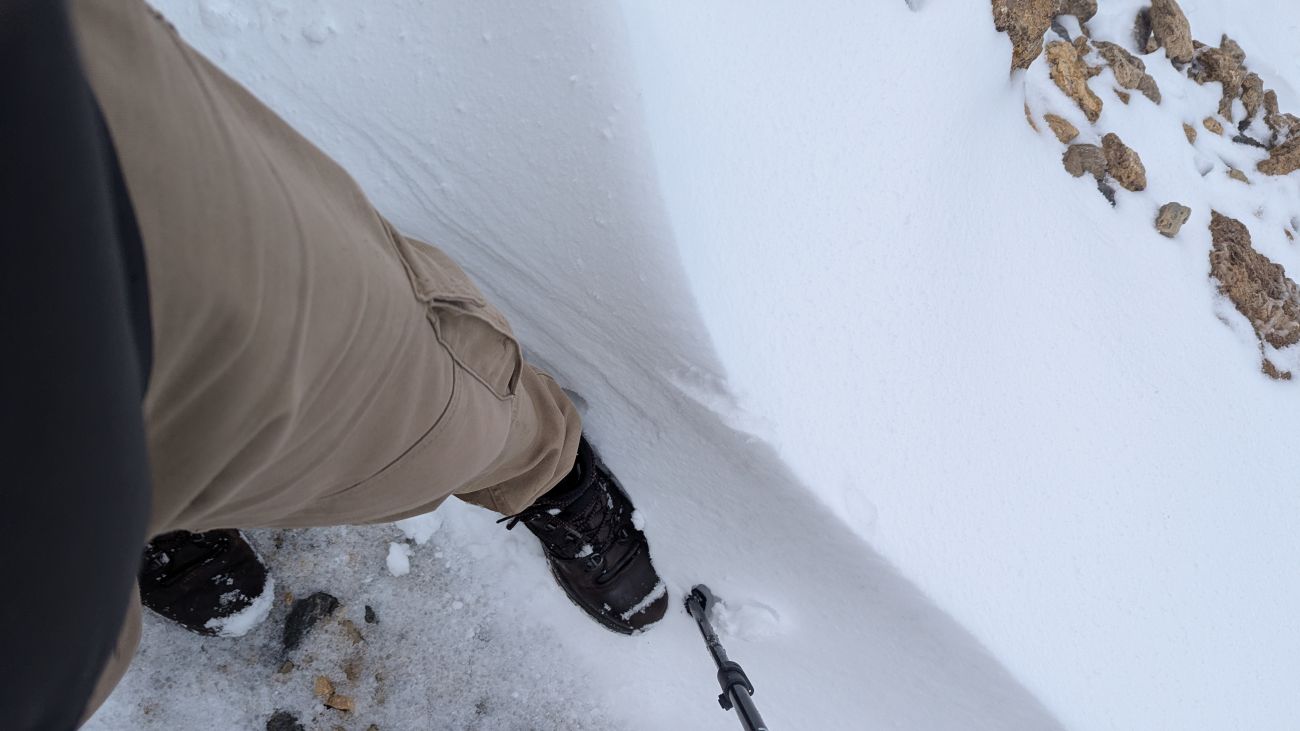
The reasons for descending
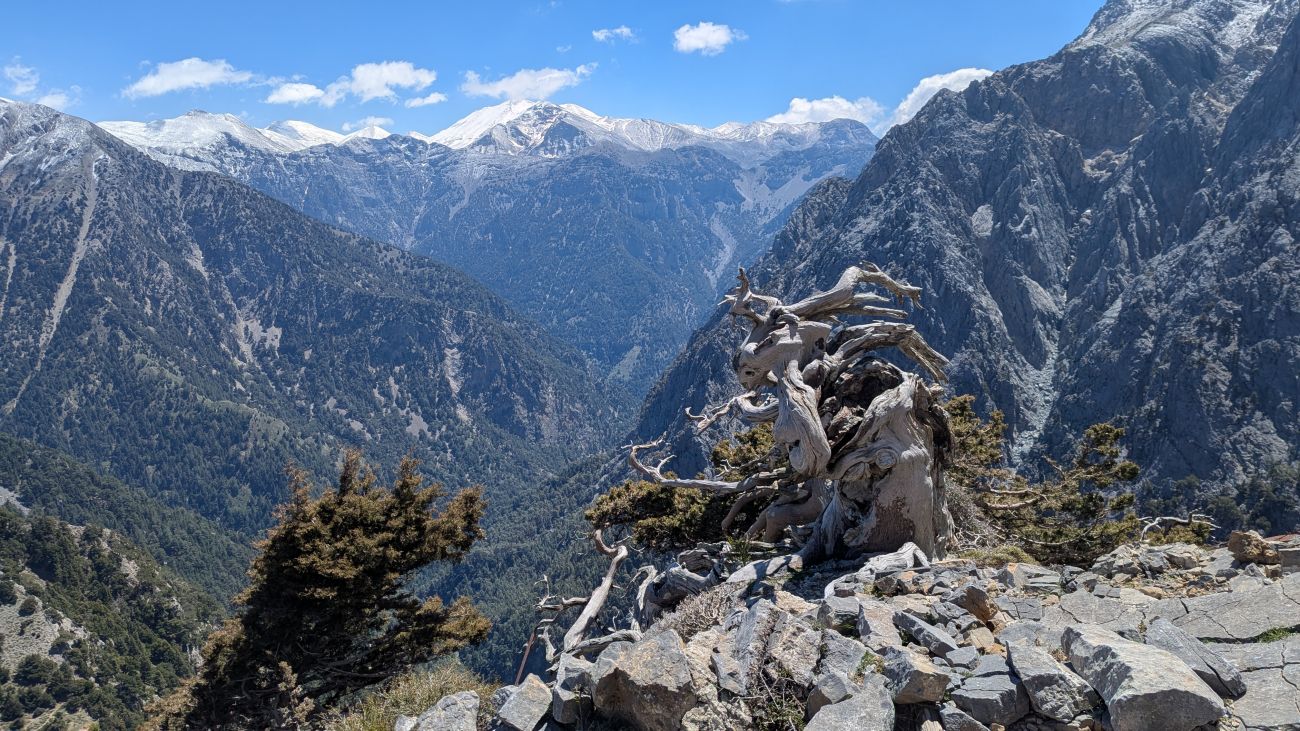
Cupressus sempervirens – Ancient beauty. Lefka Ori in the background
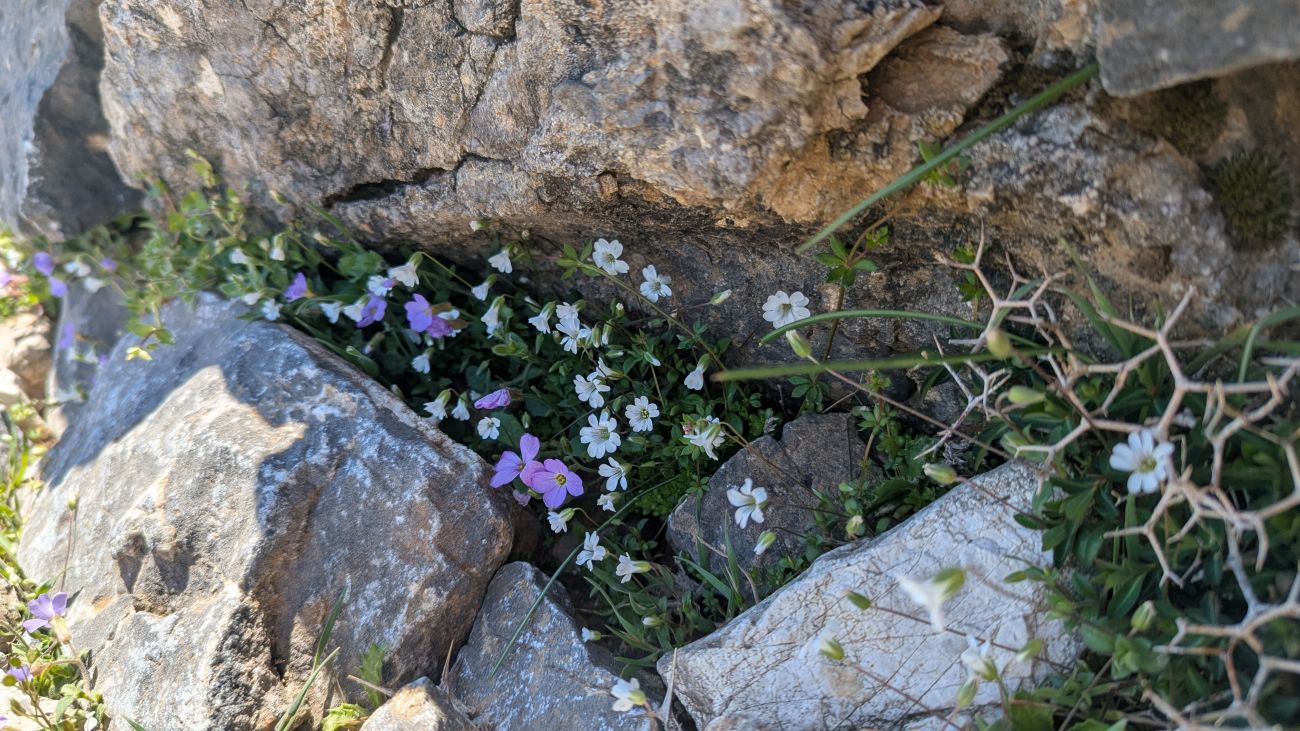
A medley of Aubrieta deltoidea, Cerastium scaposum, Euphorbia acanthothamnos, and an unidentified bulbous plant in leaf
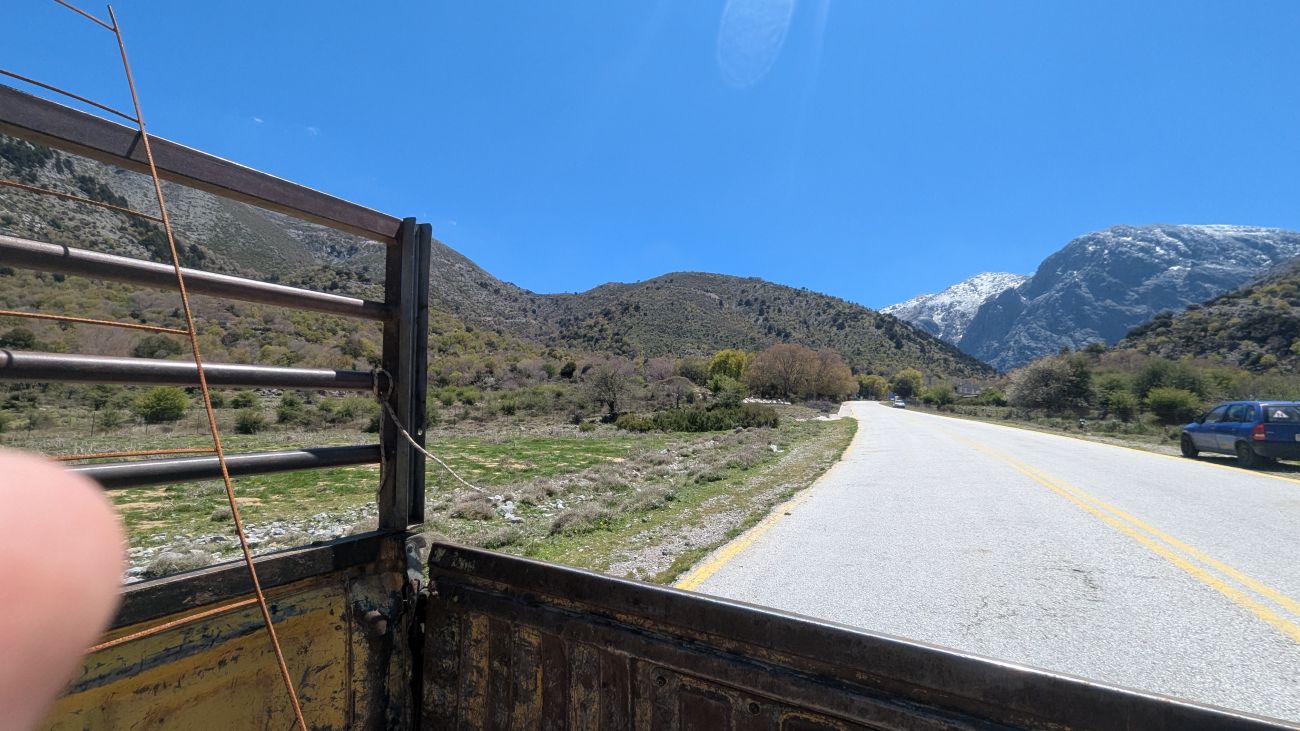
Hitching a ride with the shepherds, Gingolos in view
Before wrapping up the day I wanted to check out a spot recommended by John Fielding from his many years spent botanising in Crete. After descending Gingilos it would have only been an hour (uninterrupted walk), but the day was going by, so I waved down some local shepherds who were happy for me to jump in bed of their truck back to the village. From the village I made my way to the spot, stopping at a cave along the way. The dark entrance, dripping with water, was home to plants such as Umbilicus parviflorus, Lamium purpureum, Veronica cymbalaria, Centranthus calcitrapae, Orobanche pubescens, Arum concinnatum and Berberis cretica. Bryophytes covered the rocks and walls at the entrance. The Berberis cretica here was not in the usual compact cushion form seen previously but was a sparse shrub with long trailing stems crawling over the rocks.

Berberis cretica growing much less compact in the shade of the cave
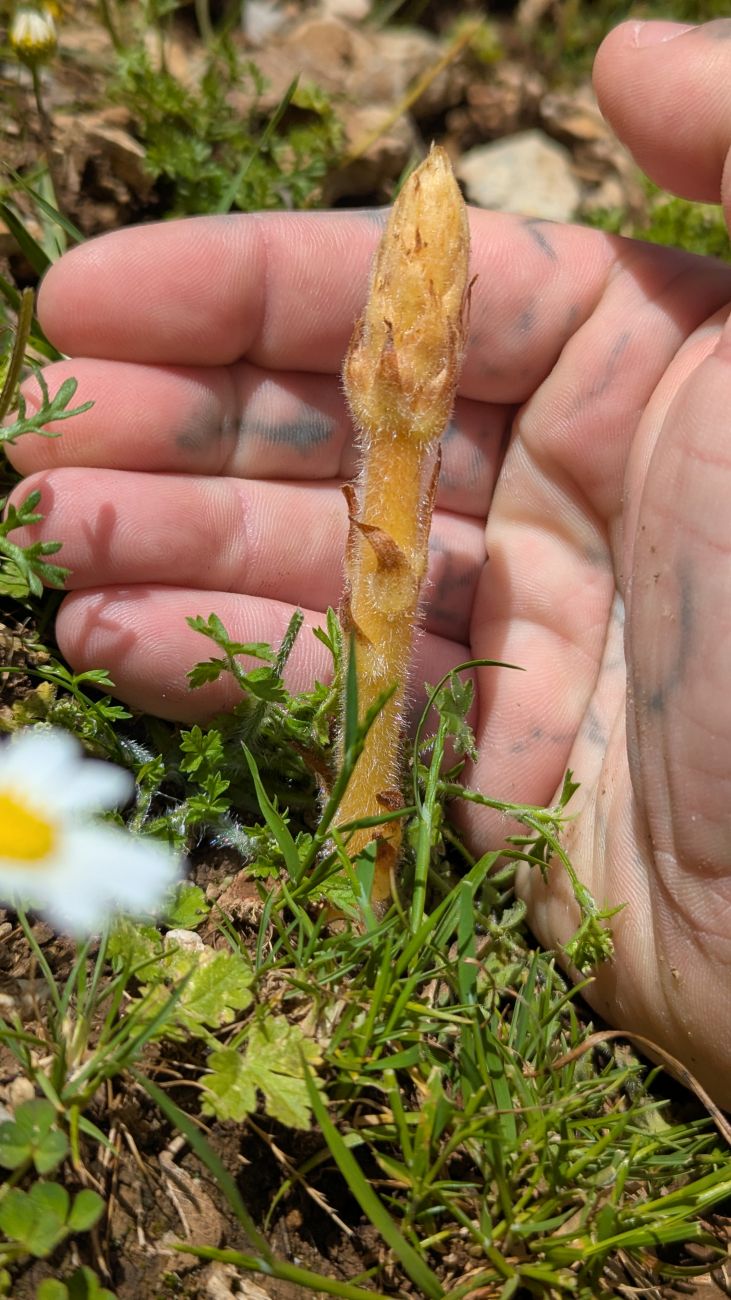
Orobanche pubescens, a parasite with a range of hosts
Reaching the site of interest, it was clear that habitat was drier than the plateau, yet not as dry as up in the mountains. Accumulated organic matter from the vegetation and grazing livestock, along with sediments carried by meltwater from Lefka Ori provide a more water-retentive and richer soil than seen higher up in Lefka Ori. The small steep hill was roughly 1120m – 1160 m in elevation. It was once part of a larger hill but has been dissected by the road from Chania to Omalos. The vertical carved roadside cliff face was barren of plant life, which harboured a rich community atop. The vegetated slope was a sparse Quercus coccifera and Cupressus sempervirens woodland with a shrub layer of Daphne sericea and Euphorbia acanthothamnos and Ononis spinosa. Herbaceous plants included Rosularia serrata, Asplenium ceterach, Selaginella denticulata, Sedum spp., Cyclamen creticum, Verbascum spinosum, Gagea cretica, Centaurea raphanina, Arum idaeum and Muscari sp. I suppose this habitat was borderline-woodland-scrubland This marked the end of my botanising around the Omalos Plateau and Lefka Ori.
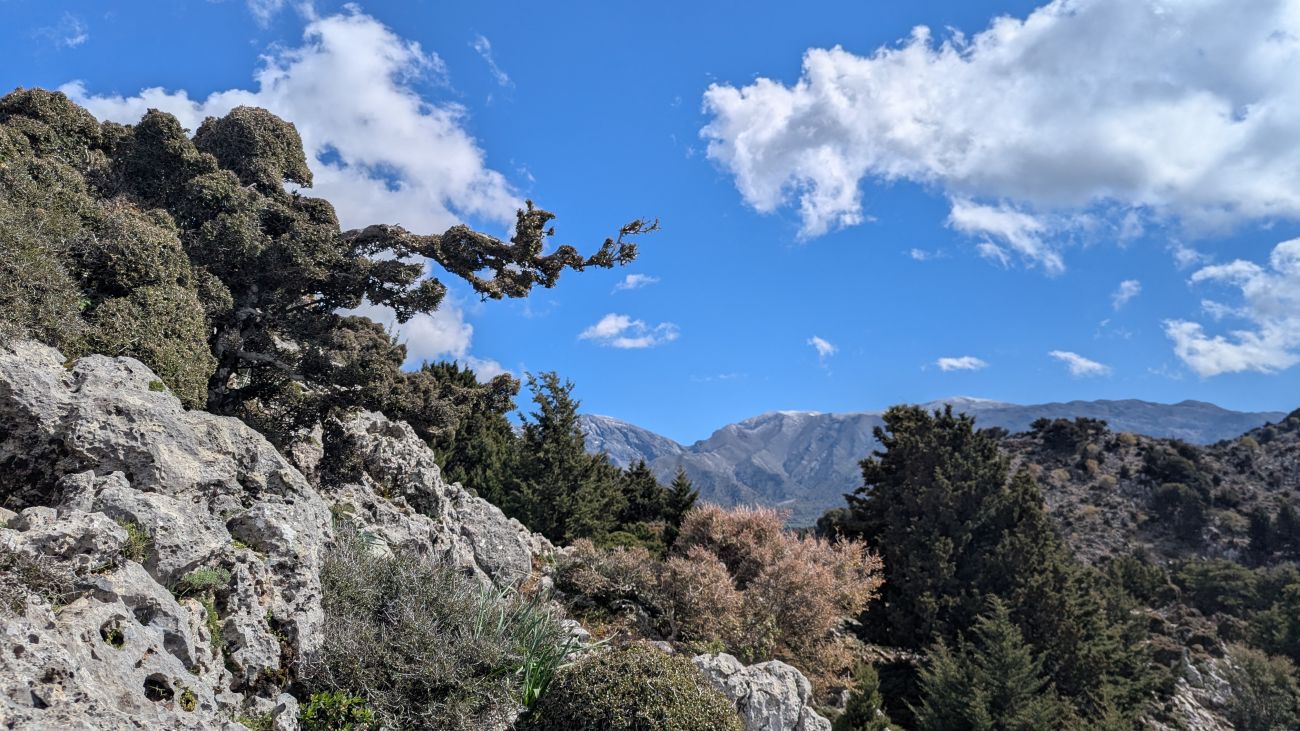
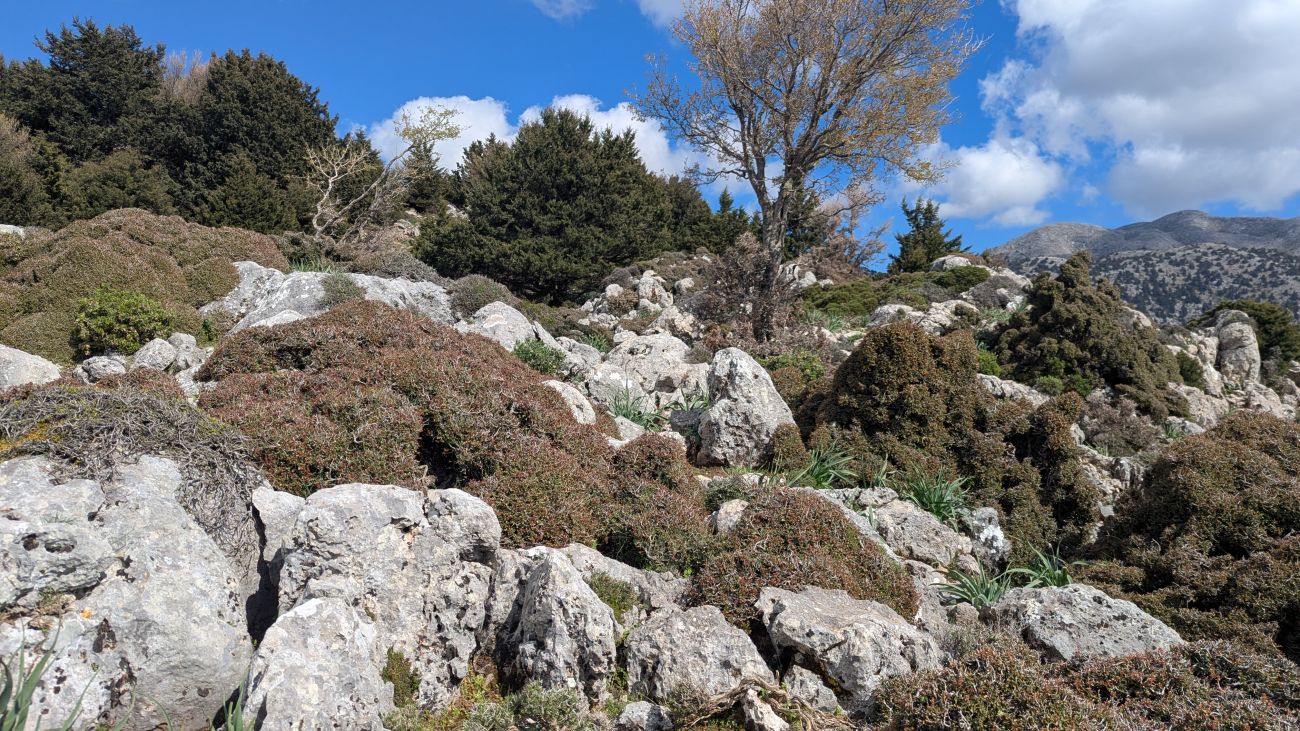
Habitat visited
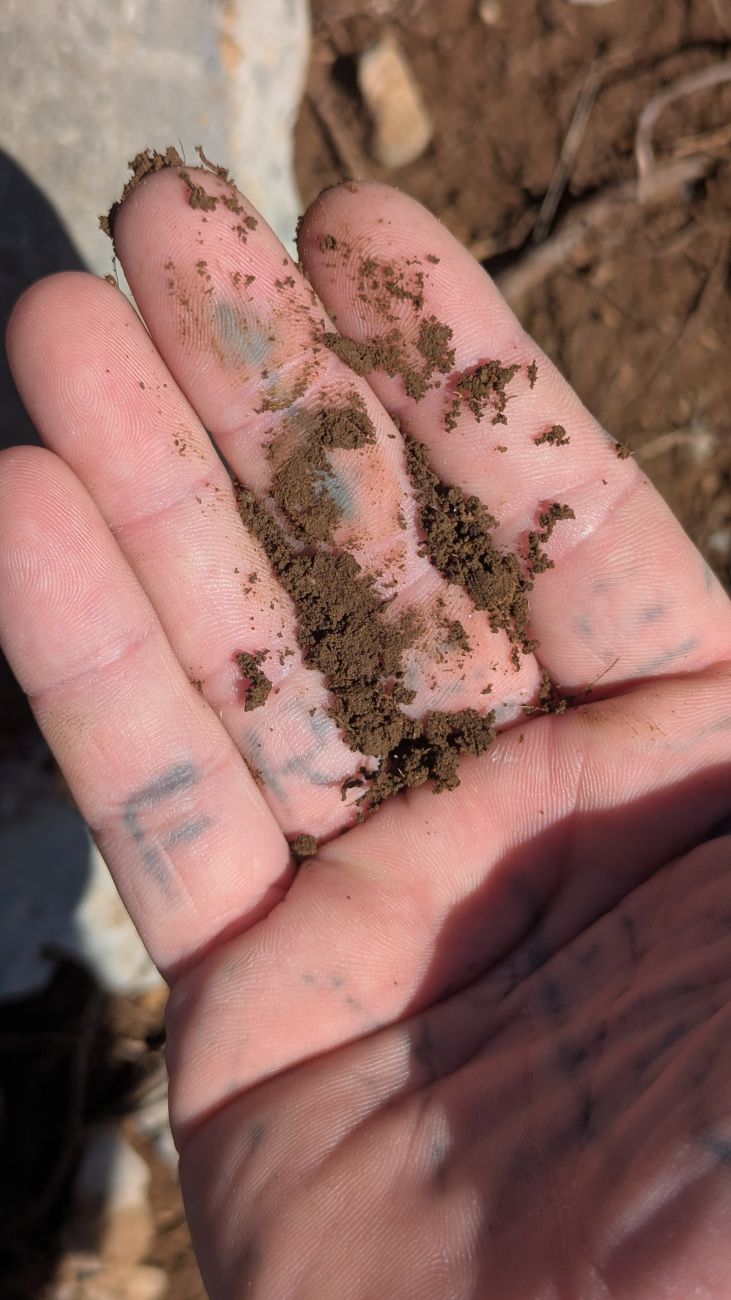
Relatively (to the mountains) rich and water-retentive soil
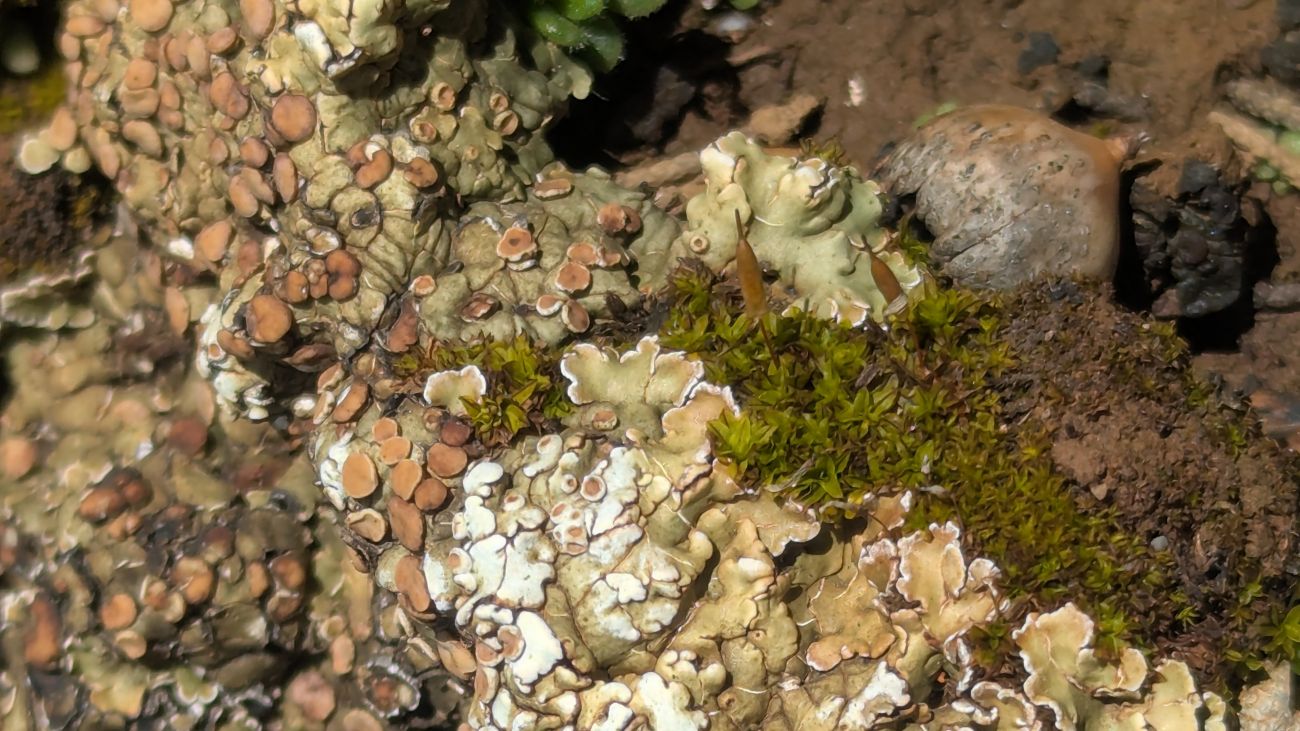
Shade and moisture enough to support a high lichen and bryophyte community
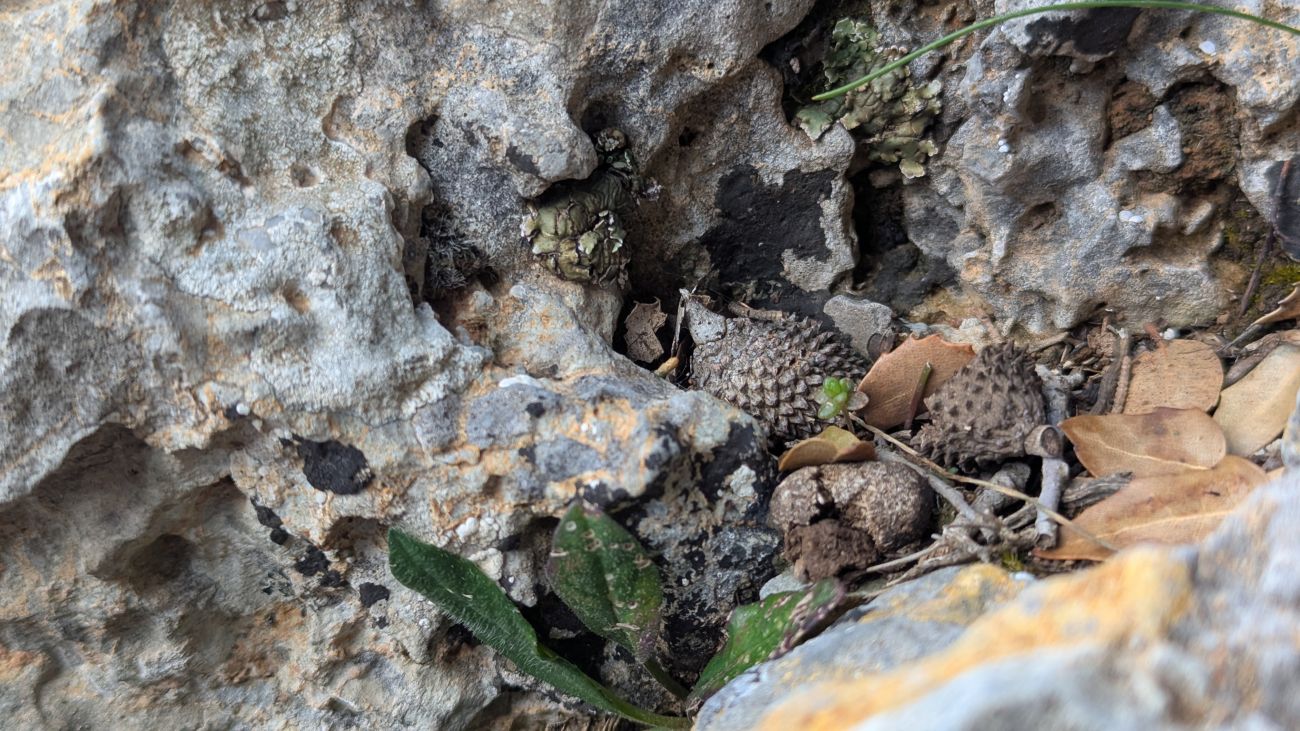
The potential new generation of Quercus coccifera

Daphne sericea was growing in abundance under the shade of trees
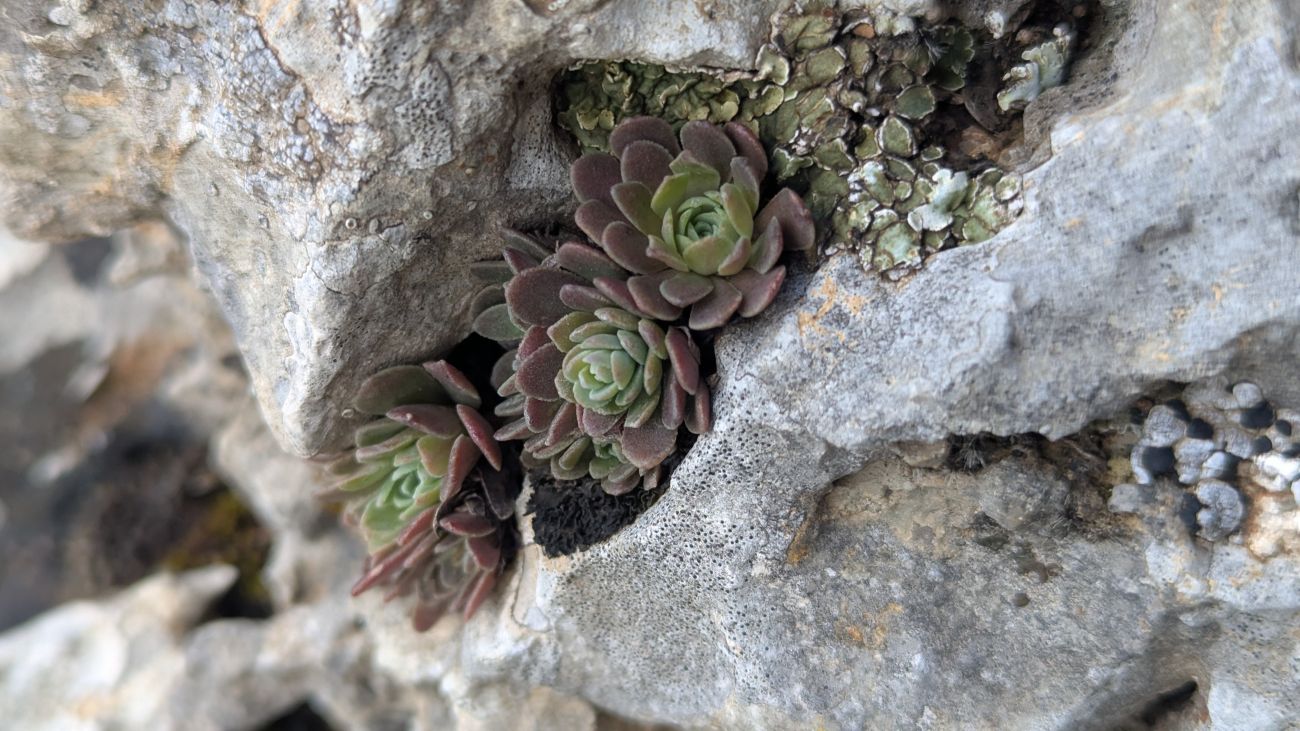
Rosularia serrata growing cosily in the rocks here, hugged from below by the lichens and bryophytes. A lovely scene of liverworts, lichen, angiosperm
Sougia
The original plan after Omalos was to hike down through Samaria Gorge, stay there the night, before heading to Elafonisi. Unfortunately, there had been a higher than typical rainfall recently, meaning that the workers who build the infrastructure to make Samaria Gorge traversable were unable to open the trail at this time. Whilst disappointing, it was just a hiccup in the trip itinerary. Instead, I decided to go southwest to Sougia. Sougia, a coastal town, also has a gorge (Lyssos Gorge). This detour ended up being for the better, as Sougia was much quieter, and botanising Samaria Gorge (if it were open) would have been hard work with my belongings on my back it and being a busy tourist trail. I arrived at Sougia around 10 am, and with the sun not setting until after 8 pm I could treat myself to a couple of hours on the coast and an early lunch before heading into the gorge. After lunch began the botanising. The aim being to go through Lyssos Gorge then up and down the ridge to the bay. The route went through highly exposed to semi-shaded gorge into pine woodland, then to a phrygana ridge before heading down an exposed hill to the bay.
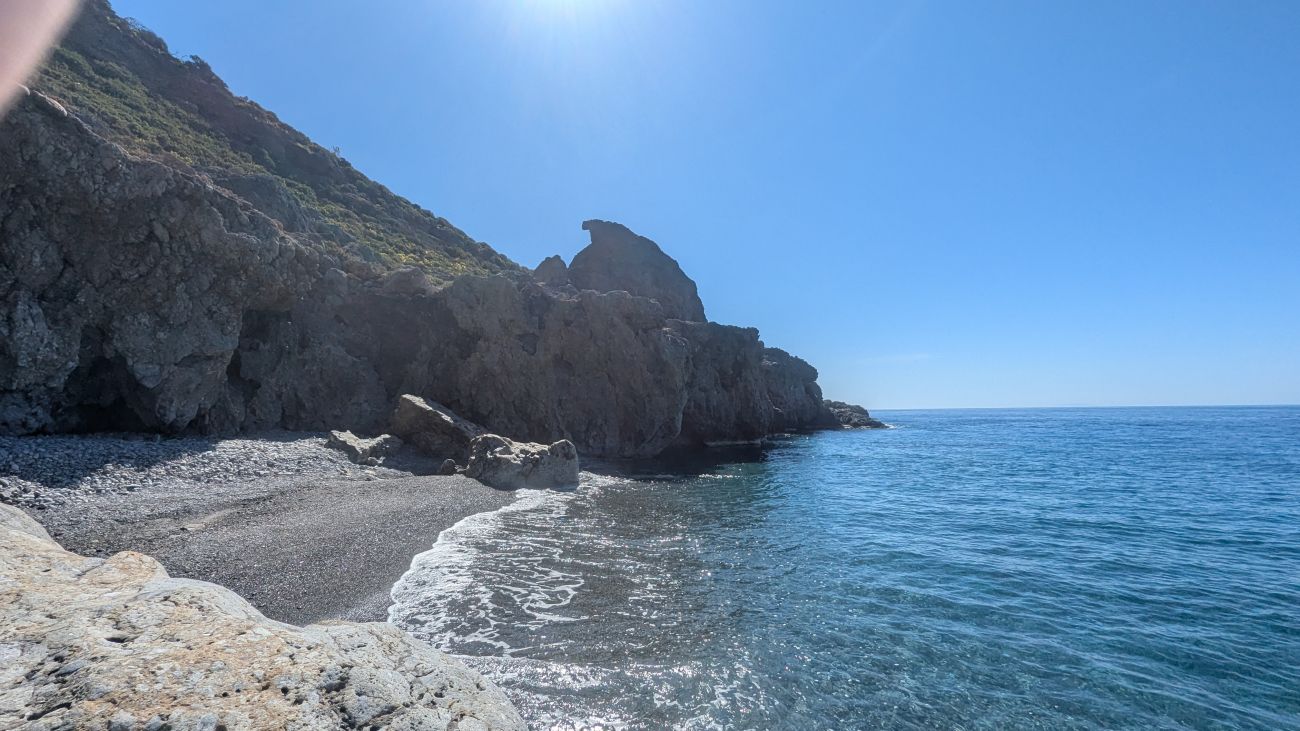

A morning break on a “private” (it turned out to be a nudist beach when others started arriving later on) beach with a little bit of rock climbing before getting back to the plants
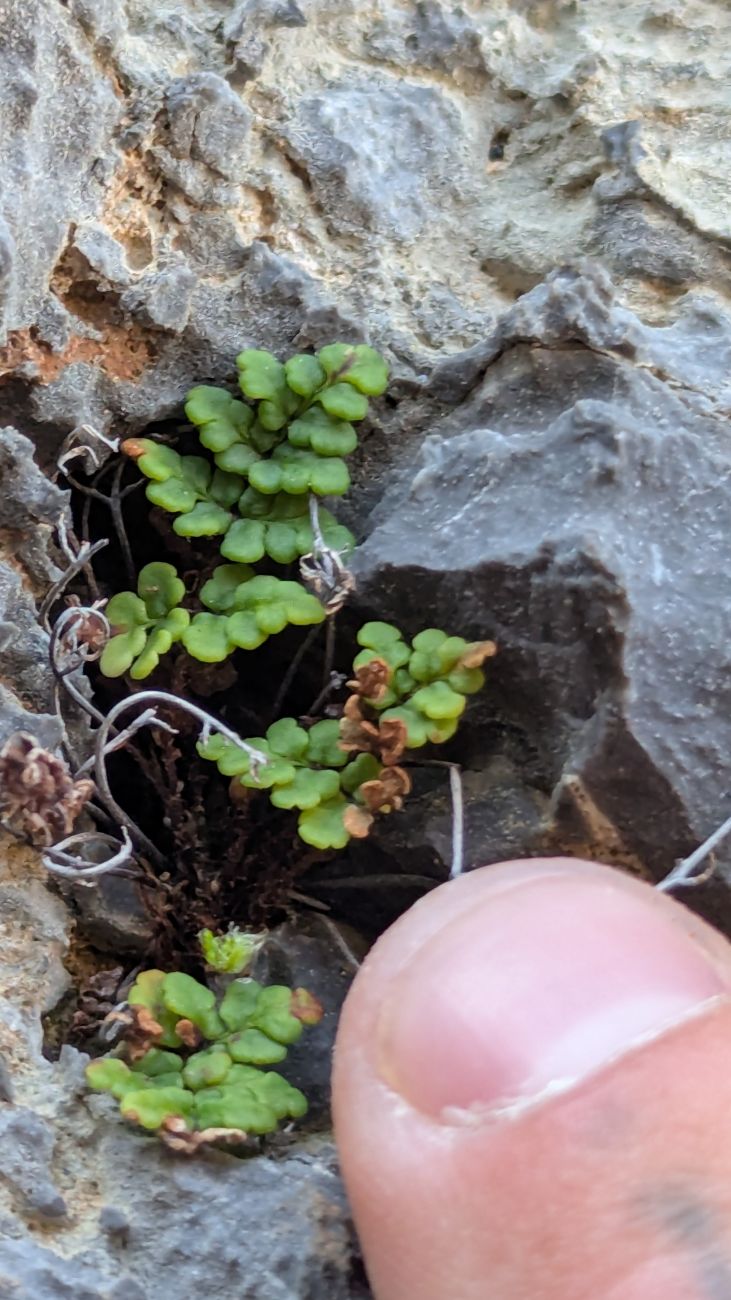
Oesporangium acrosticum spotted on the rock climb
The entrance to the gorge, for a good distance, was highly exposed to sun, wind and salt, with incredibly sandy soil and a high ratio of rock to soil, my sacrificial offering of water to the ground drained almost immediately, indicating the flora seen here (at least up to the pine forest) was tolerant of high-stress environments. It was an exciting start the walk, as within the first few metres I encountered one of Crete’s endemic and monotypic genera Petromarula pinnata as well as the north-northeastern Mediterranean native aroid, Dracunculus vulgaris. I had seen the leaves of this aroid at the previously mentioned cave (Omalos), but not the inflorescence. You will smell this plant before seeing it, should it be flowering. Don’t be fooled though, you are not in the vicinity of sewer-dwelling corpse, you are close by one of Crete’s most strikingly beautiful plants. A little climb up the near-vertical rock faces led to spotting a few populations of Rosularia serrata, Pseudodictamnus sp., and Oeosporangium acrosticum.
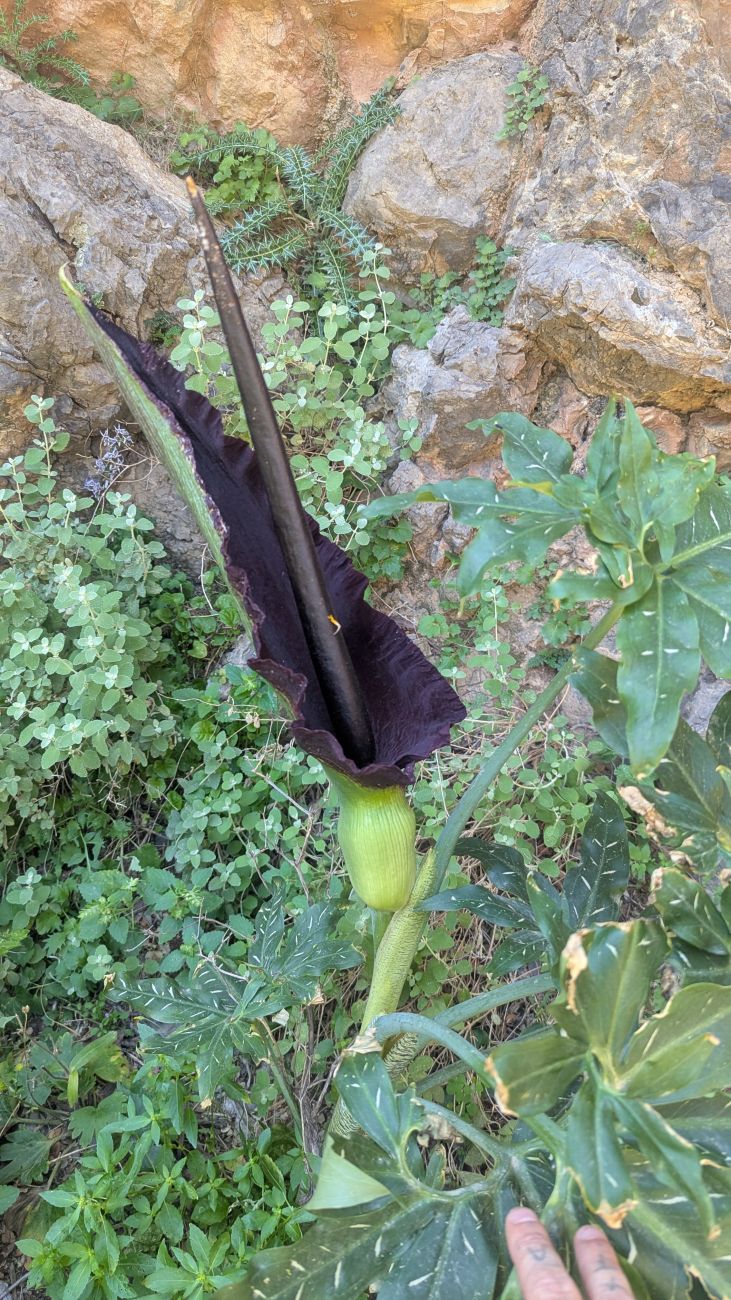
Dracunculus vulgaris

Aforementioned rock faces
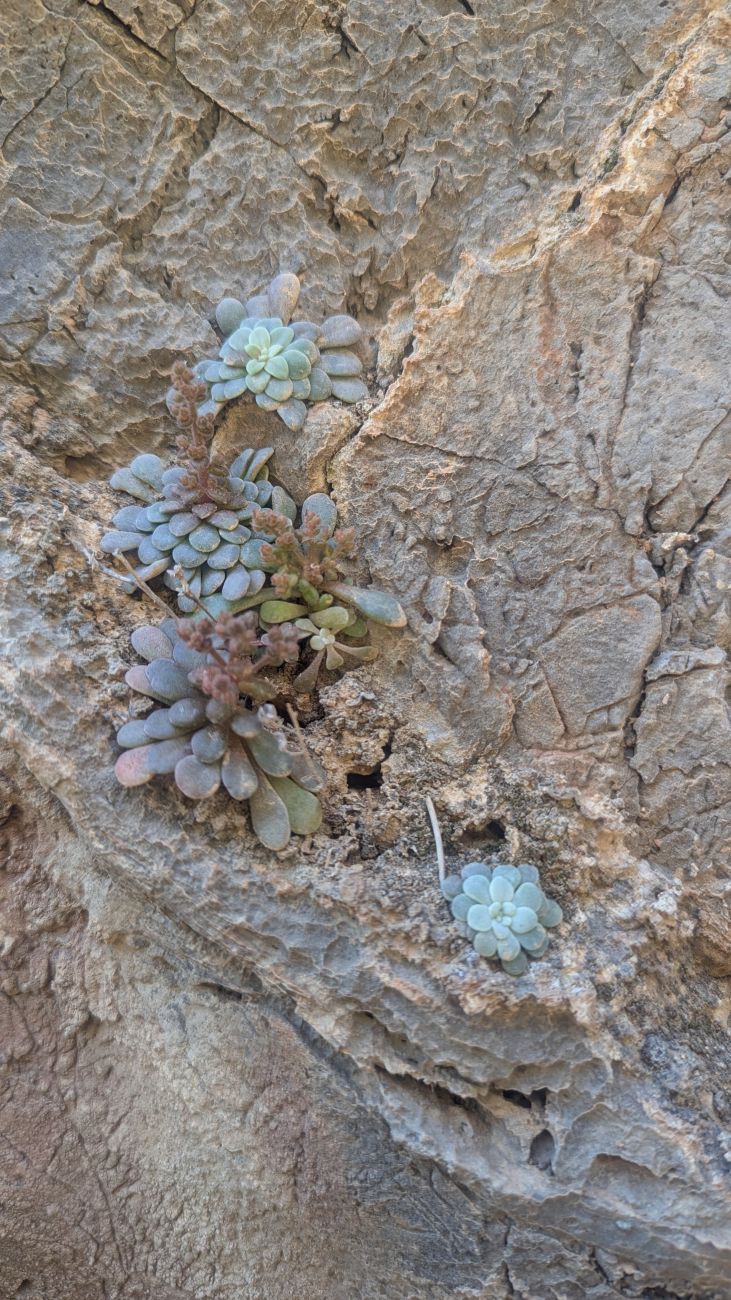
Rosularia serrata

Unidentified, likely Pseudodictamnus
Becoming less exposed further on, I entered a woodland primarily consisting of Ceratonia siliqua (Carob), Pistacia lentiscus, Pinus halapensis and P. brutia. Soil here was brown-orange, more on the side of orange. This may be due to the higher organic matter, or traces of iron and manganese in the limestone rock here. Another sacrificial water offering showed the soils in this woodland to be slower draining, with a wider spread via capillary action. It was evident the soil here had a higher water-holding capacity than the entrance to the gorge and, of course, the flora changed with that. Dominant herbs in the woodland include Malva sylvestris, Cyclamen graecum, Ranunculus asiaticus, Solenopsis minuta and Prasium majus. The parasitic plant Orobanche pubescens also appeared here, O. pubescens having a wide range of hosts. The orchid Serapias orientalis was seen growing in semi-shaded clearings between trees.
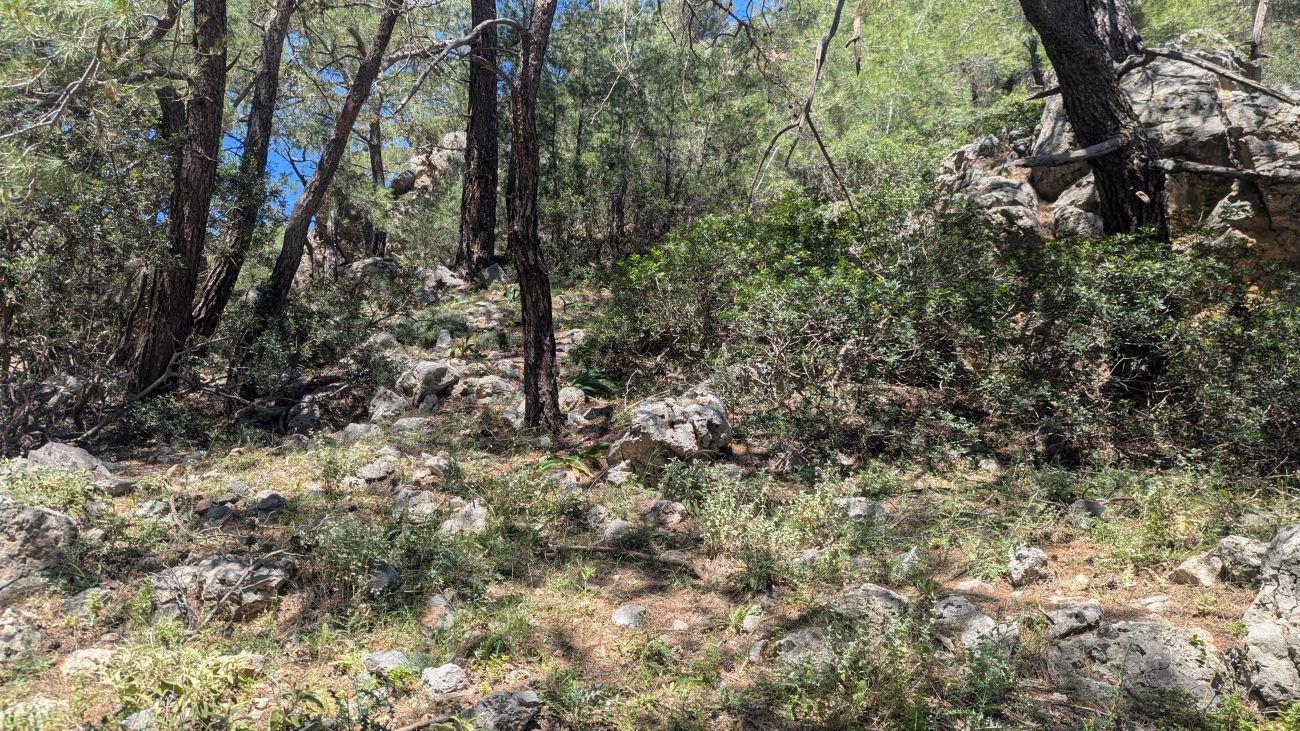
The mixed woodland
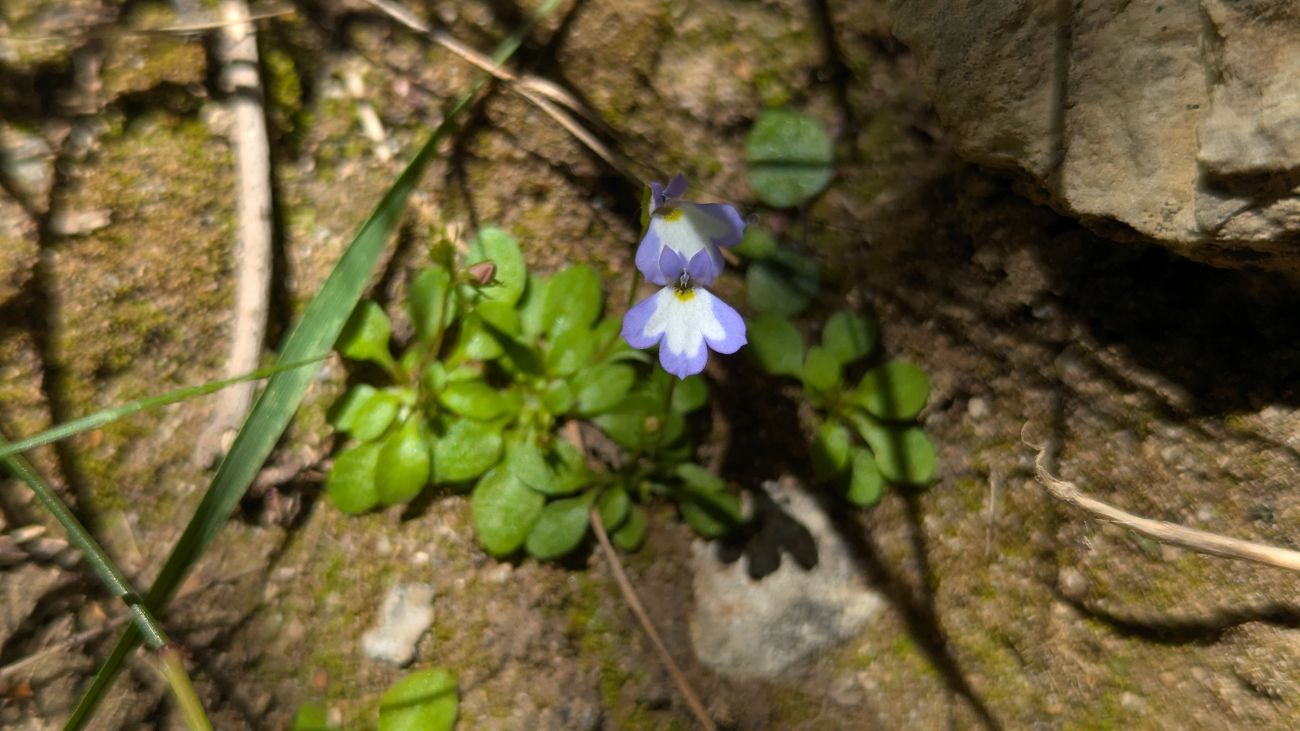
Solenopsis minuta growing under the shade of rocks and trees

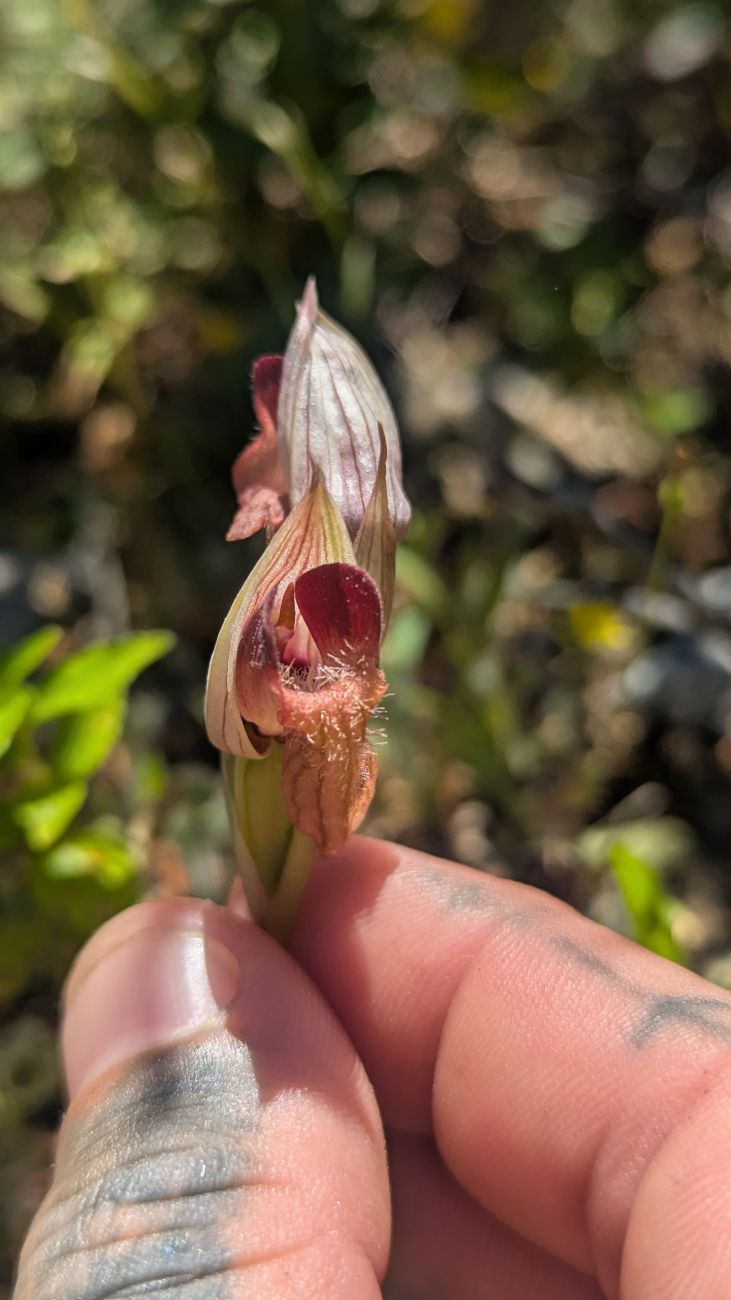
Serapias orientalis growing in a population of over 10 (visible and active) plants
Reaching the top point of the hike, the habitat hastily turned from conifer-dominant woodland to a heavily exposed rocky phrygana. This was definitely shrub territory, averaging a half metre in height, with a few trees growing up to a point as if they’d lost their way. Here are essences of what was seen at higher elevations in Lefka Ori, but the makeup was different. Shrubs / subshrubs whilst still spiny and rigid were not quite as “cushiony”, many more herbs and bulbs exist here, the soil held more water, the terrain was flatter, and even at a glance there was more soil and vegetation than rock. Here it felt the more prominent element of exposure to plants was the baking sun and potentially the salt in the air, rather than the whipping winds and cold seen previously. The shrub layer consists of primarily Sarcopoterium spinosum (vicious and mean – do not sit on or accidentally grab for support), Lithodora hispidula and Genista acanthoclada. Drimia, Phlomis, Muscari, Cyclamen and many, many Asteraceae spp. littered the herb layer.
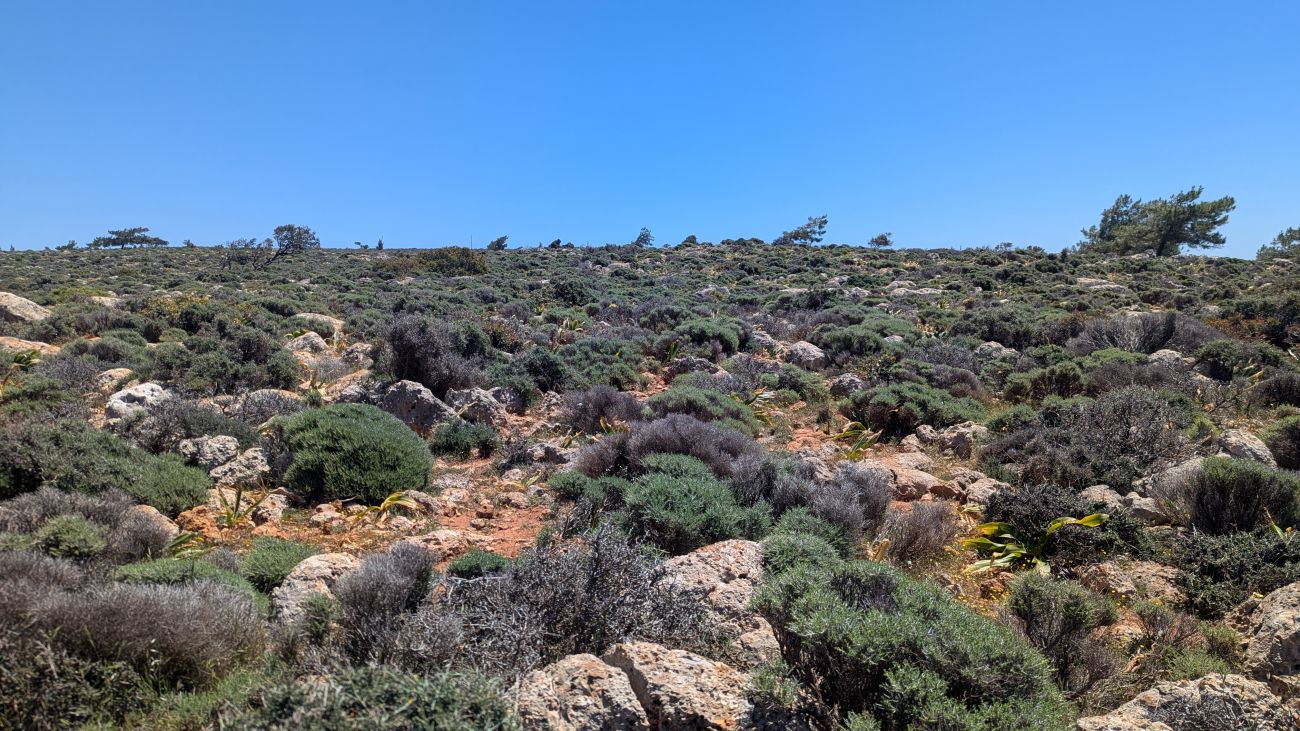
Phrygana segment on the hilltop
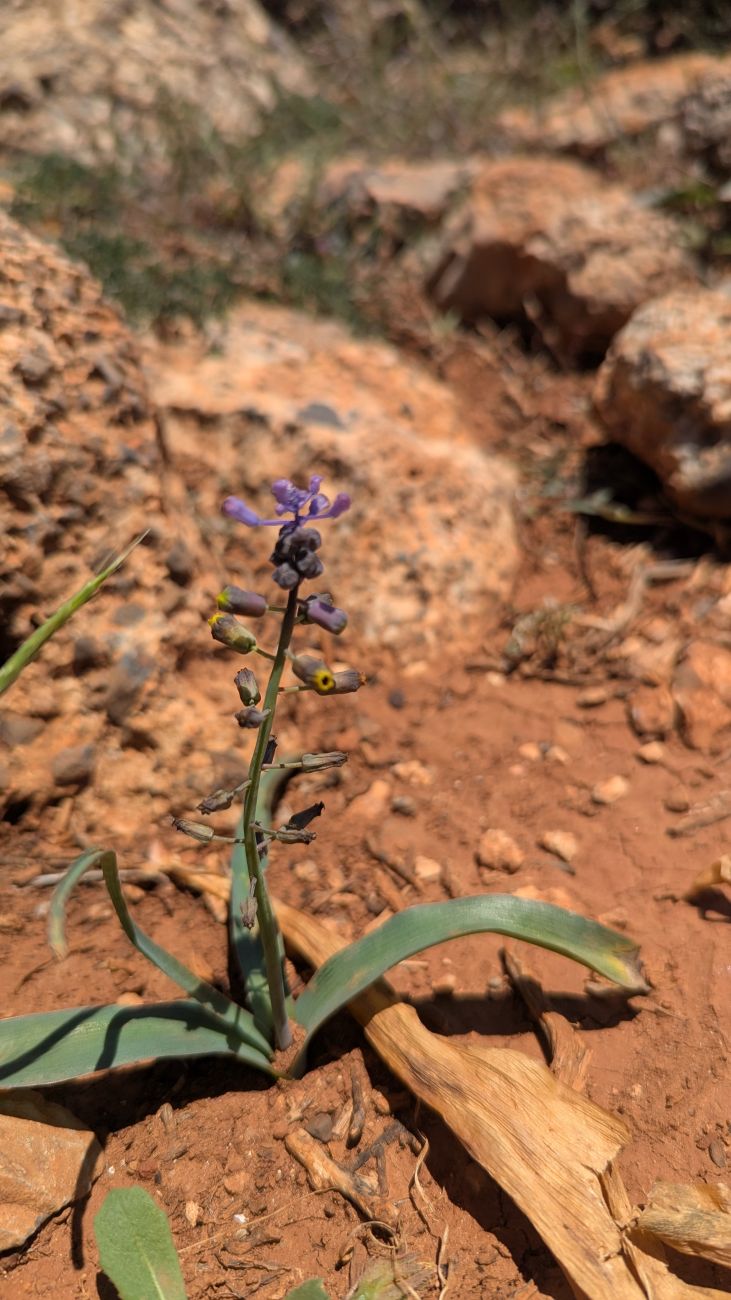
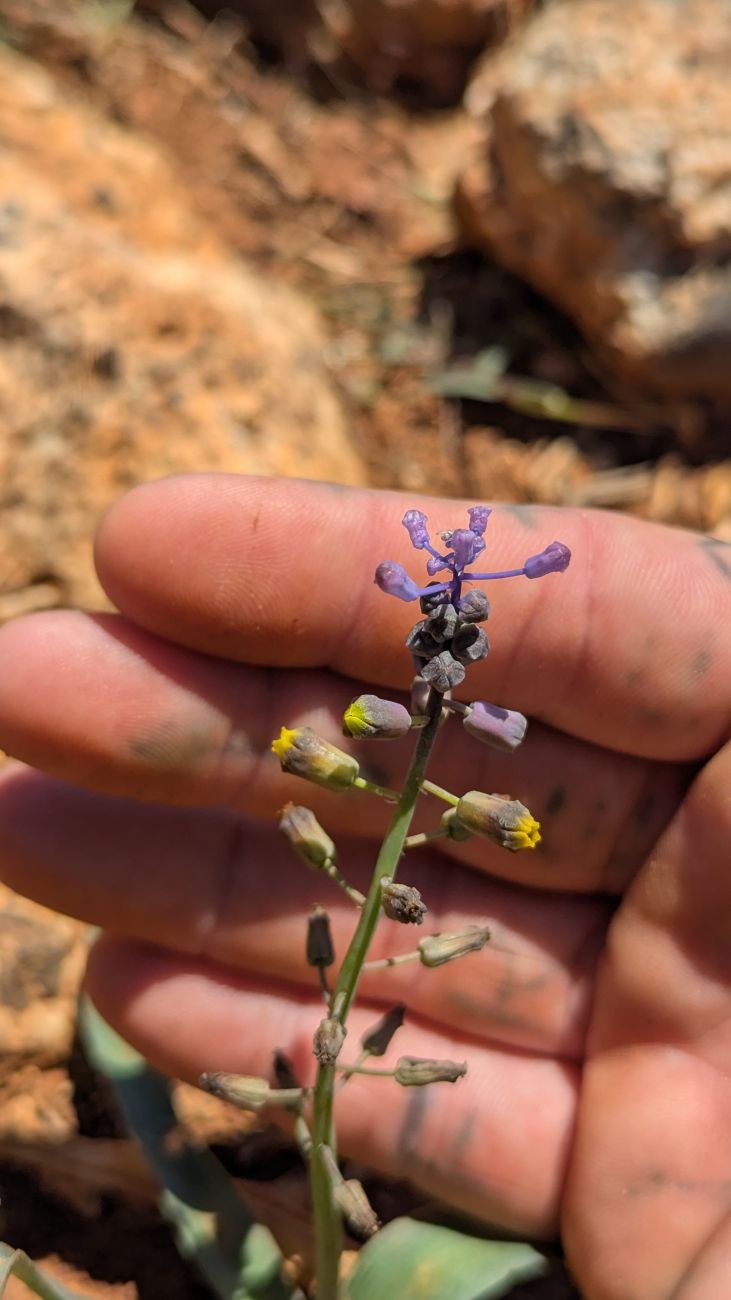
Muscari spreitzenhoferi
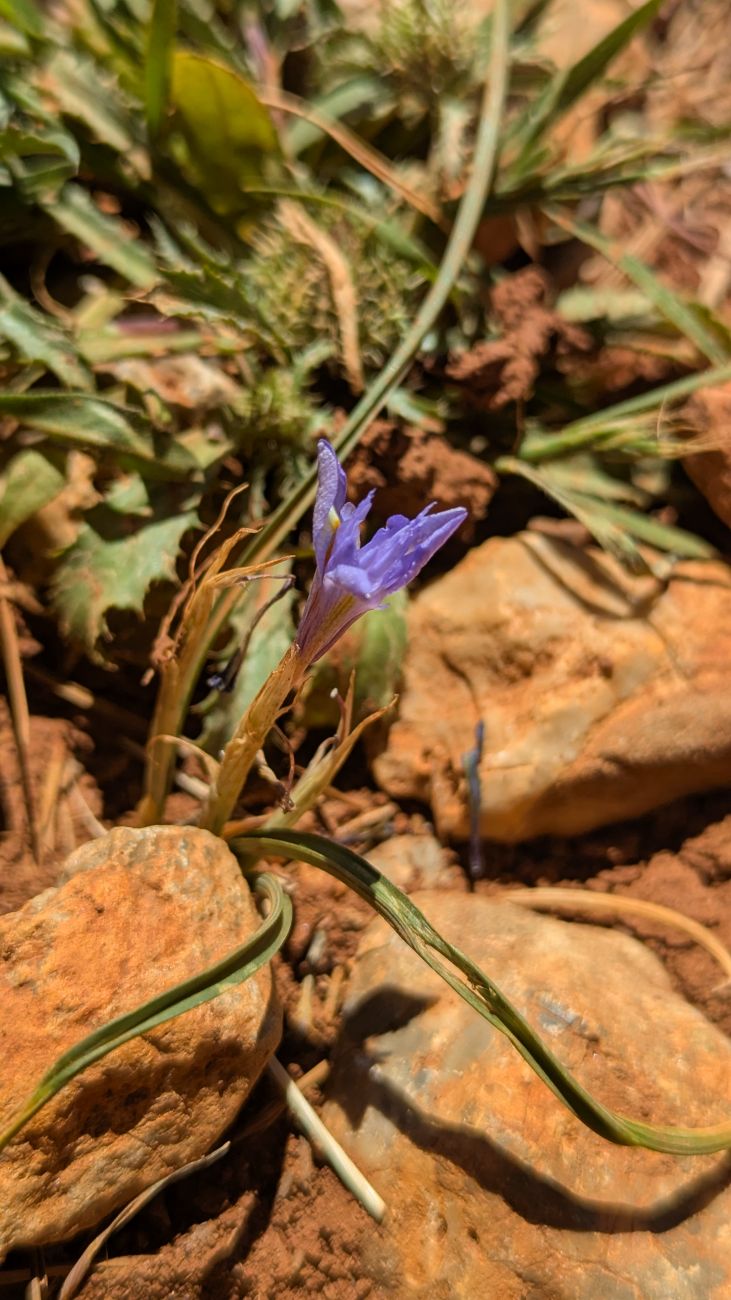
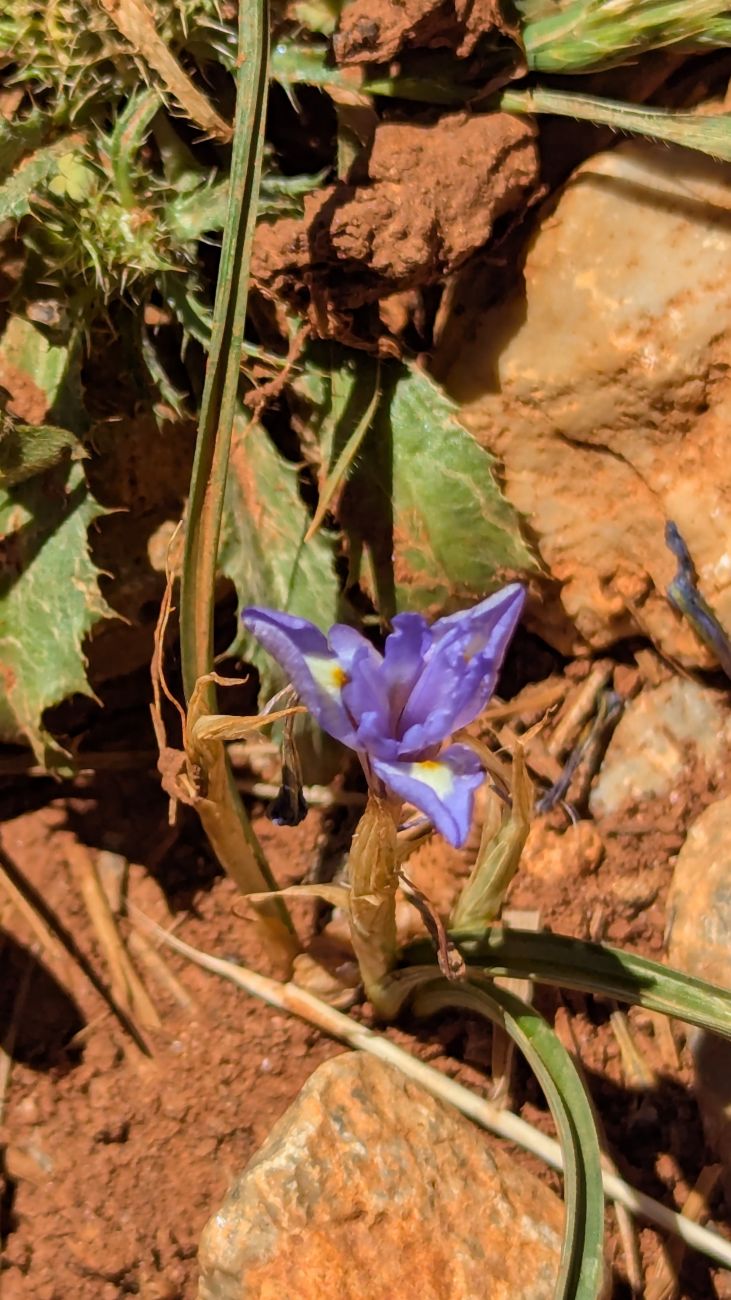
Moraea mediterranea
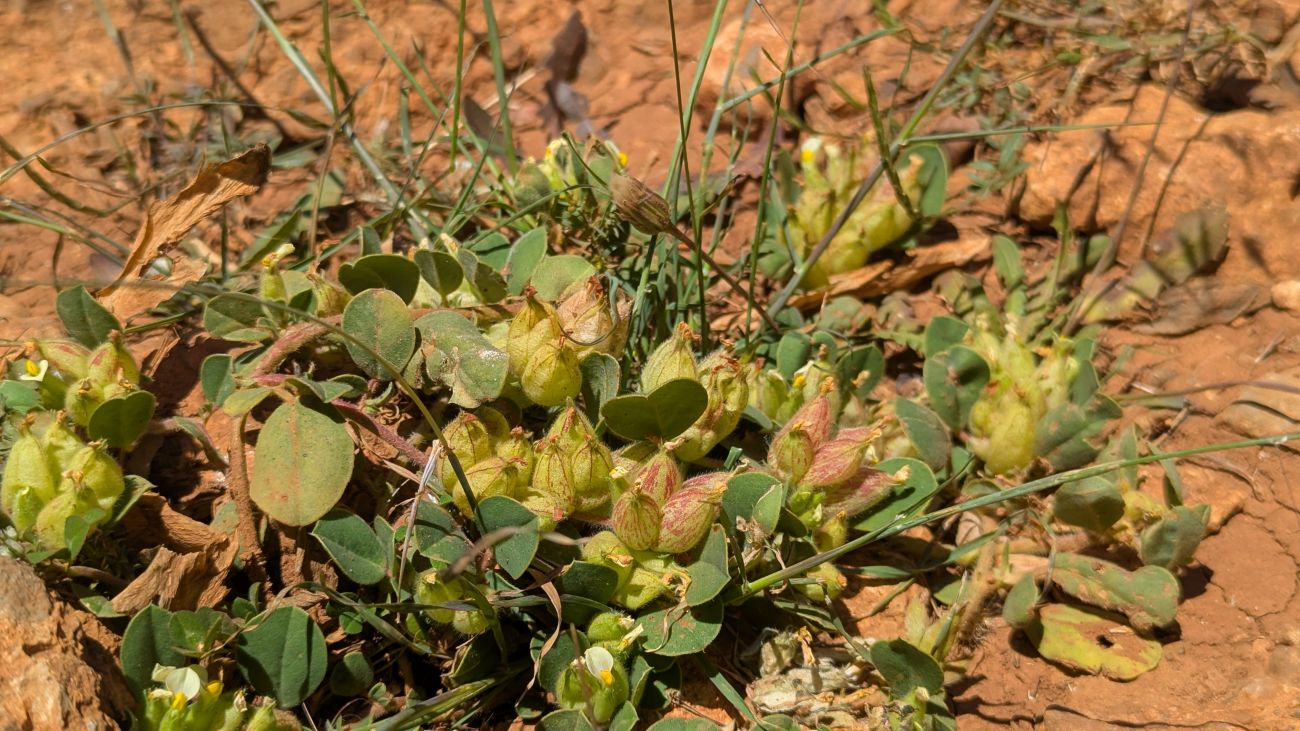
Tripodion tetraphyllum
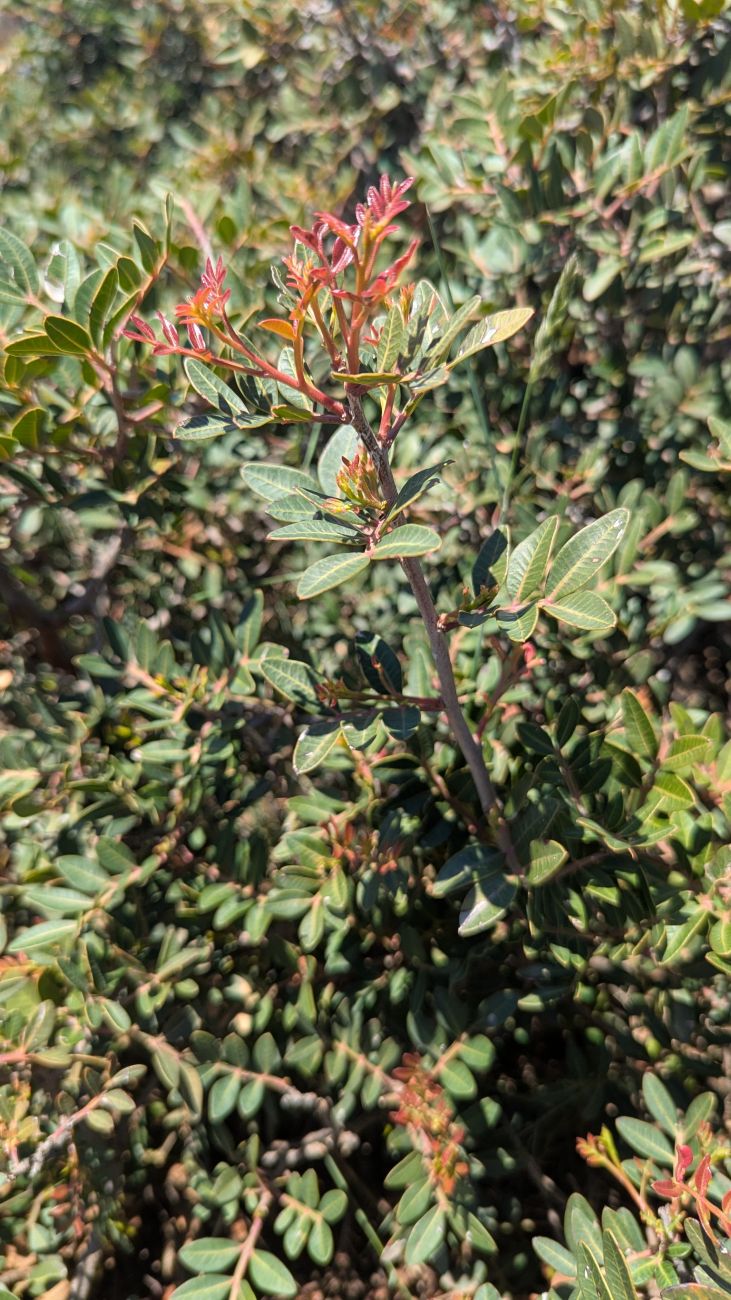
Pistacia lentiscus

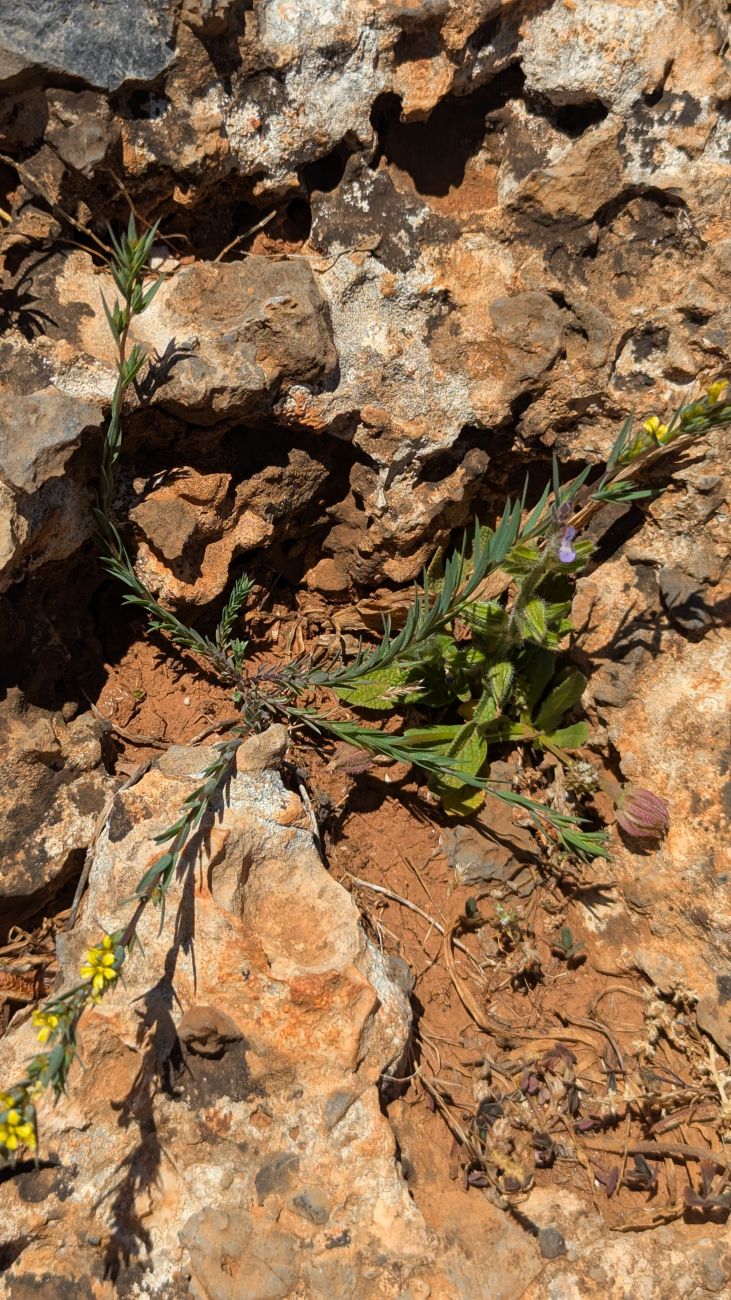
Linum strictum var. spicatum growing in soil deposits between karstic rock
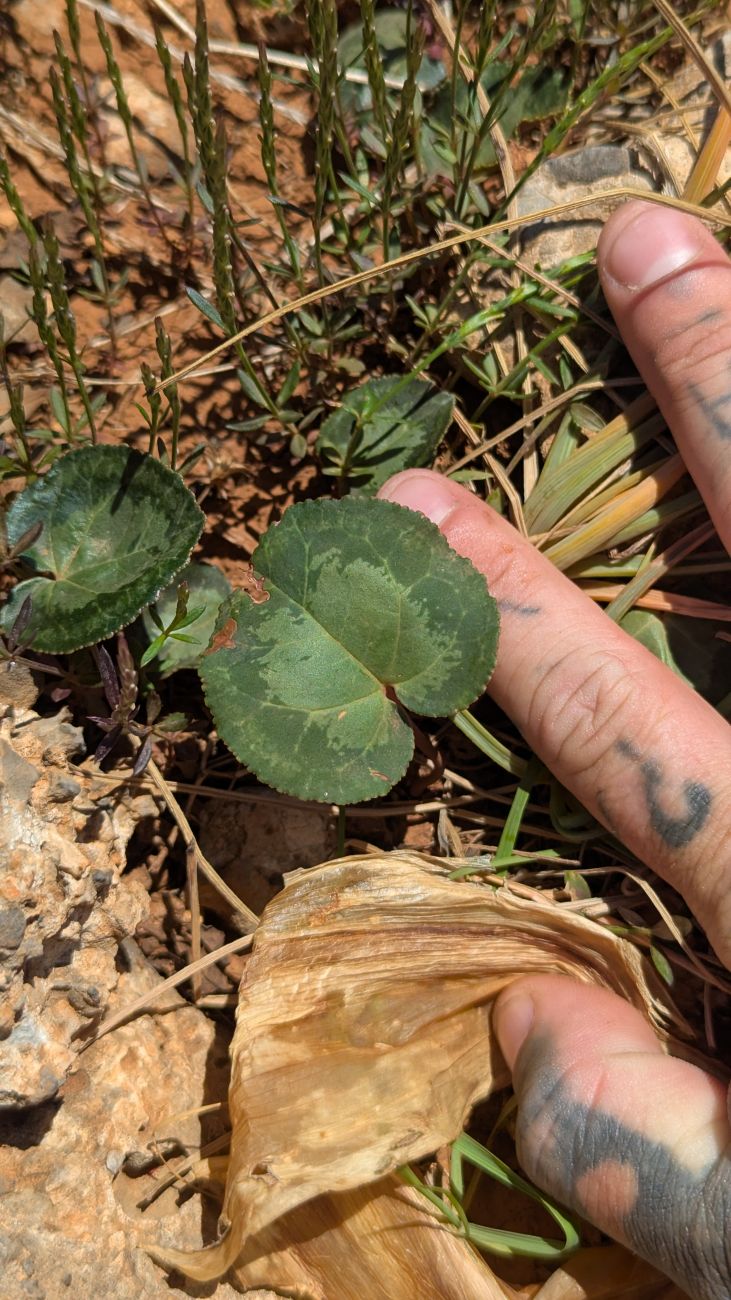
Cyclamen graecum
It was here that I found one of my favourite plants of the trip, Atractylis cancellata. It was love at first sight. A small, spiny, vegetatively prostrate and dense Asteraceae of the Carduoideae subfamily. The inflorescence of this Asteraceae protected by a bronze cage of spiny phyllaries, of which the tubular purple florets graciously emerge, demanding acknowledgement that it can also be delicate and beautiful. It reminded me of a Koelpinia that I’d seen in the Arabian desert whilst in Jordan, with its clutching phyllaries adorned with spines. Atractylis cancellata occurs in the “old world” in mediterranean-to-subtropical dry climes ranging from the Canary Islands to Pakistan, also spreading south into the Arabian Peninsula in all “countries” but not yet recorded in Yemen. This may simply be due to observation / recording bias.
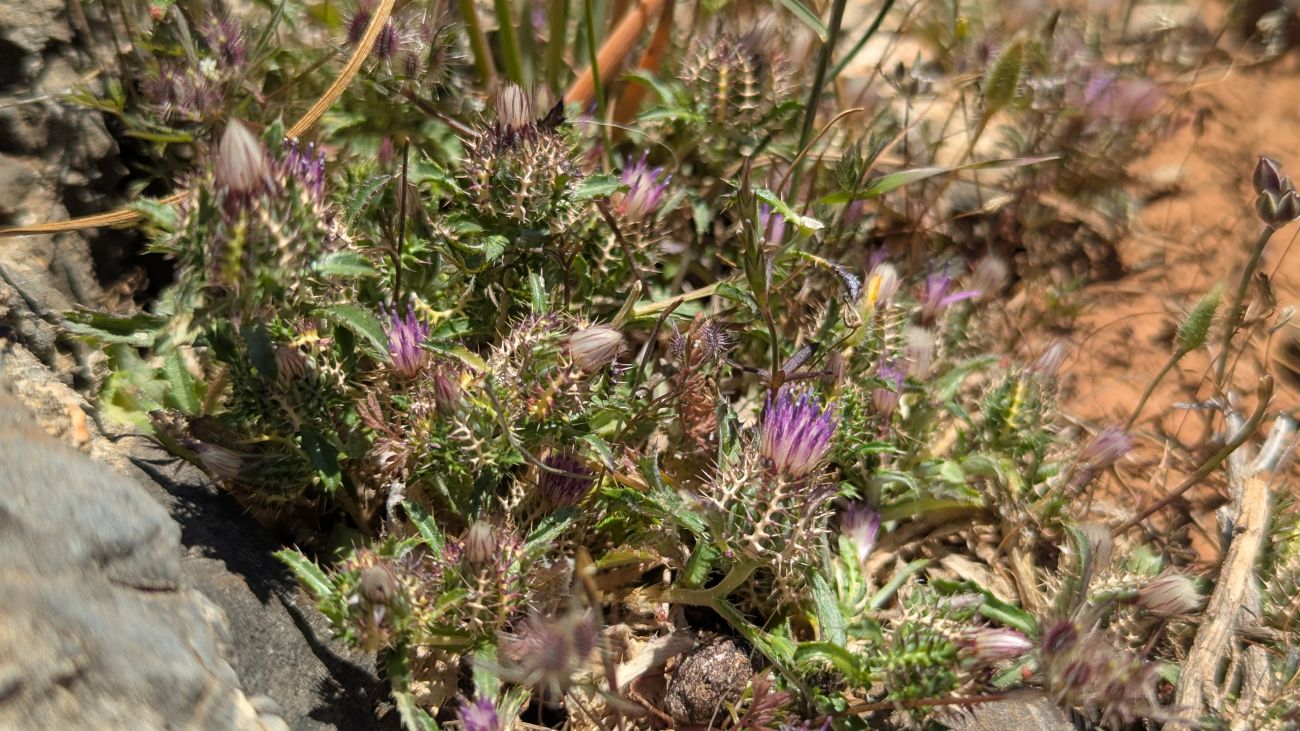
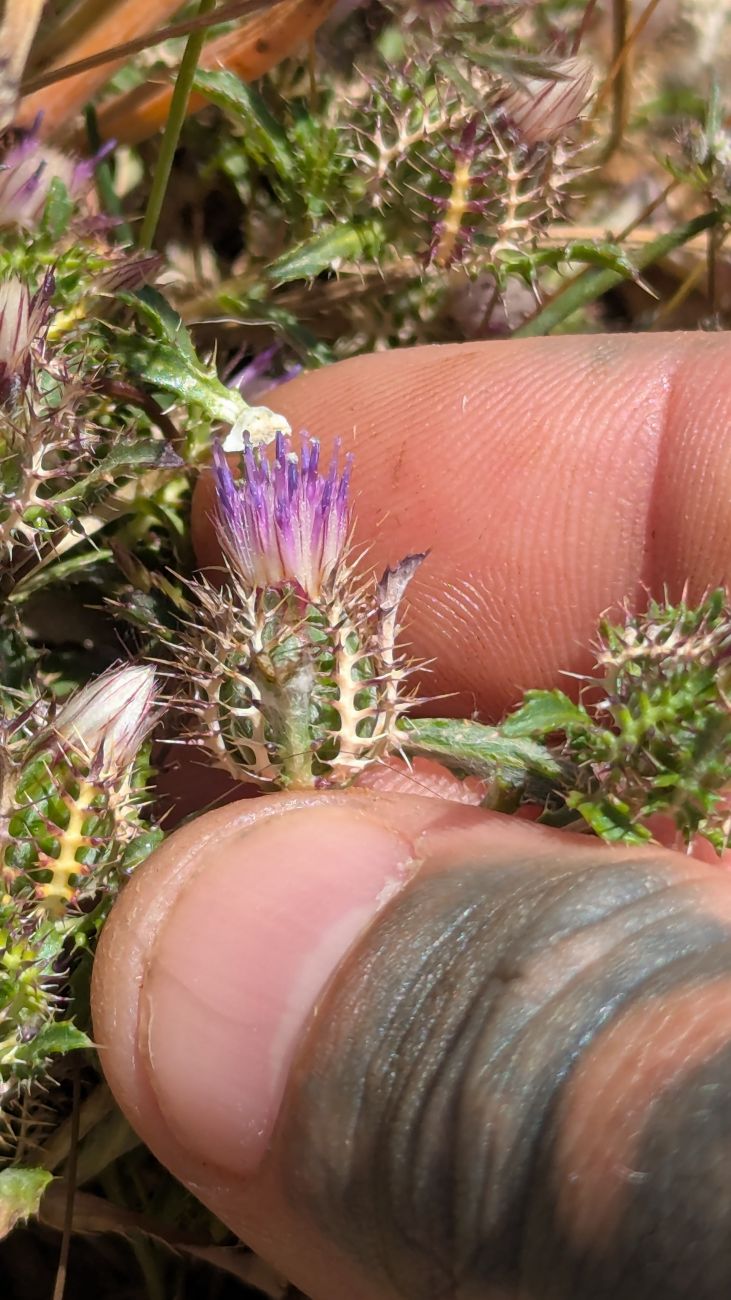
Actractylis cancellata
On the note of the Arabian Peninsula, in this gorge I also spotted the Roman nettle, Urtica pilulifera, a plant I had been familiarised with in the Nabataean ruins of Petra. Part of this trip was to observe differences within the same species seen across different climates, and how their morphology may change. This plant is a great example of that. Both plants were observed in semi-shaded areas: A gorge in south Crete, and a desert gorge in Jordan. The nettle observed in Crete lives in a cooler climate with more rain and lower UV / sunlight, compared to the nettle observed in Jordan, living in a much drier climate with higher UV / sunlight. Admittedly, this is not a scientific study of the morphology of plants. However, comparing both nettles at maturity, it is clear that the Cretan nettle is leggier and of a lighter green colour, whilst the Jordanian nettle is much more compact and of a deeper green colour. Whilst two pictures do not make a study, I have observed enough individual plants in both of these locations to vouch for their differences.
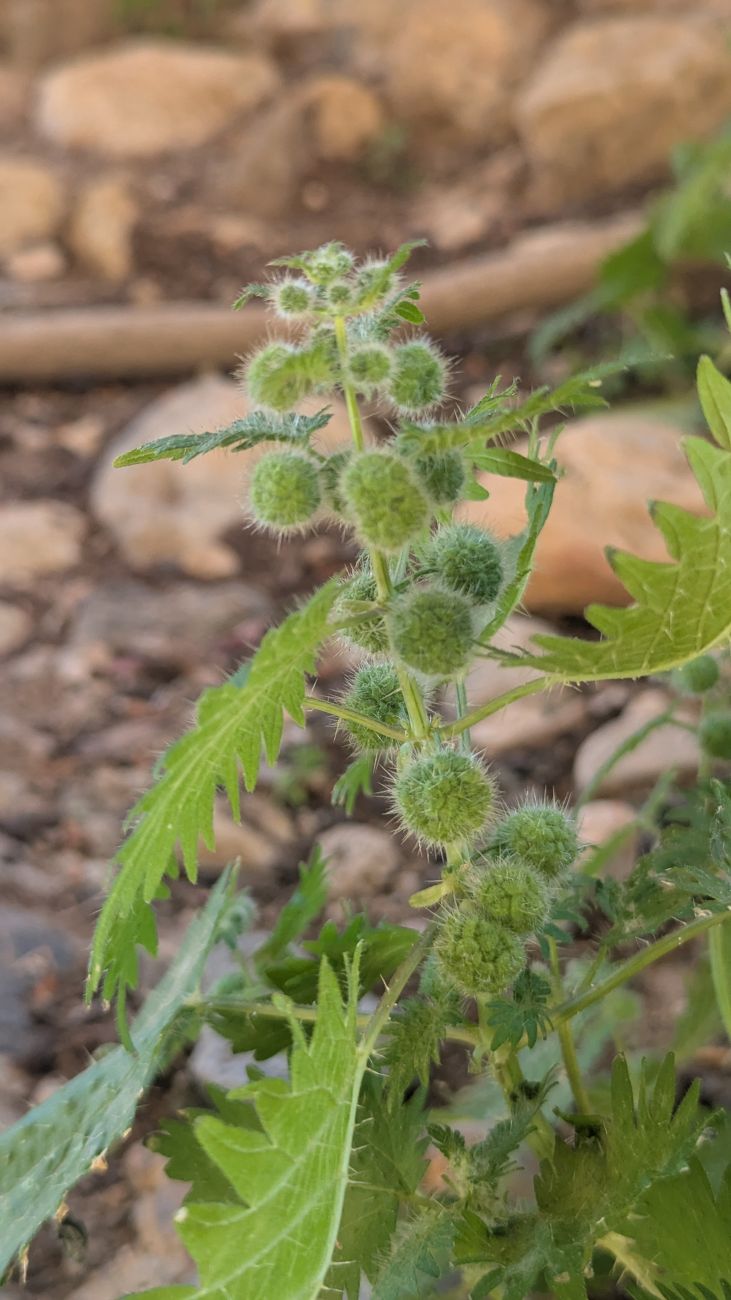
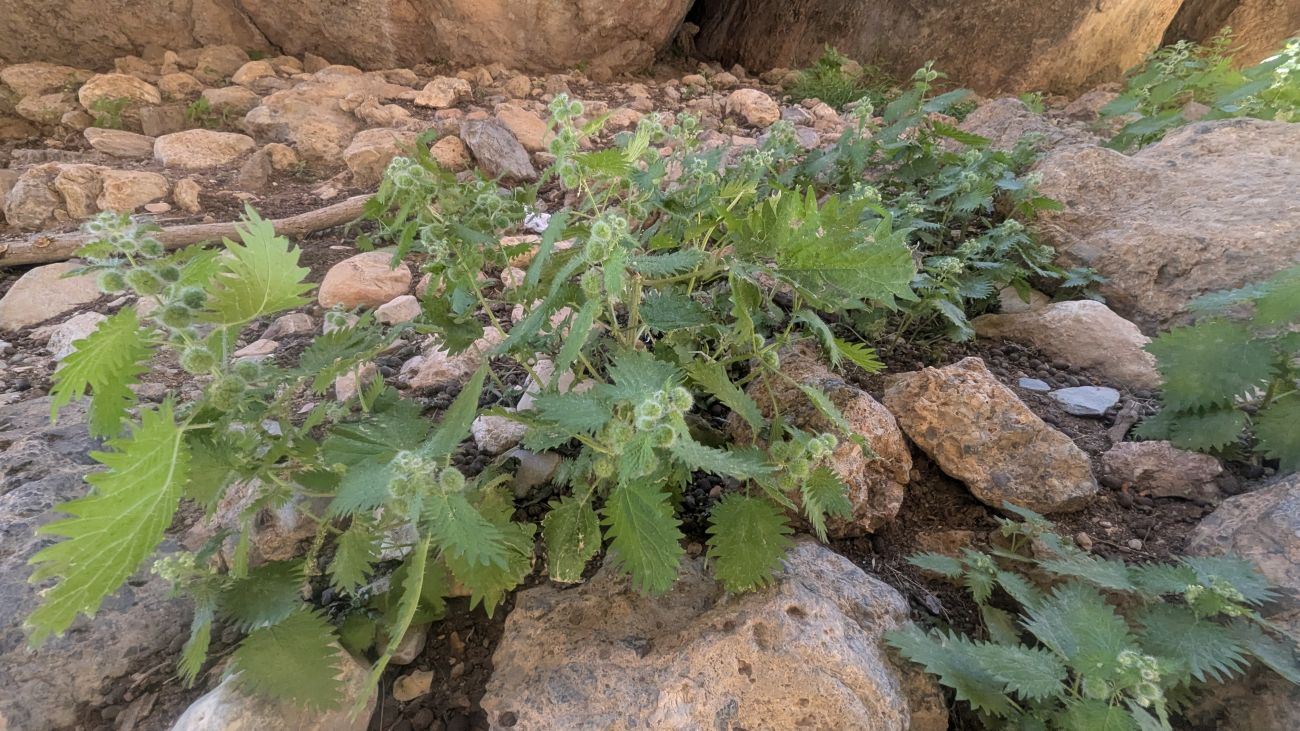
Urtica pilulifera in Sougia Gorge, Crete
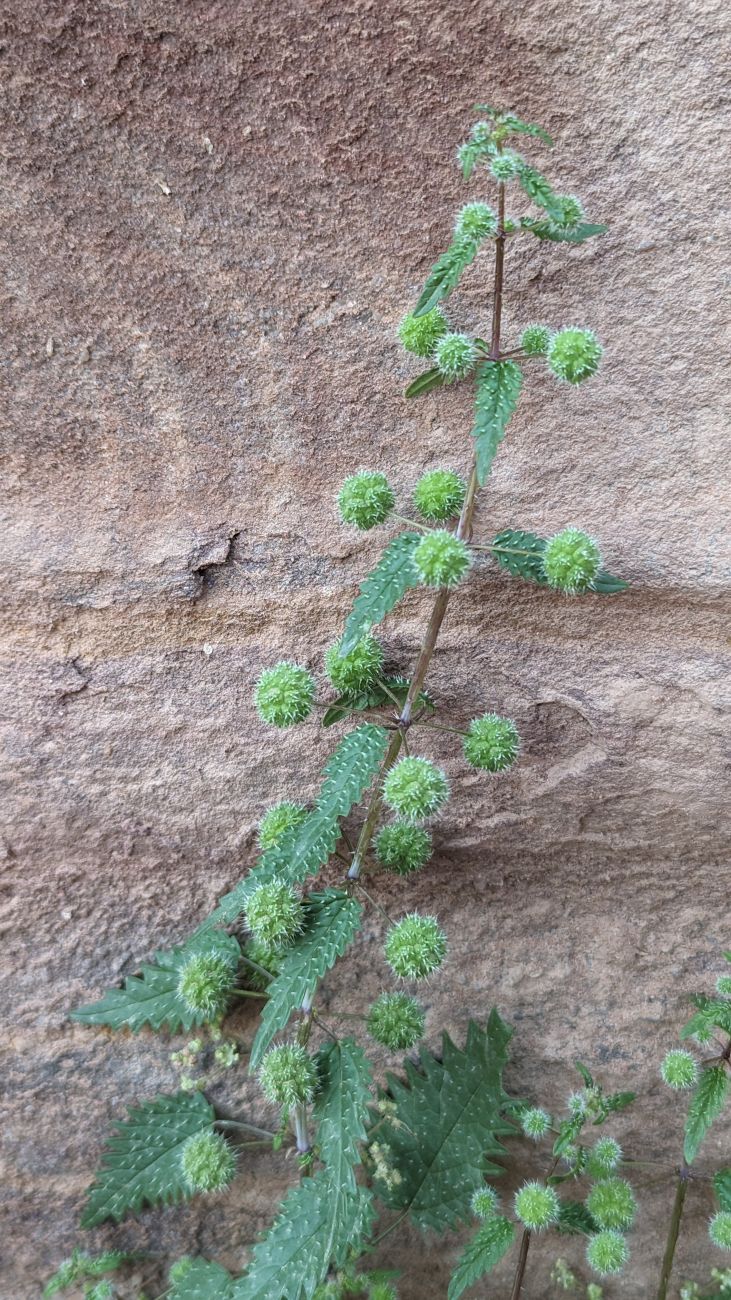
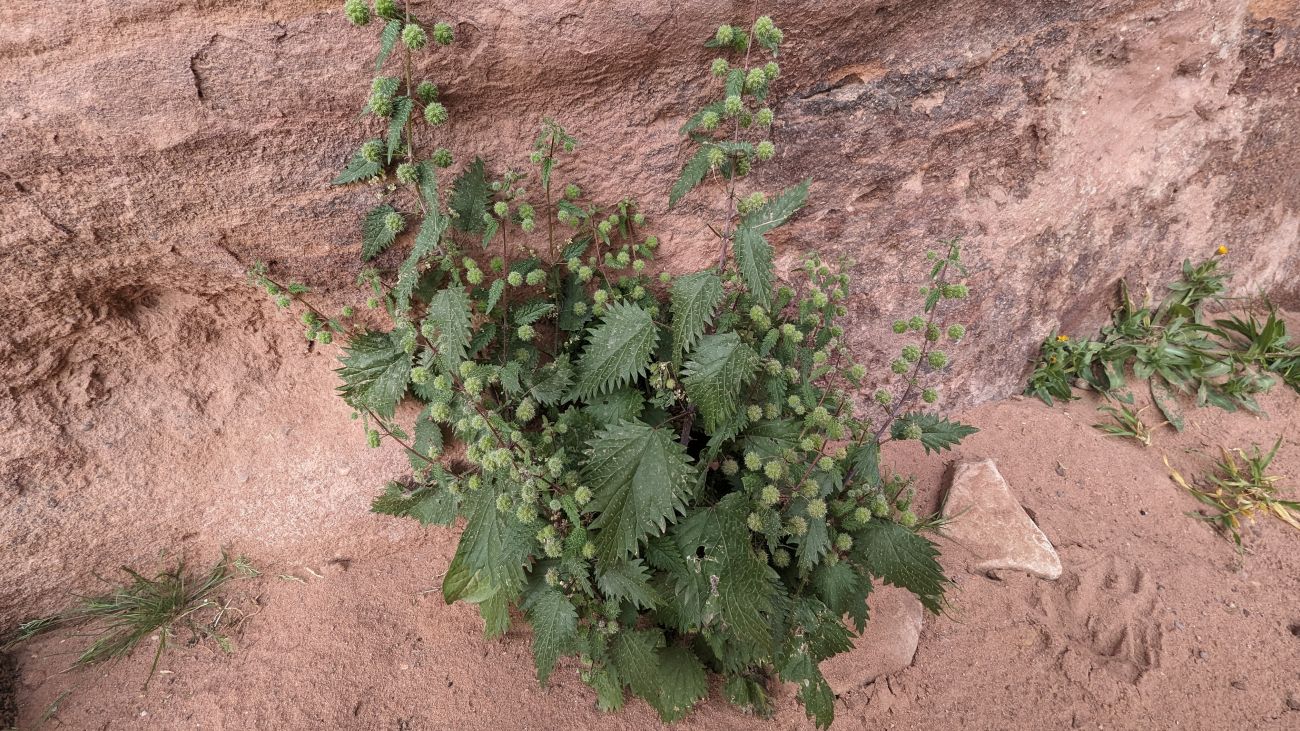
U. pilulifera in Petra, Jordan
I ended the day with a swim in the crystal clear and warm waters of the bay before jumping on a small boat back to Sougia.
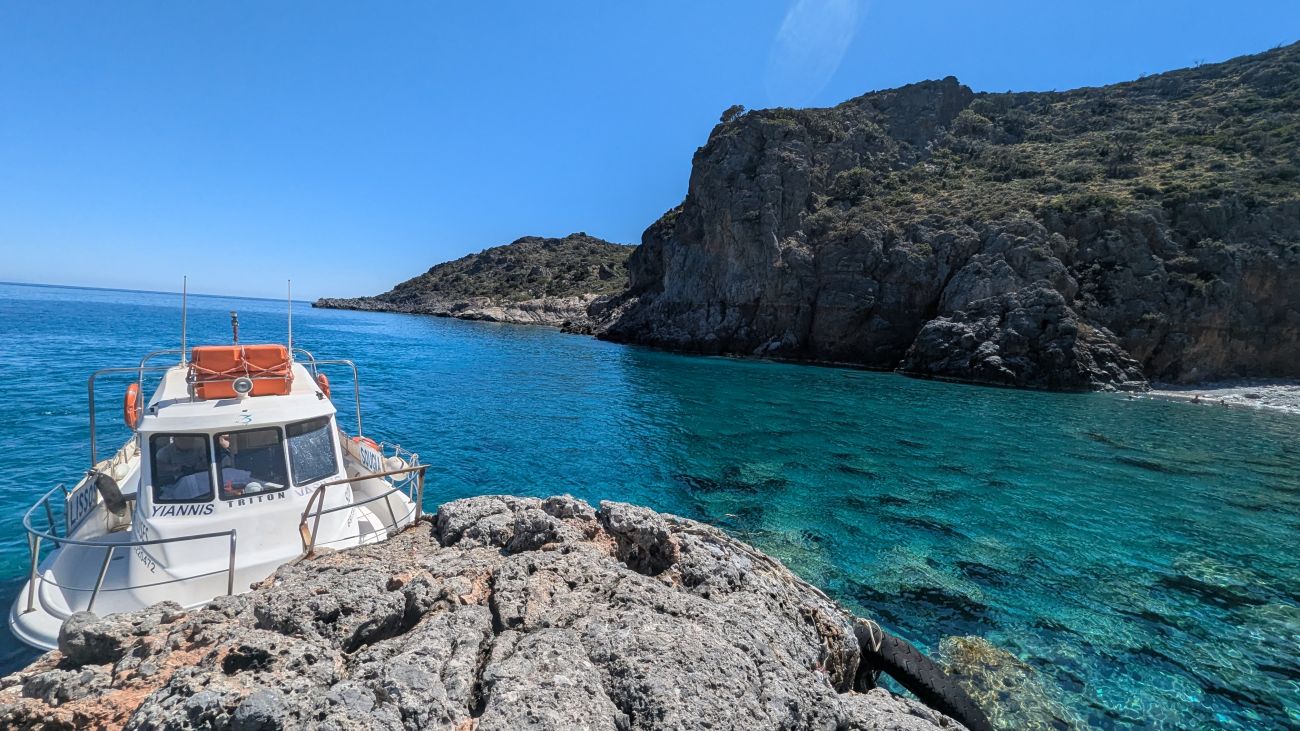
My ride home bobbing on the sea
Elafonisi
Elafonisi is a small coastal village on the very south-west corner of Crete, with small sandy islets reachable by wading through the lagoon. It is home to a rocky maritime habitat, sand dunes on the mainland as well as dune systems on the islets along with phrygana-esque scrubland, and the islets themselves are a protected nature reserve. Whilst mostly known for being a breeding site for loggerhead turtles, it is also home to a thrilling array of plants and interesting landscapes.
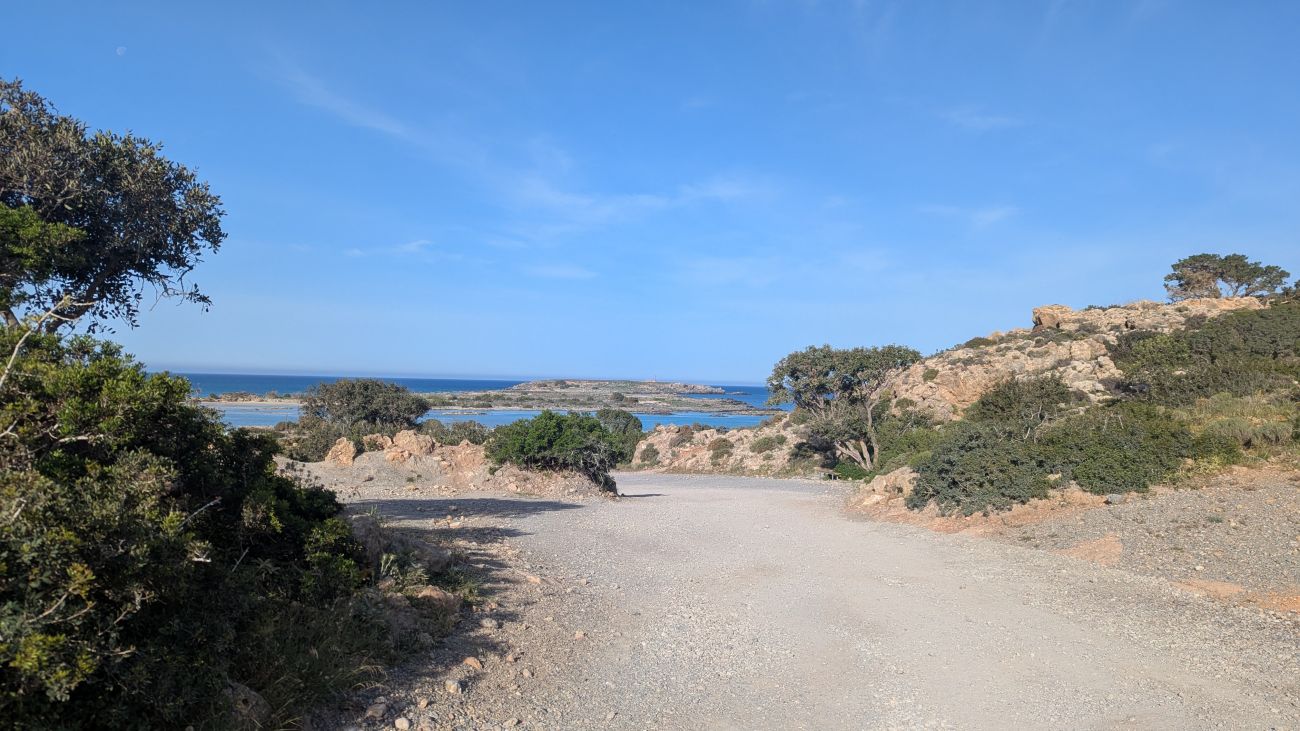
View of Elafonisi islet from the mainland
The route down from the town to the coast can be broken up into two sections: rocky coastal scrub and a small and short dune system. The scrubland had – no surprise – an incredibly well-drained soil, and plants here will be adapted to high wind, salt and UV/sun exposure. The scrub density was dense away from the coast, petering out towards the coast. Towards the mainland the scrub did not have much bare soil at all, with non-vegetated areas being primarily rock, apart from the path and areas of obvious high human footfall leading to viewpoints. Non-exhaustively, shrubs and trees encountered here include Cistus parviflorus, C. creticus, Euphorbia dendroides, Nerium oleander, Olea europaea. Herbs observed here included Pallenis spinosa, Fumana laevis, Centaurium tenuiflorum, Mandragora officinarum, Sedum spp., Onopordum bracteatum and much more.
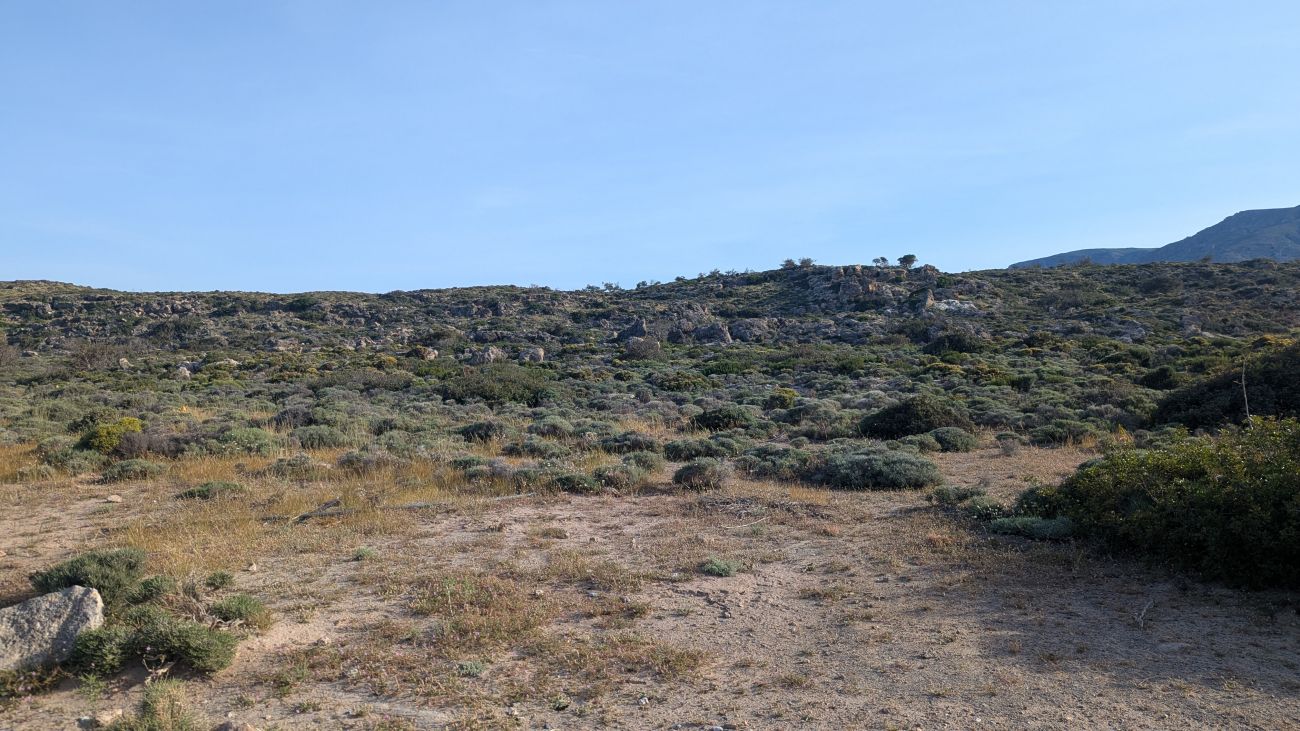
Coastal scrub
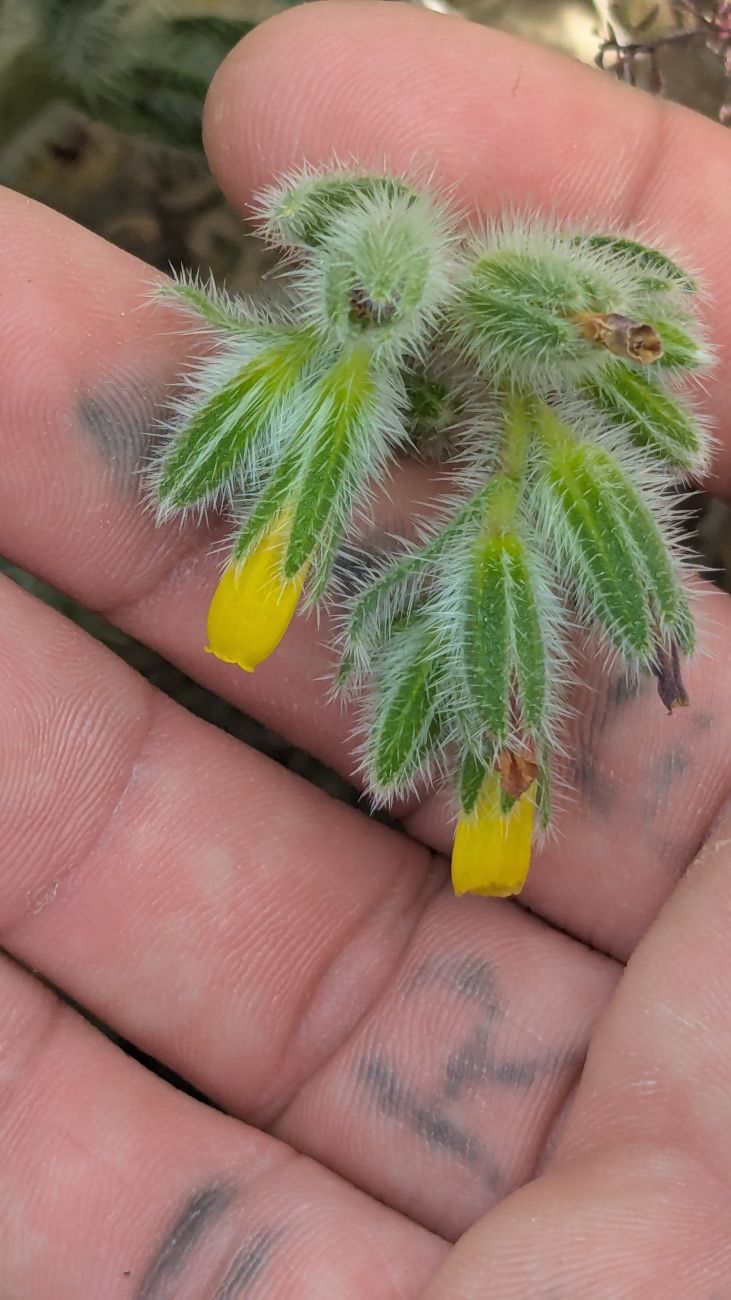

: Onosma graeca
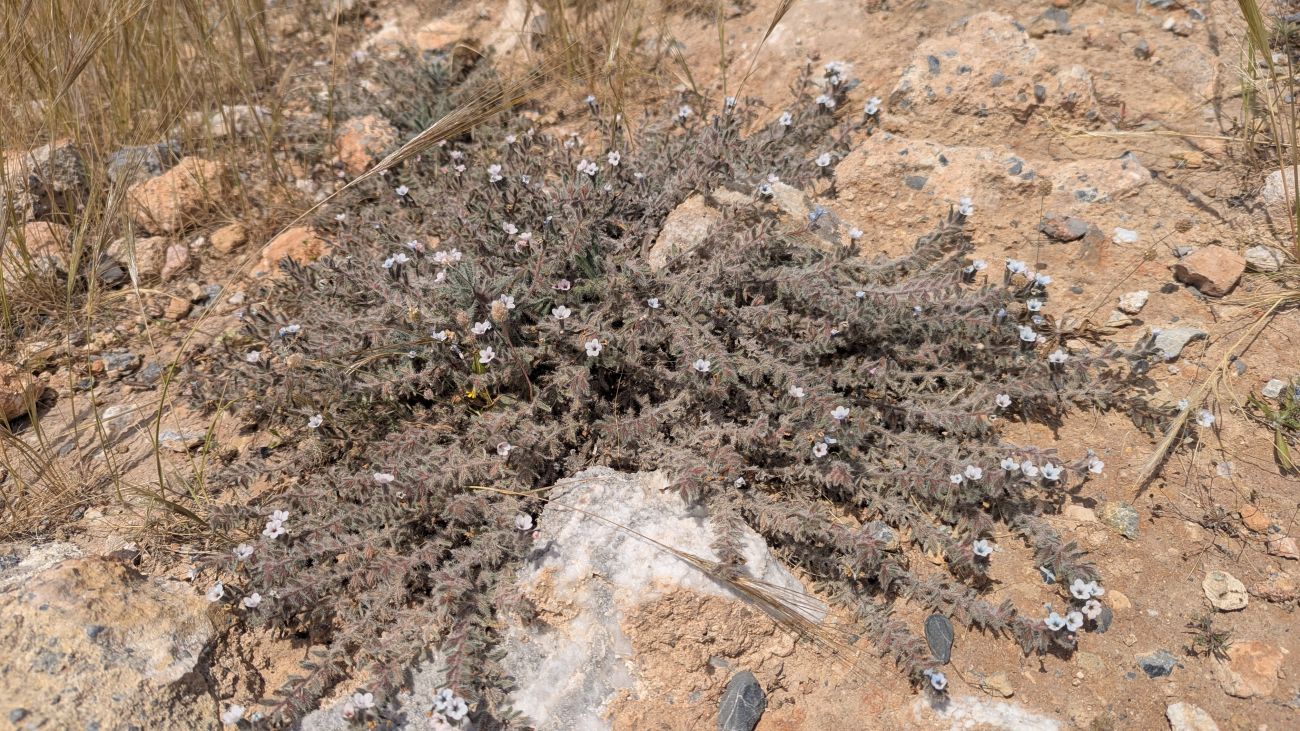
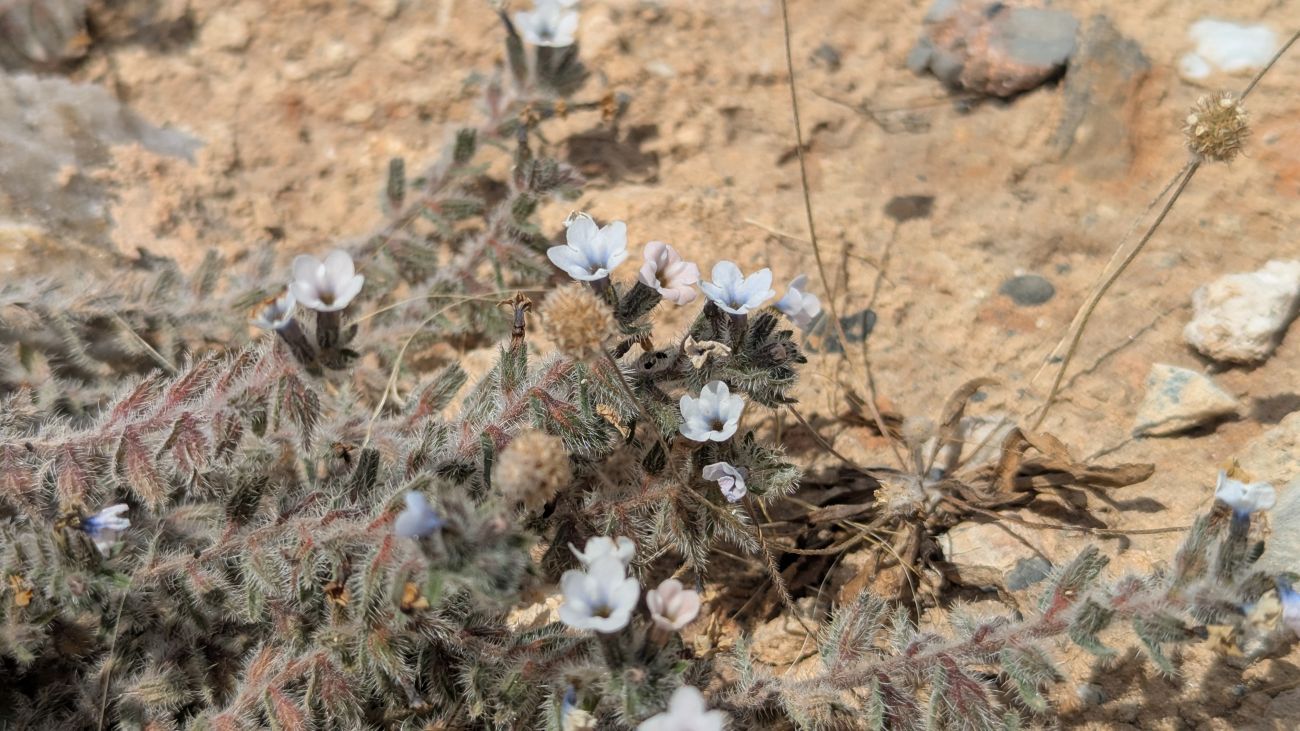
Alkanna sieberi
At the coastline were aforementioned small dune systems. Whilst these dunes had nothing on some of the dune systems we have back in the UK in terms of area and height, the vegetation pattern remained similar, just with different taxa. One major difference I noticed between these micro-dunes here and those I have visited in the UK, were the shrubs and small trees dotted around the dunes, with some (Juniperus macrocarpa) reaching over 1.5m in height. It could simply be, that the “squashed” habit of these dunes made these shrubs / trees stand out more amongst the low-growing predominantly herbaceous community. Elafonisi is a very touristic destination, so I did not spend too much time at the mainland dunes. I wanted to get a headstart on the islets before people started making their way there.
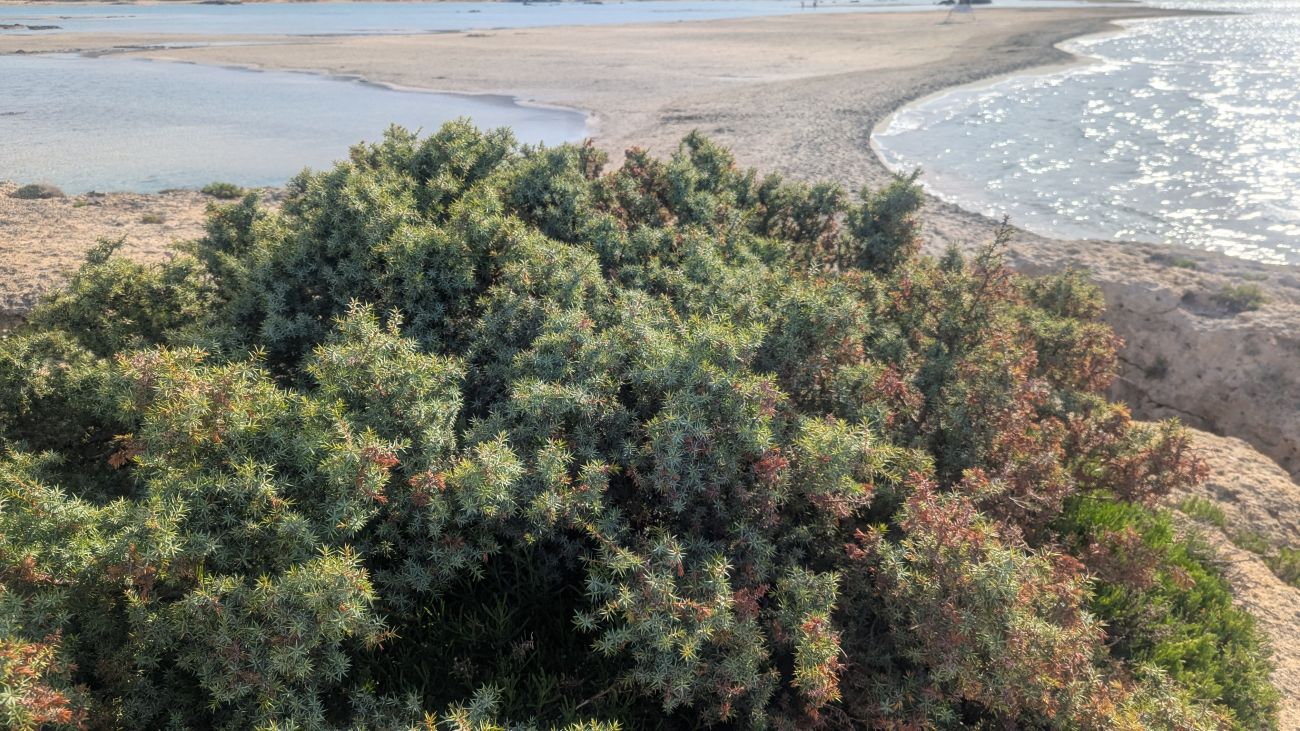
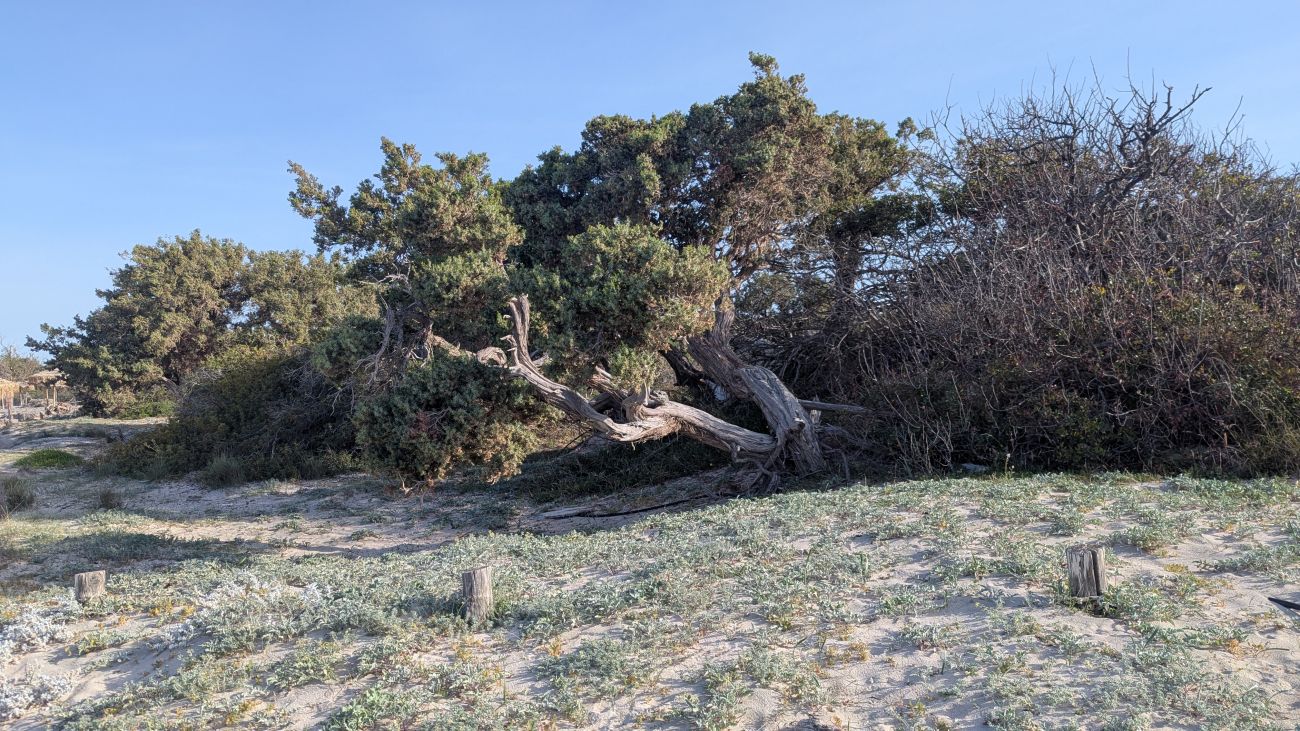
Juniperus on the dunes both on mainland (left) and Elafonisi islet (right)
The lagoon water toward the islets was only deep up to my (short) thighs, so it was no bother wading through to beat the crowds. From one end of the main islet to the other I saw less than five people, population density hinders botanising and having an islet essentially to yourself is bliss. On the walk back the islet was busier, the mainland beach packed, lined with sun chairs. I imagine this affects the flora of the dunes on the mainland, but it is a beautiful beach, and if people can’t also enjoy it with their friends and families, what’s the point, really?
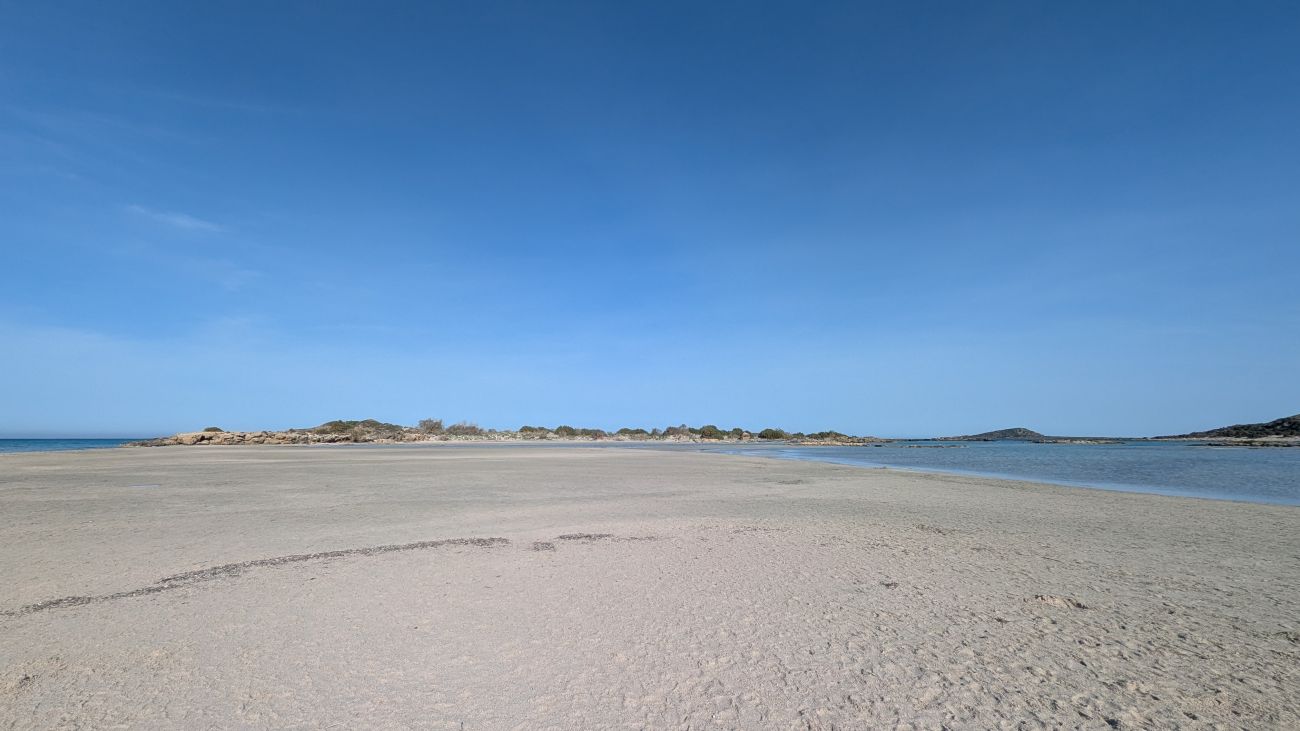
A mostly empty-of-people Elafonisi
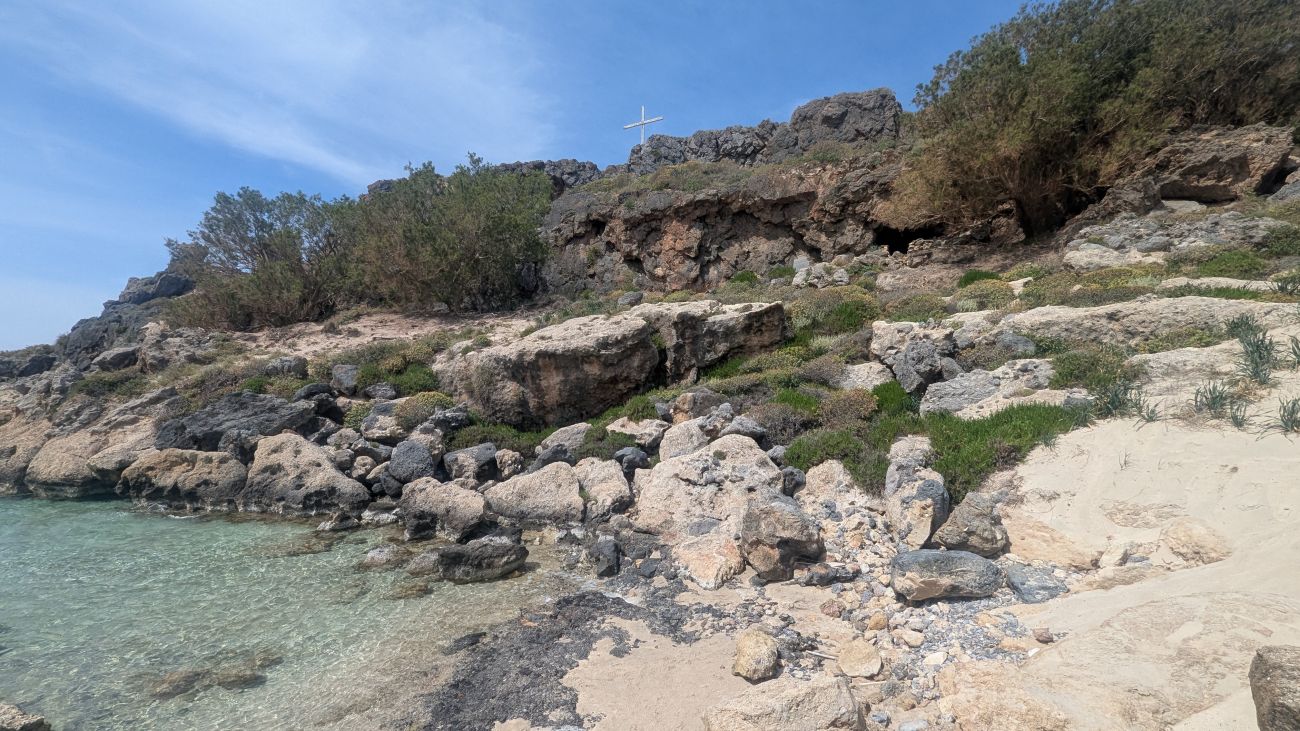
On to the plants. The “start” or east coast of the islet are rock faces / outcrops of limestone which, whilst steep at the edges, and jaggy throughout, feature enough relatively flat ground to walk on or hop between. Crevices and overhangs made for an area rich in topography and thus many varying levels of sun exposure or shade and wind exposure or shelter. This, combined with a predominantly sandy soil, made for some interesting plants. Here were echoes of UK maritime climate genera, such as Cakile, Euphorbia, Silene, Salicornia, Orobanche, Limonium, Erodium, Malcolmia. Plants of interest here include: Crododilium pumilio, Orobanche sanguinea, Capparis orientalis, Silene sedoides, Pancratium maritimum and Daucus pumilus.

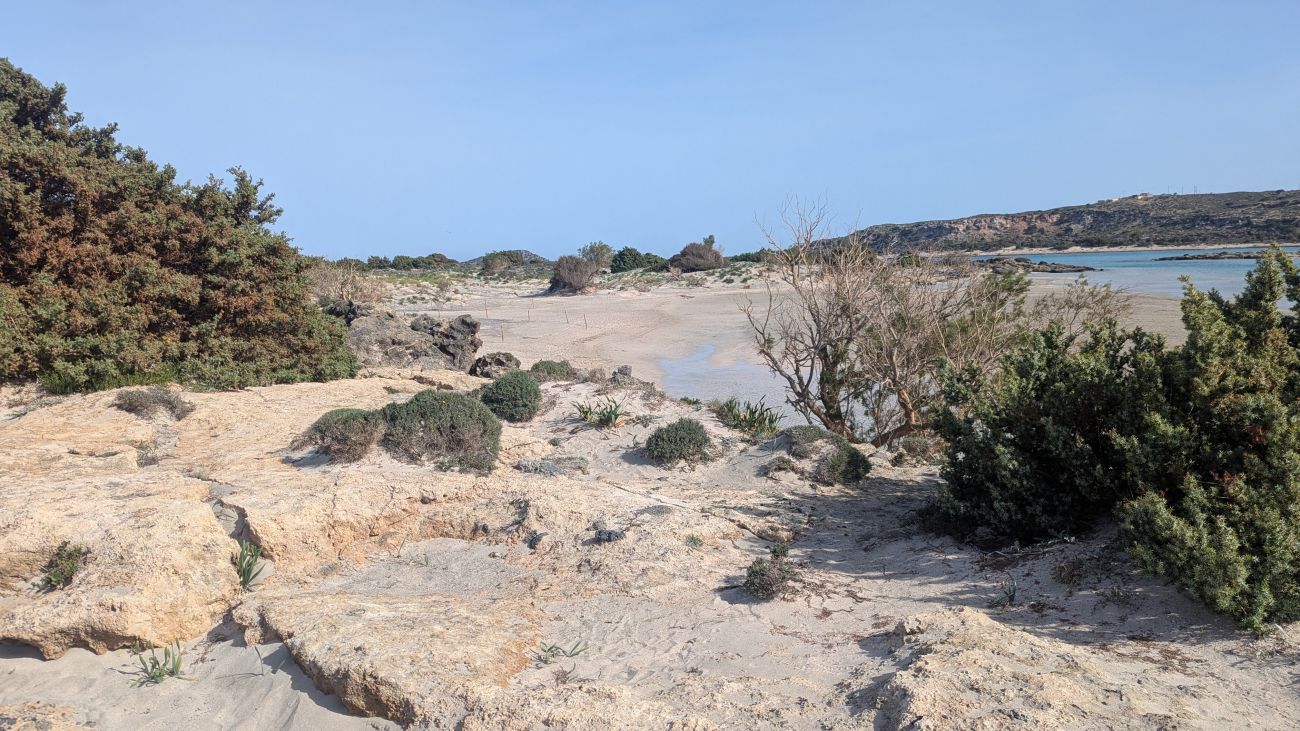
Habitat of the east-side of the islet

Crocodilium pumilio
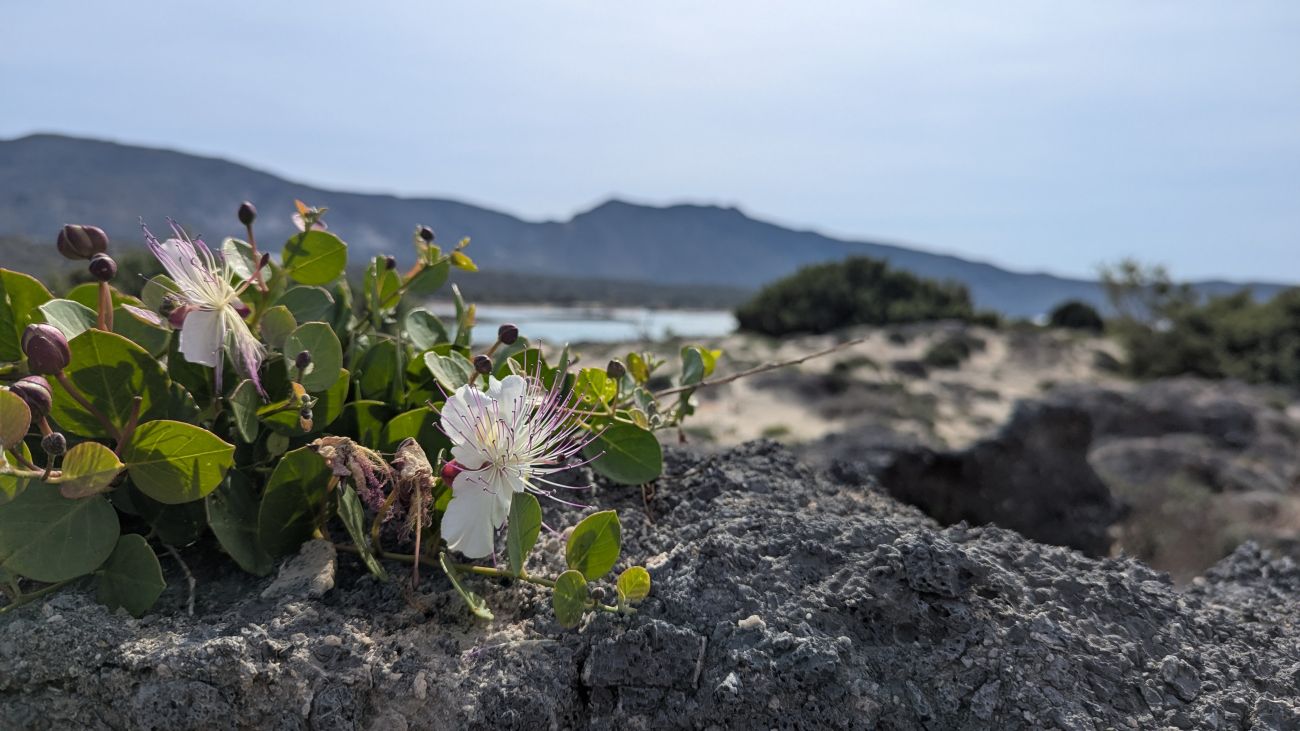
Capparis orientalis
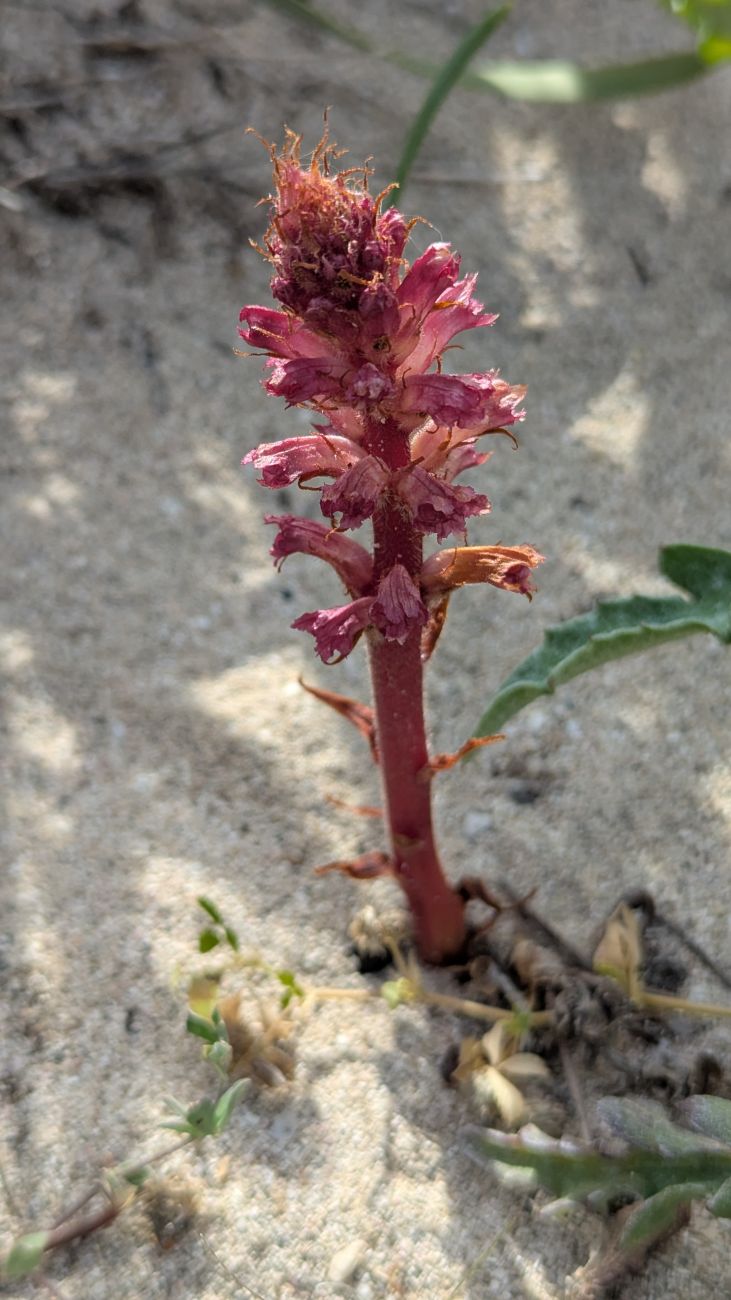
Orobanche sanguinea
In between the eastern outcrops and the next area laid a long and mildly undulating stretch of sand and sparse but predominantly herbaceous flora. This was windswept and interesting. Some of the flora here being Crithmum maritimum, Eryngium maritimum (a personal favourite maritime plant of mine – how can you not love its rugged and spiny form combined with the pastel colour pallete?), and Medicago marina. The plant of the day, however, was Achillea maritima. This perennial Asteraceae bearing tomentose, silver-sage coloured leaves in a whorled arrangement, from a distance tricked me into thinking I was looking at a Euphorbia. The new growth of this plant is much more densely pubescent, acting as protection from the harsh sun of the coast, but also acting as a buffer between the environment and the stomata of the leaves. Could this stop sand from clogging up stomata whilst also providing a “breathable” space for the leaves?
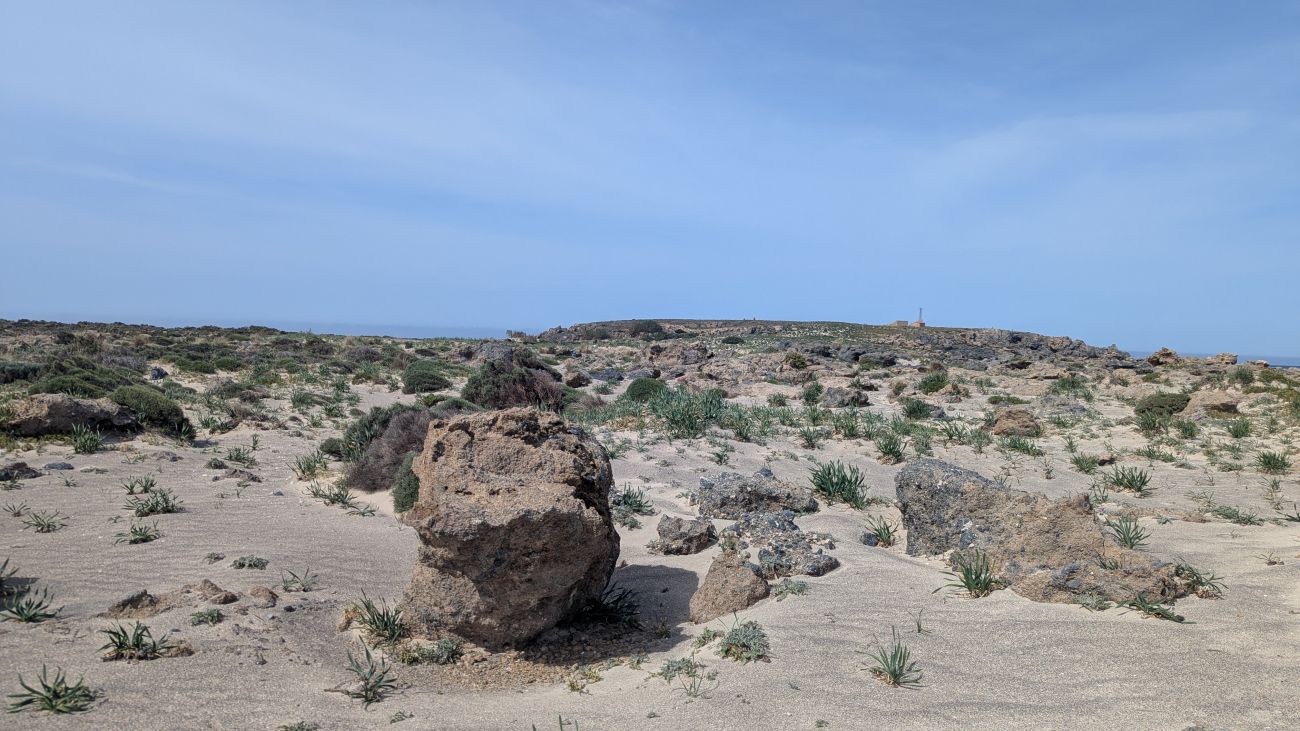
Habitat facing west
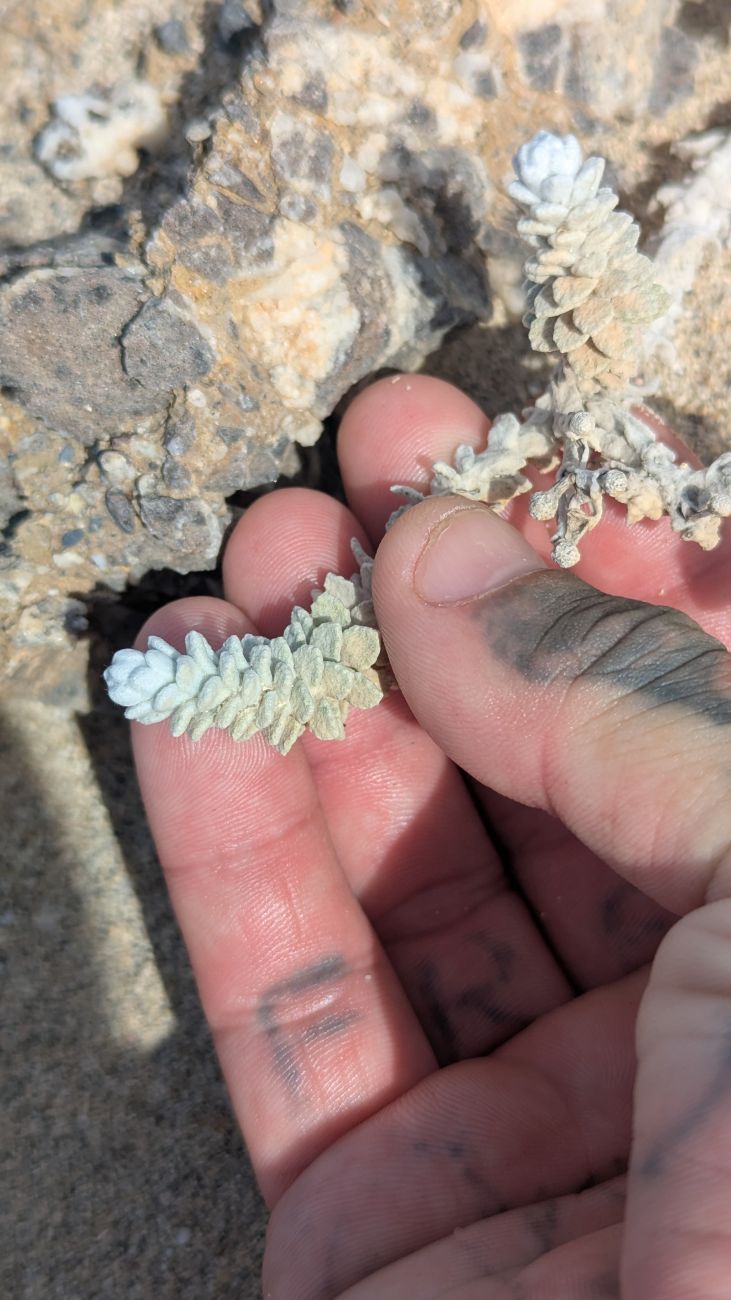
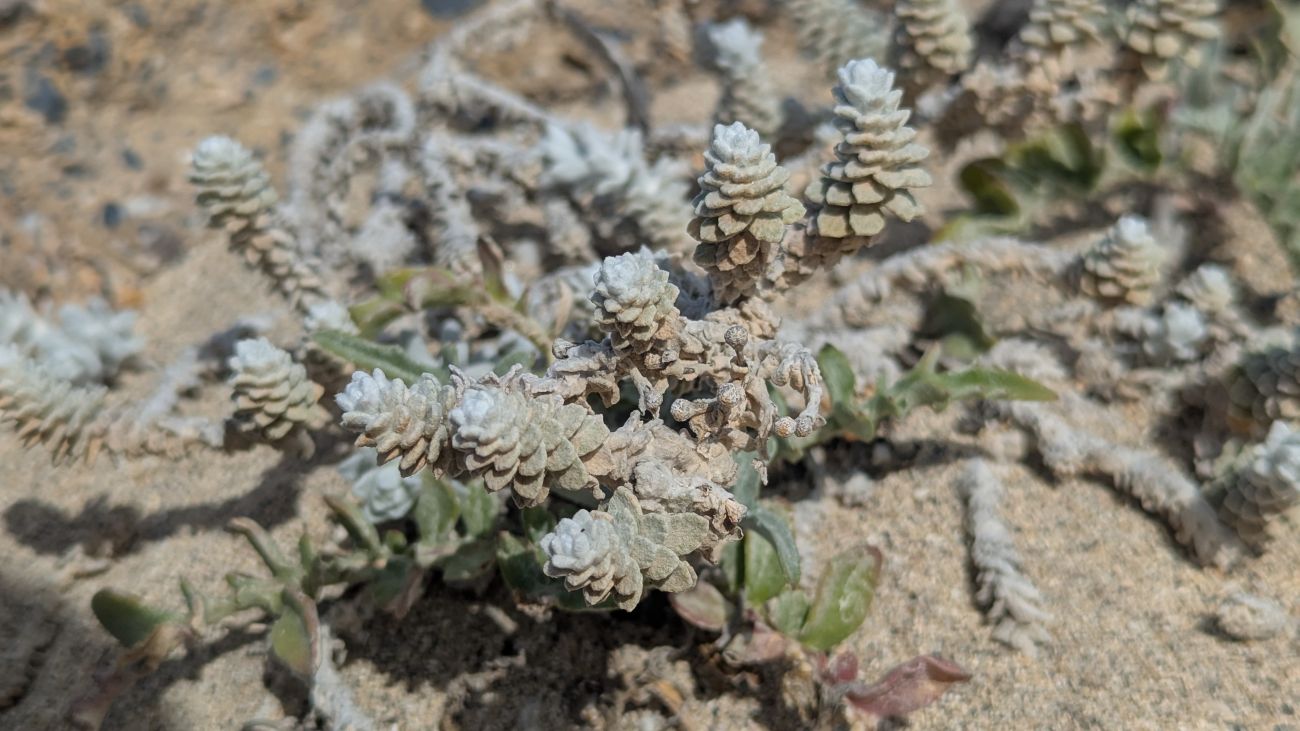
Achillea maritima
Towards the western end of the islet was some phrygana, but with a different vegetative makeup than previously seen this day. Again, soil here was mostly sand – so incredibly well-drained. Vegetation density here was high, apart from some foot tracks around a lighthouse, rocks, and the occasional opening (even those were populated with minute herbs). The scenery was like something of a painting, especially with the lighthouse as a focal point. Predominant flora here were Euphorbia dendroides, Pancratium maritimum, Drimia numidica, Ruta chalepensis, Capparis orientalis and Capparis orientalis, with Orobanche sanguinea, Silene succulenta, Linum strictum, and other smaller herbaceous flora peppered between them. The form of the plants here was very consistent, with even the herbaceous flora taking on a low-growing domed habit with age.
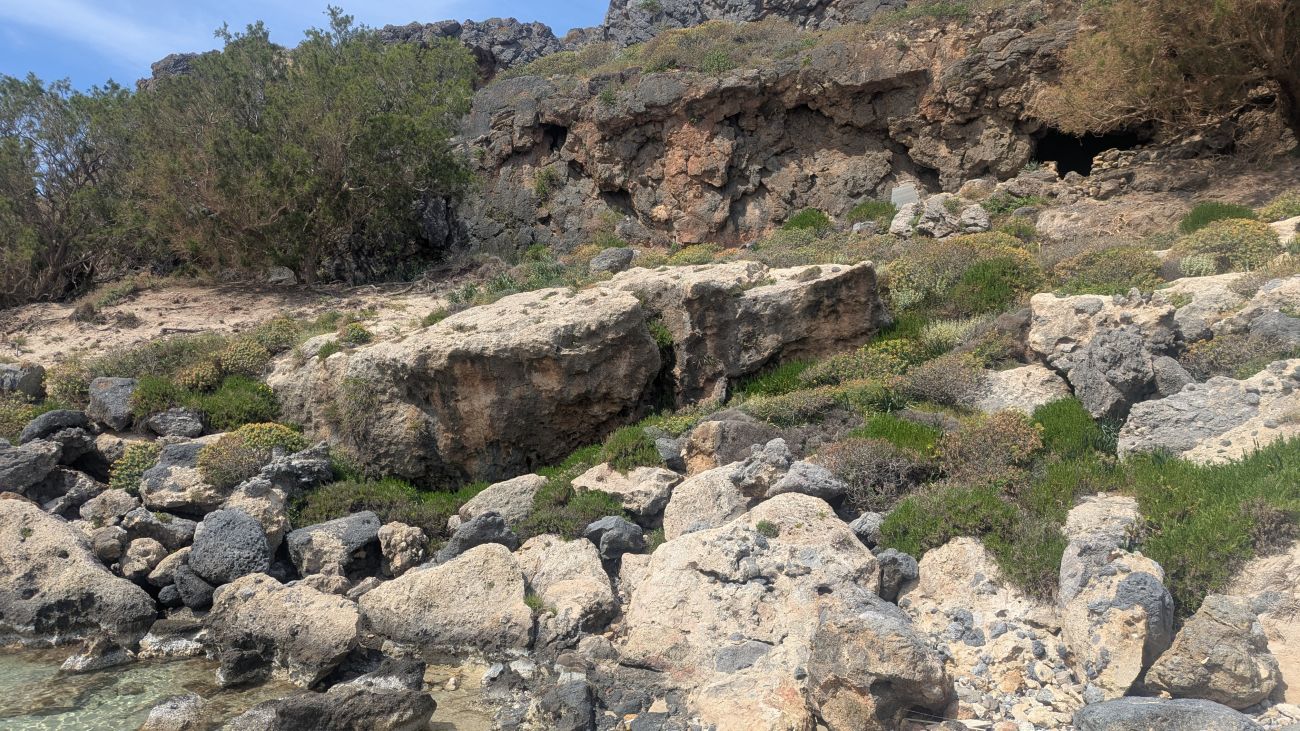
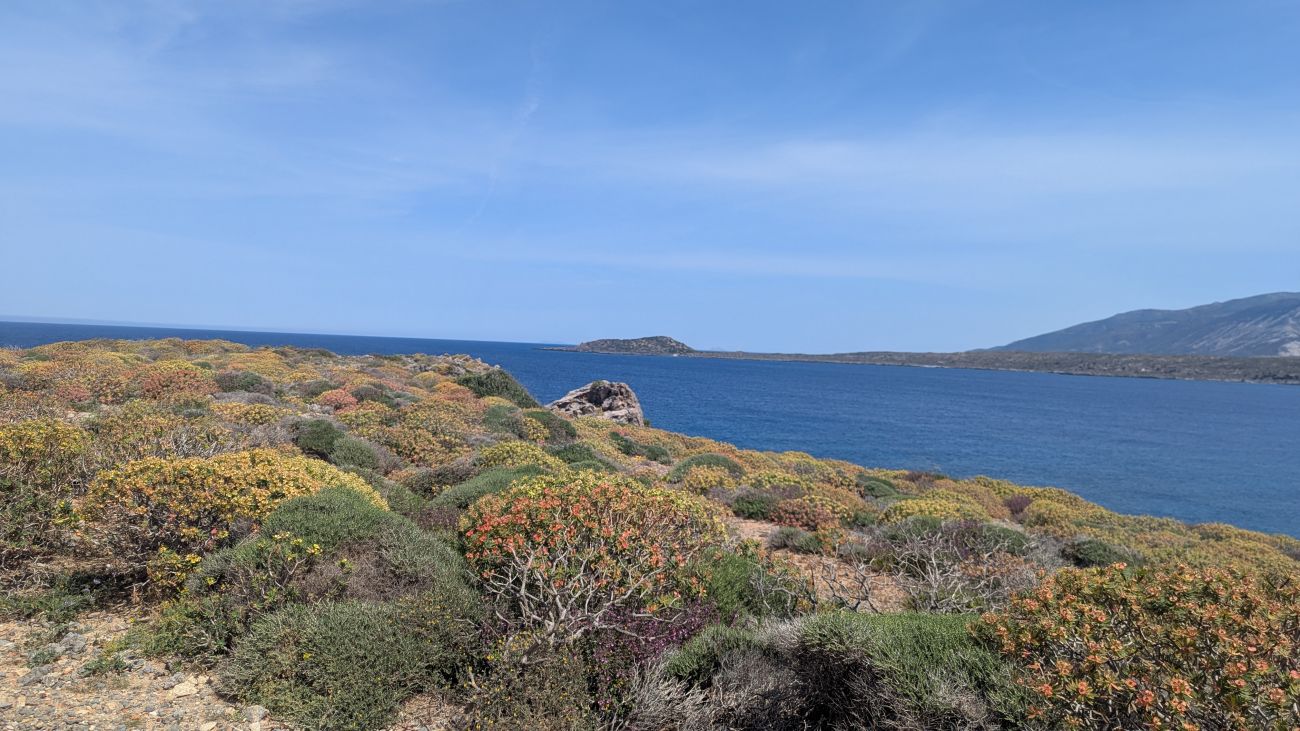
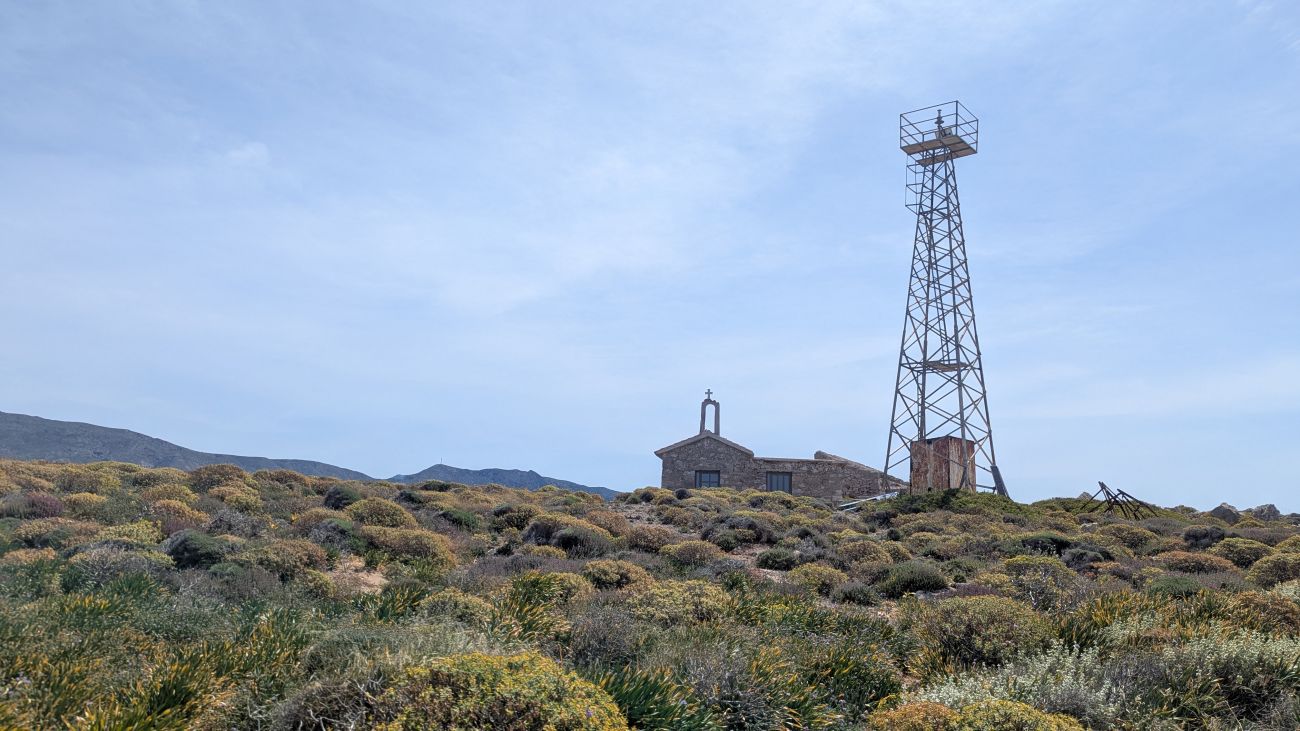
: Small cliff habitat and scrub/phrygana on the western side of the islet

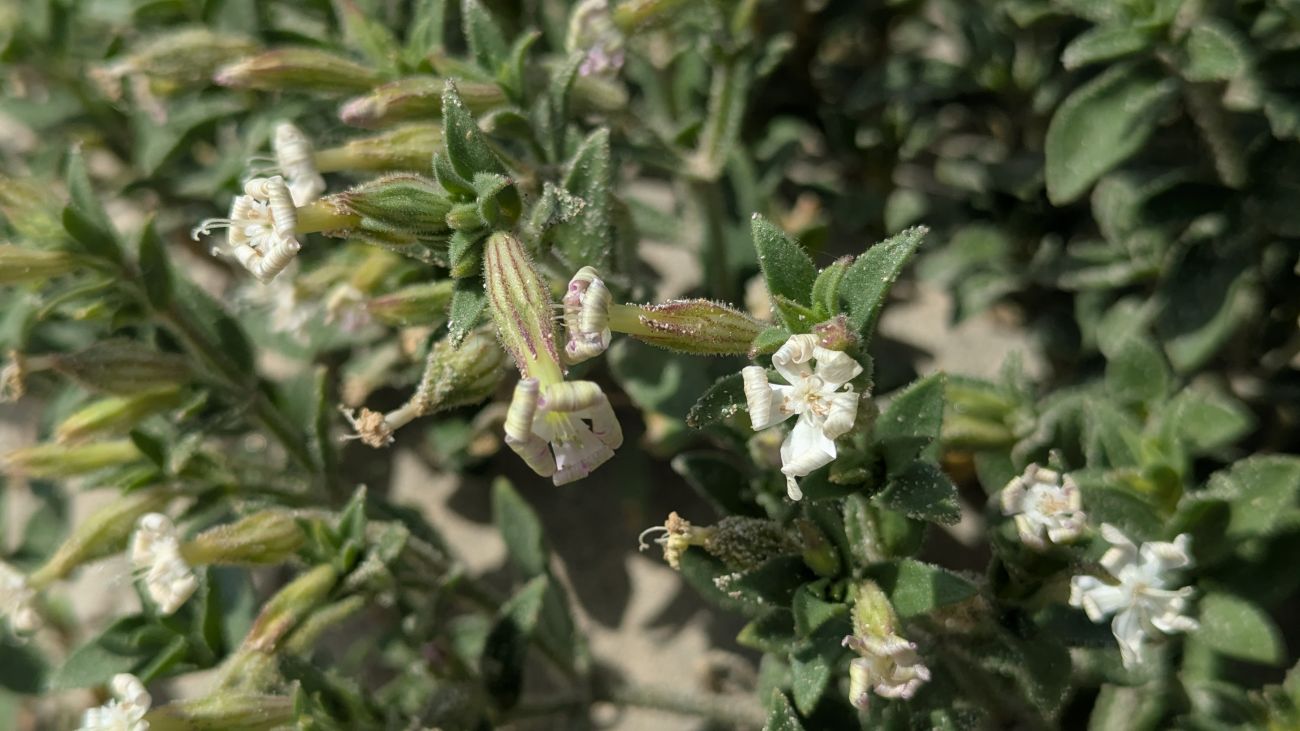
Silene succulenta

Salicornia perennis
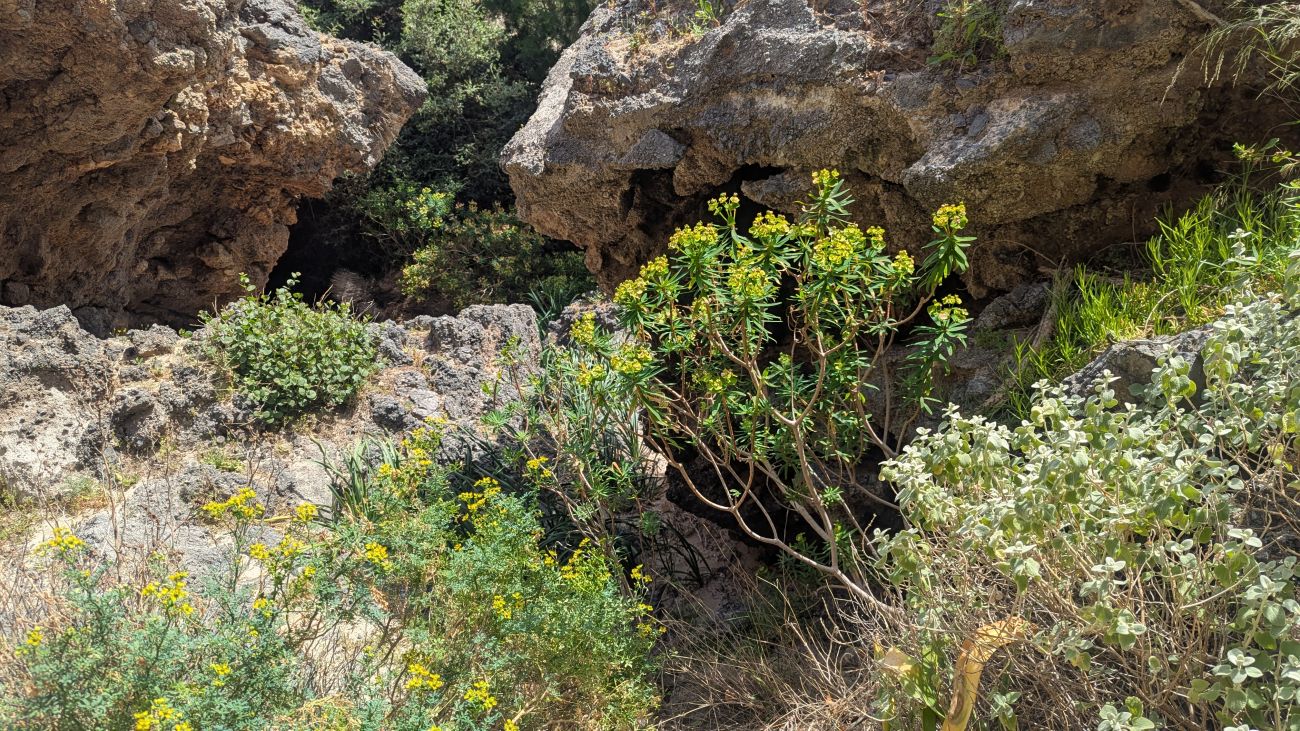
Euphorbia dendroides grew more arborescent in the cliffs, whilst dome-shaped on the scrub in pictures above right
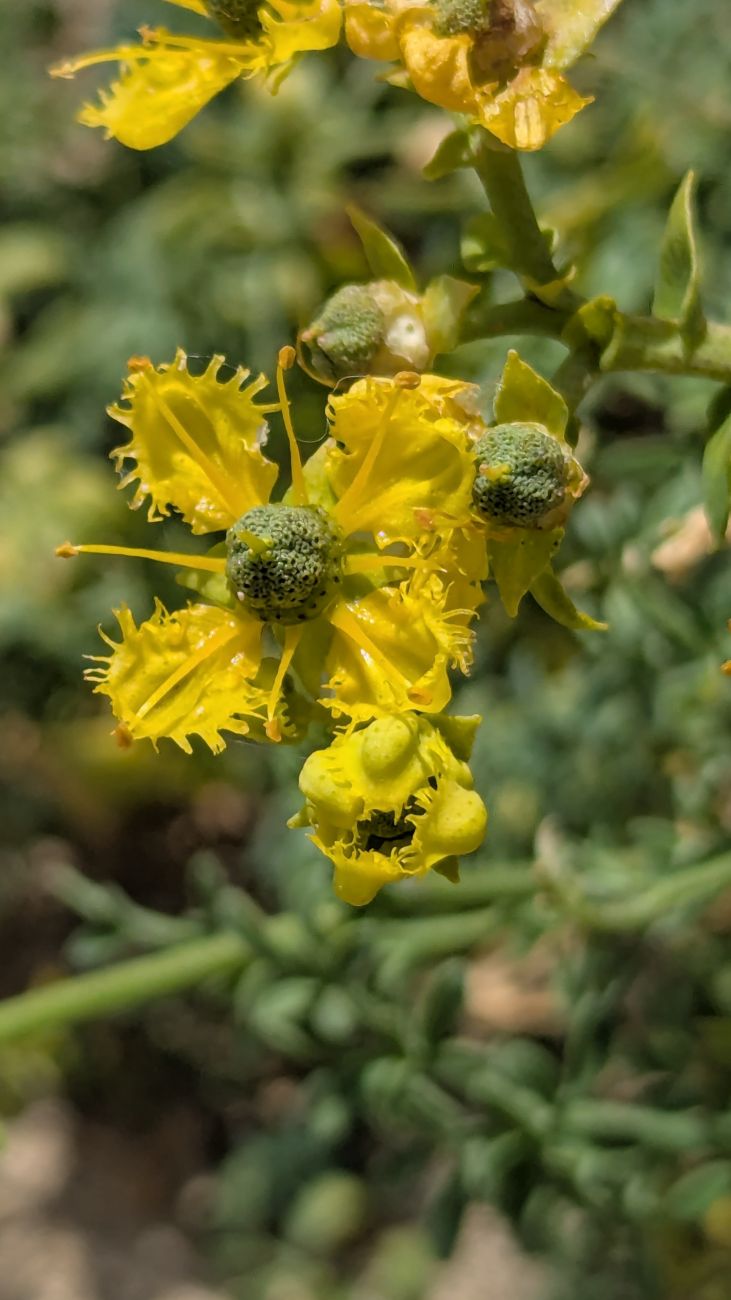
The mesmerising flower of Ruta chalepensis
Preveli
Located on the southern-central coast, Preveli gorge opens up towards the glistening clear waters of the Libyan Sea. A desire to visit more than one gorge combined with the palm Pheonix theophrasti being present at this site meant Preveli was a non-negotiable stop.
The gorge is primarily composed of grey limestone, with steep gorge cliffs rising vertical-to-overhanging, providing shelter from the blistering sun, the entrenched river running through the gorge cooling the area further. The ground here was varied and unique in more exposed parts: very rocky and sandy – but with a decent amount of organic matter, including the old, dehisced palm appendages. In the shadier areas of the gorge, where tree cover was greater, the soil was still rocky, but much more organic and some parts almost spongy, housing mosses, lichens and lycophytes. Preveli is a relatively busy tourist site due to its beach with the backdrop of palms. I noticed a couple of workers collecting dehisced palm bits from the ground and taking them away. I wonder how different the soil would be if these were left alone to decompose, but of course with that action, the gorge would become less accessible. I attempted to ask the workers what they do with the pieces but lacking any Greek language skills, and them not being interested in answering after using translation audio/text, I gave up on the interaction.

The mouth of Preveli Gorge in late morning as us tourists begin to arrive

Walking into the Gorge – palms provide light shade before the cliff faces provide more

As far as I could reach up this gorge, for reasons obvious
The observed tree and shrub community here consists of, but is not limited to, the aforementioned Phoenix theophrasti, Euphorbia dendroides, Pistacia lentiscus, Platanus orientalis, Nerium oleander, Calicotome villosa, and Sarcopoterium spinosum. Observed herbaceous flora and lower plants included Muscari spreitzenhoferi, Verbascum macrurum, V. Arcturus, Cynara cornigera Dracunculus vulgaris, Phlomis fruticosa, Sidiritis romana, Selaginella denticulata, Euphorbia characias, Asphodeline lutea, and Securigera cretica. The striking scene of Dracunculus vulgaris growing beneath the shade of Phoenix theophrasti was something to behold. Posidonia oceanica, the seagrass, is present in the seabed based on the washed up rhizomes found on the beach.
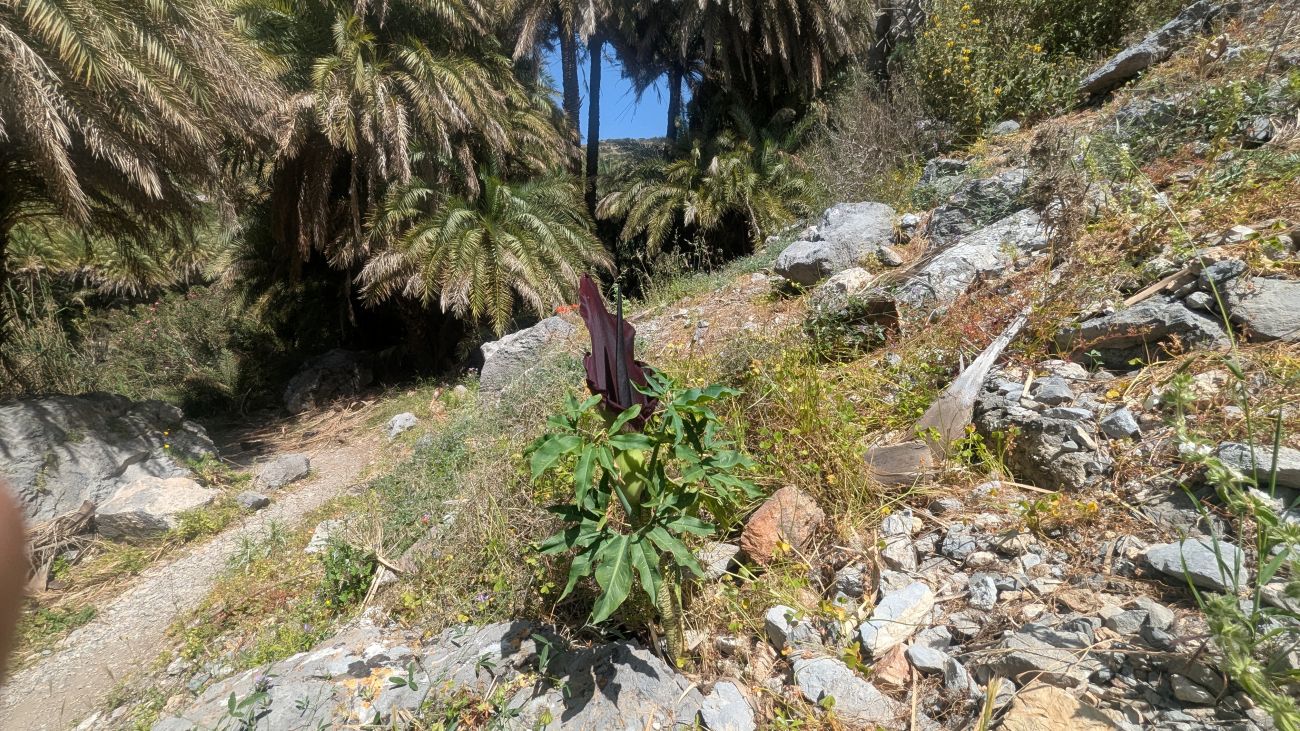
Dracunculus vulgaris beneath Phoenix theophrasti
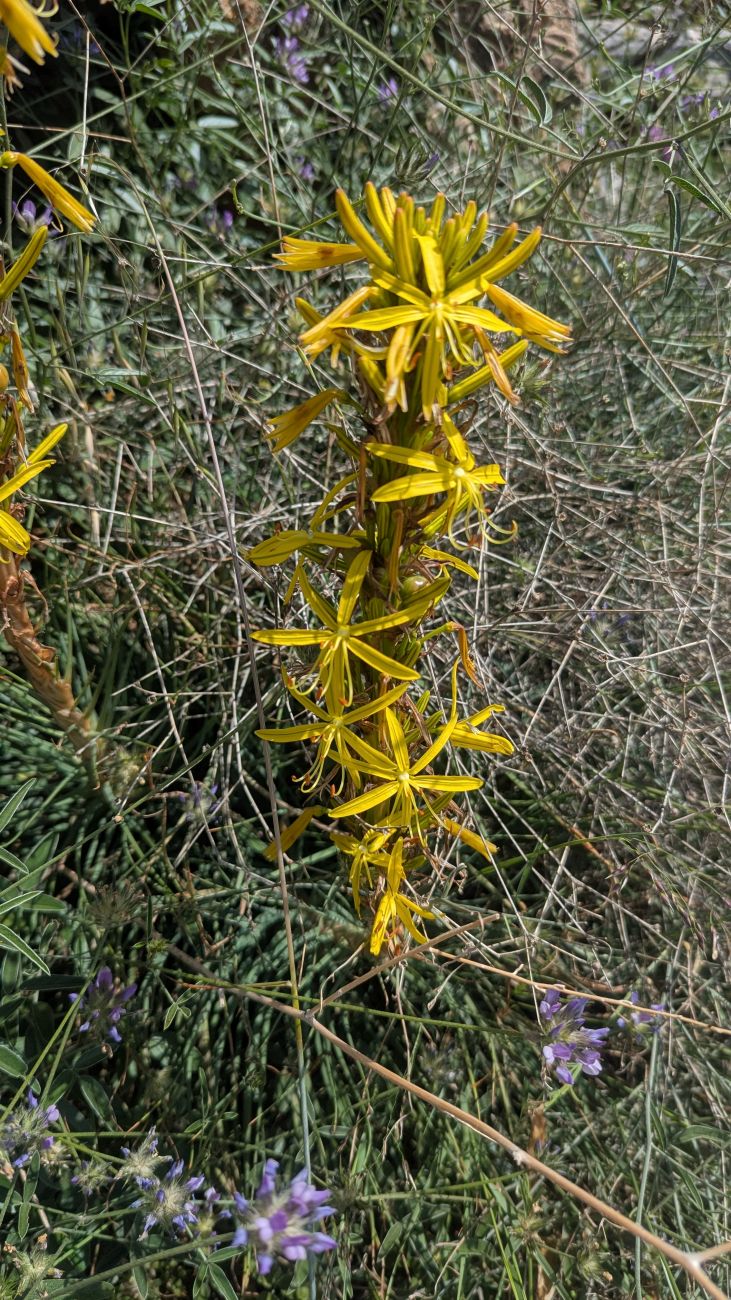
Asphodeline lutea
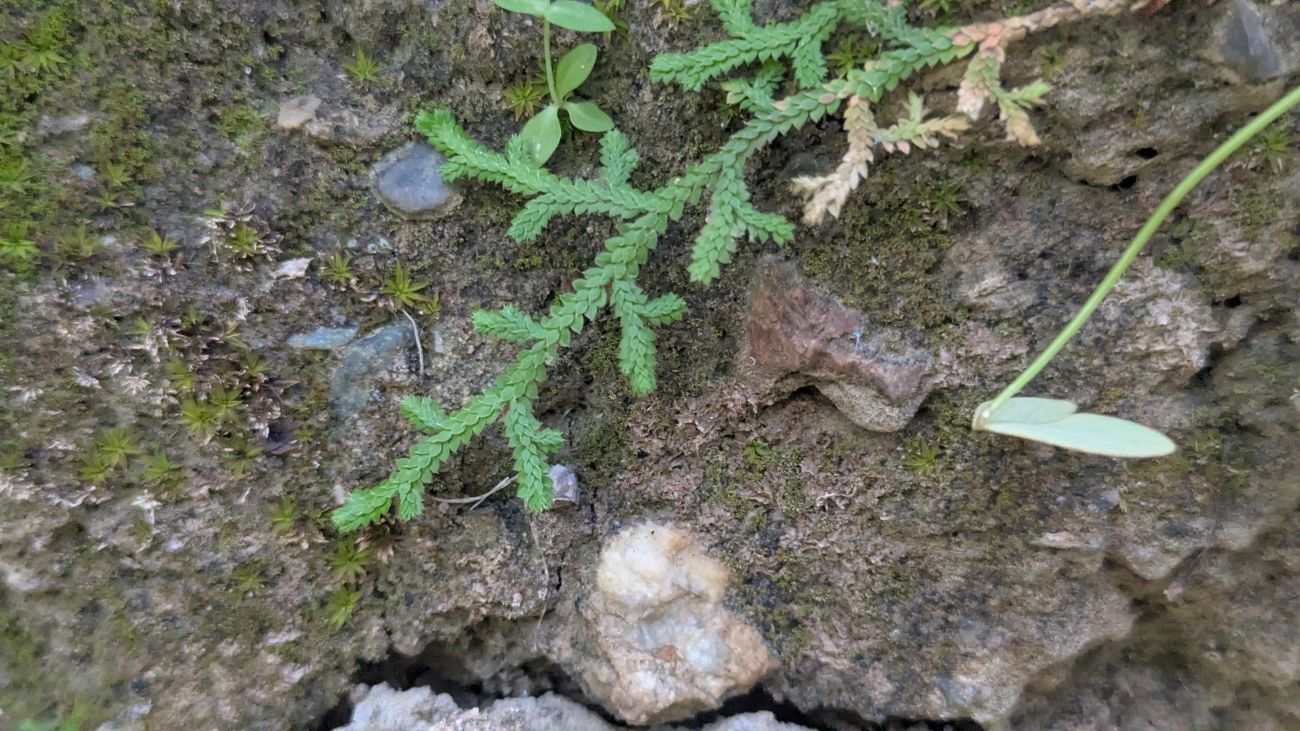
Selaginella denticulata
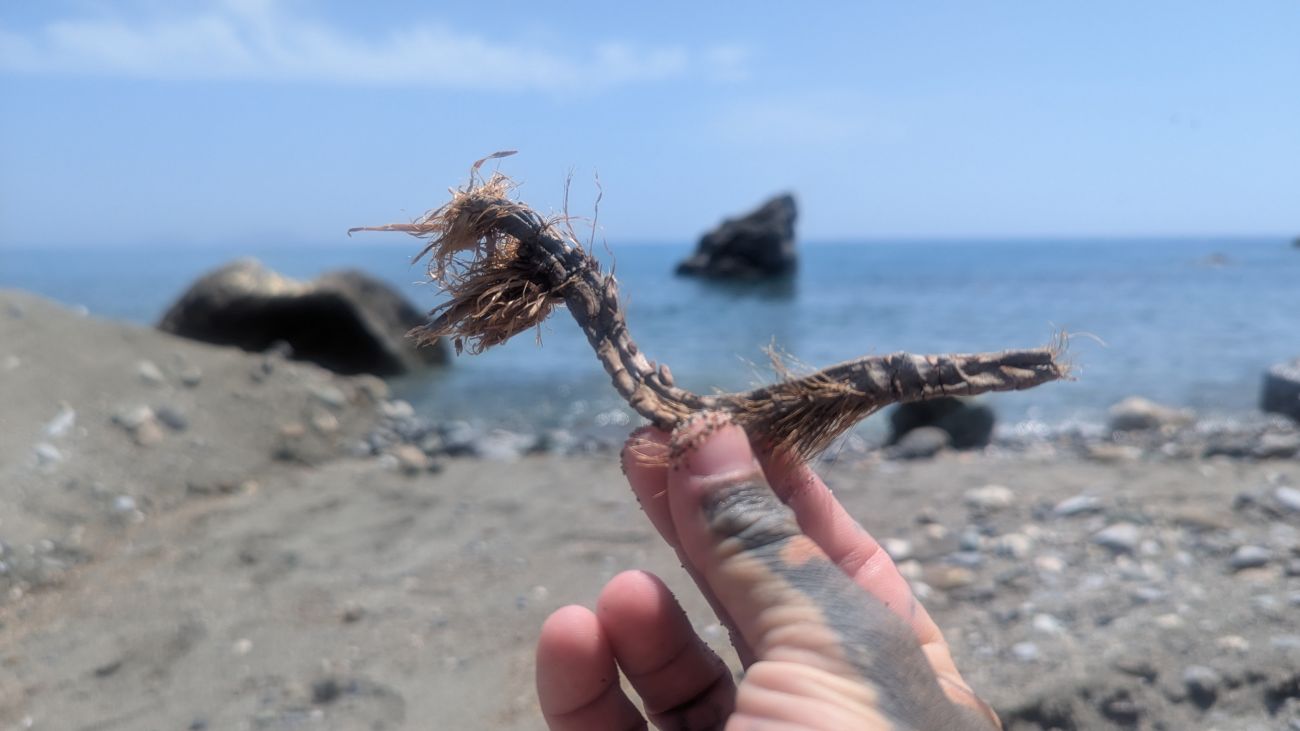
Posidonia oceanica rhizomes washed up ashore
Four plants stood out in Preveli.
Phoenix theophrasti: Named after Theophrastus, the “Father of Botany”, this magnificent palm exists naturally in only a few locations on Crete, the East Aegean islands and the southern coast of Turkey but has been introduced to mainland Greece and Tunisia. There is a large population of these palms at Preveli Gorge. These palms can reach up to 12m in height, their stems snaking along the ground before shooting upright into the sky, presumably when they reach a location of sufficient light.
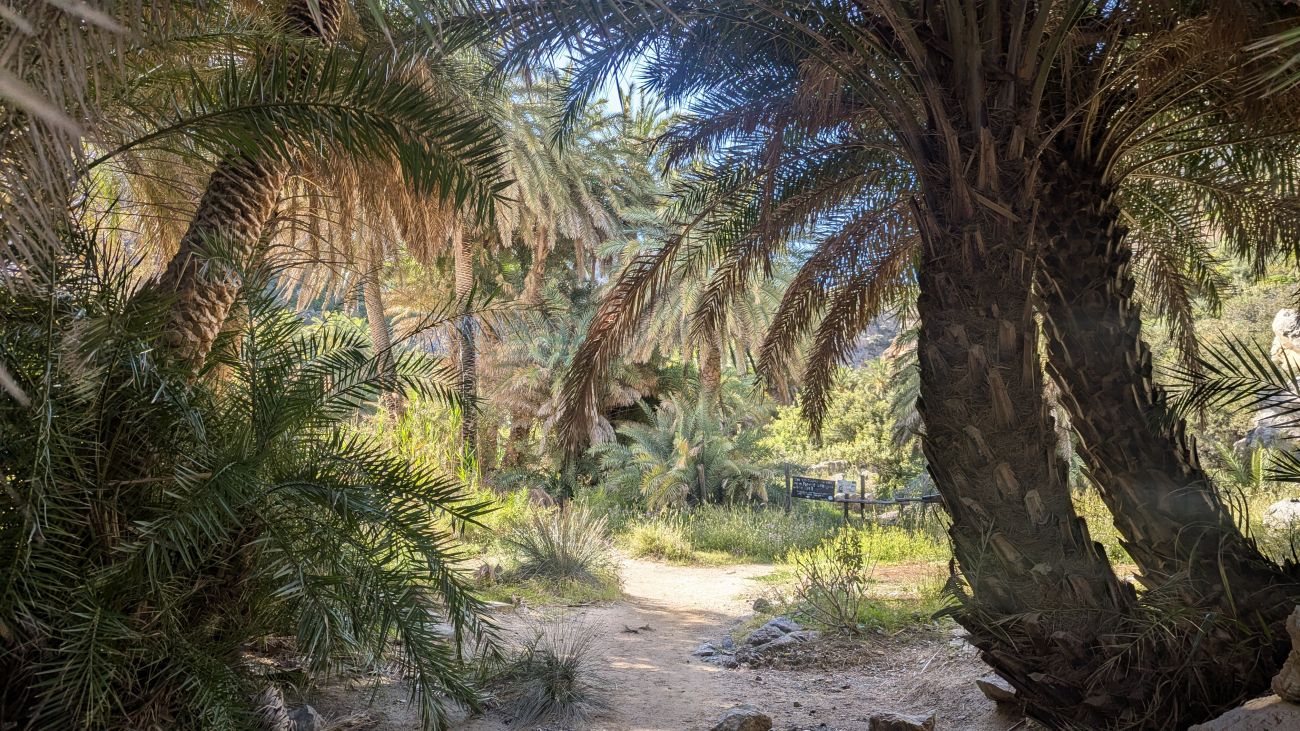


Pheonix theophrasti from different perspectives
Ebenus cretica: An endemic sericeous, densely branched shrub of the Fabaceae family, growing 0.5m – 1.0 m, bearing racemes of bright pink flowers. This plant was seen growing out of the limestone cliff faces here but is widespread throughout Crete. I was able to get close to one plant on this day, however there were many growing high up in the cliff faces up the gorge.

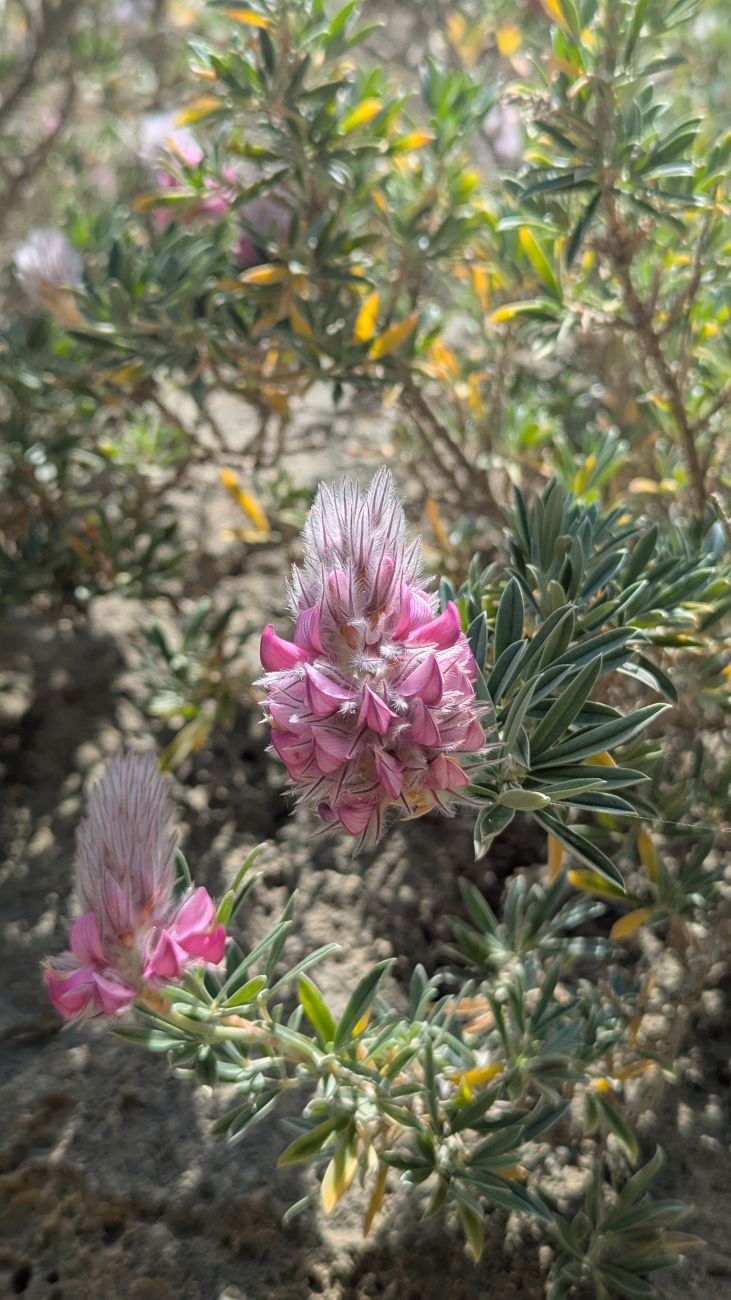
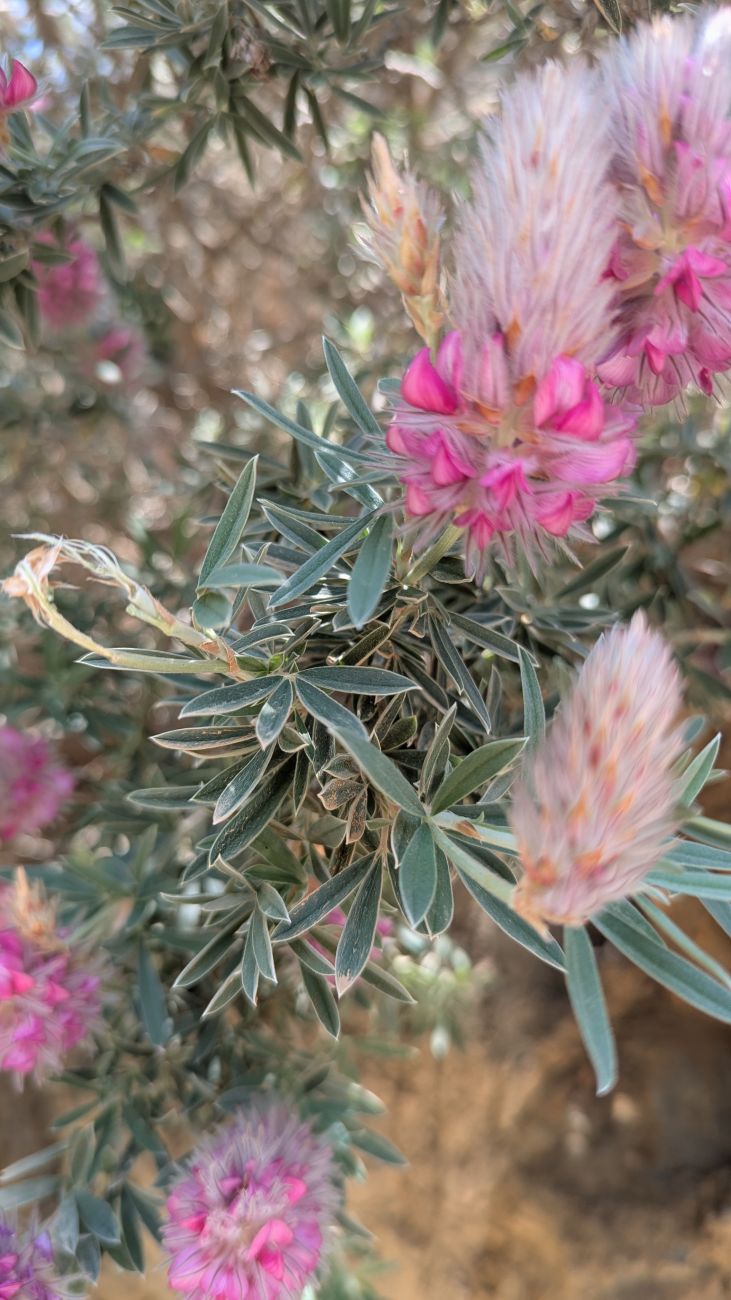
Ebenus cretica
Petromarula pinnata: One of Crete’s two endemic genera. A medium-sized (up to 0.8 m) perennial of the Campanulaceae family, with deep green pinnate leaves and tall inflorescences (paniculate), bearing violet-purple flowers reminiscent of flowers of the Solanaceae. On this day the plants were both seen growing at the bases of the cliffs in highly-drained and rocky soils but also growing slightly up into the cliff faces.

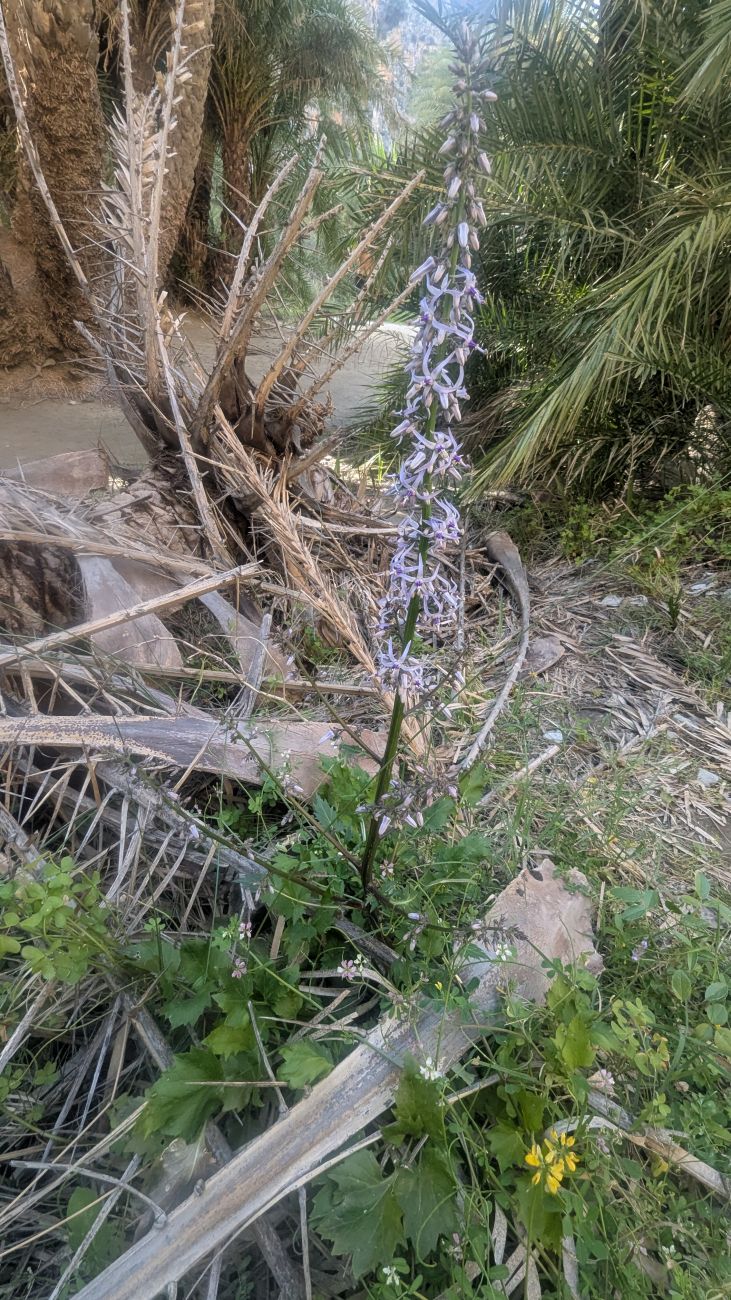
Petromarula pinnata
Verbascum arcturus: A Cretan endemic reaching 0.3m – 0.7m in height, this plant inhabits limestone crevices, gorges and occasionally appears in stone walls. Whilst more common on the west coast, it does appear on the east coast also. On this day the plants were seen growing out of a shaded cliff face, stems reaching out into the gorge until they found the light to grow upwards and flower. Unmissable inflorescences bearing yellow flowers with purple-violet centres.
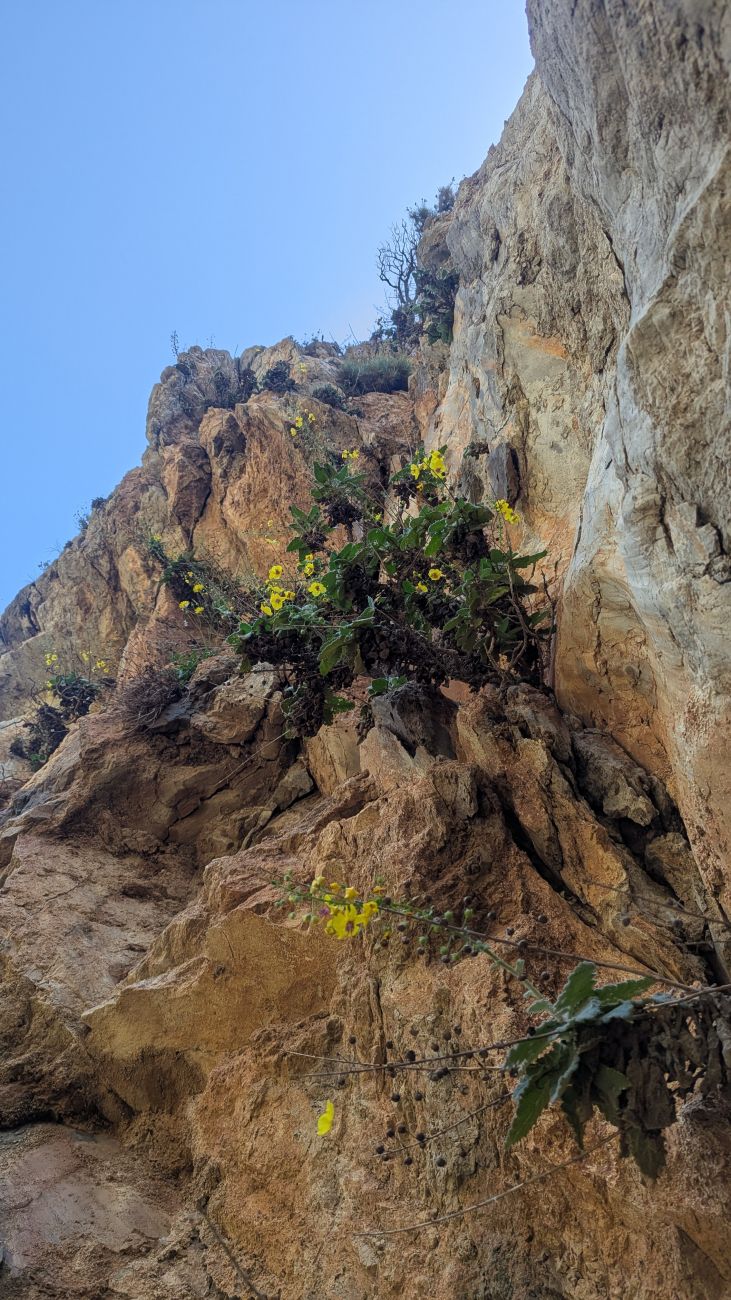
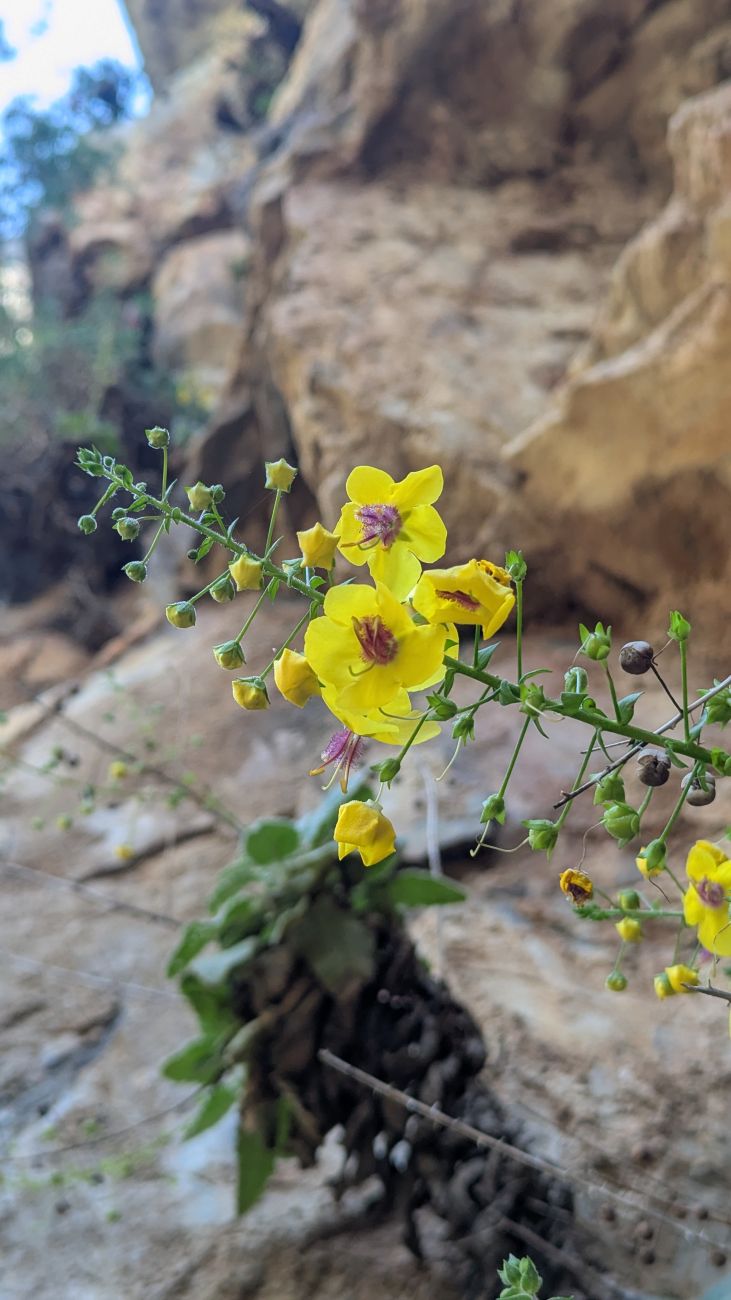
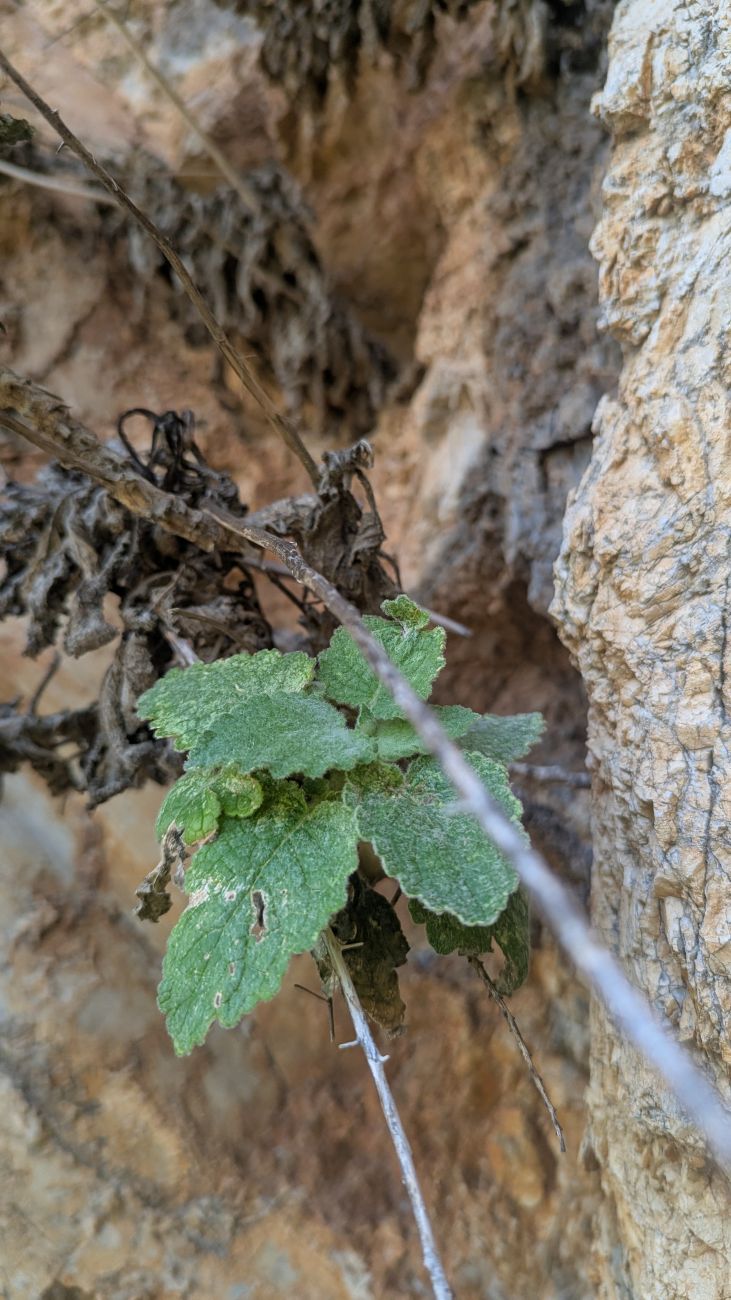
Verbascum arcturus
Psiloritis Range
This period was spent in the Ida range of the Psiloritis geopark. A geopark is a defined area of geological value, rarity or beauty. It is often the case that these places are also of biological value, such as high floral diversity. The Psiloritis Geopark was established in 2001 and was recognised as a Unesco Global Geopark in 2015. Over 1272 sq km, the geopark spreads over eight municipalities, including seven wildlife refuges. At the centre of the geopark towers Psiloritis (Ancient Idi, or Mount Ida) at 2456m.
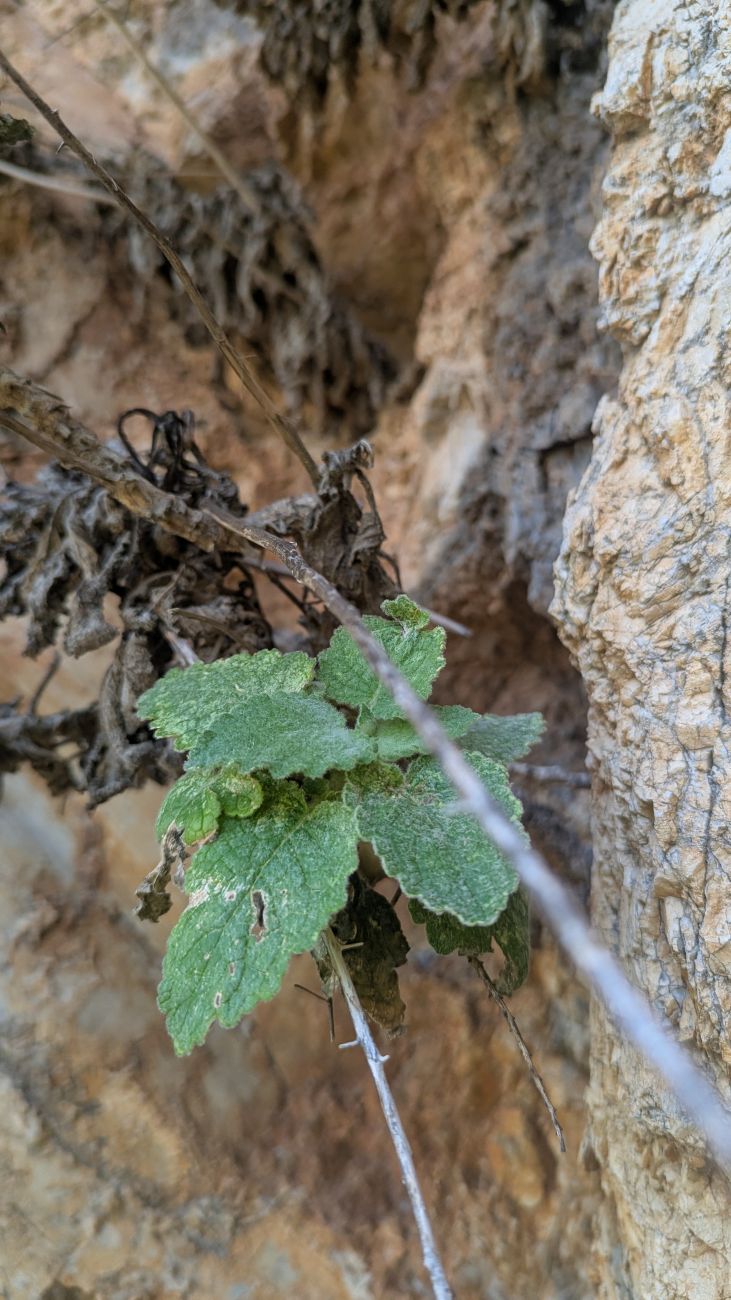
The Psiloritis Range from approximately 700m
Arriving slightly too late on this day to go on any meaningful hikes to botanise, I checked out the Geopark Information Centre in Anogeia where I was staying. There I met the wonderfully welcoming and helpful Chara, mountain guide and conservationist, who showed and talked me through their displays of the flora of Psiloritis. After talking for a while about the plants and which routes to or not to take up into the mountains, I left feeling confident about the next day’s plans, either A: hitchhike far enough up into the hills to hike up to the summit of Ida, or B: hike up to Skinakas Observatory. The option being dependent on whether or not I was successful at hitchhiking up the roads into the mountains. The information centre had a lovely display of flora which could be seen up in the mountains, along with great interpretation of the geology of the region.
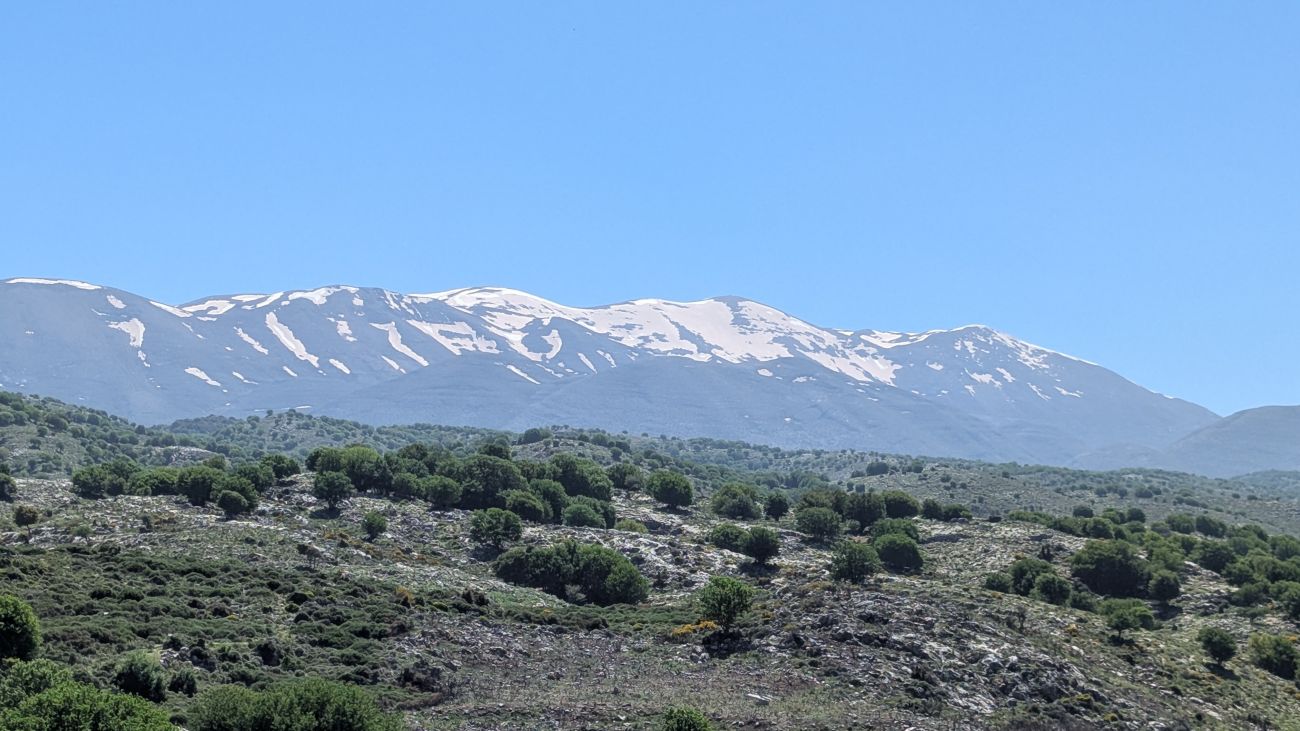
Tasteful display of a typical scene of the foothills on the northern side of Psiloritis Range
The following day was my first hike into the Psiloritis mountains. Whilst if straight up hiking I would likely have been able to make the peak of Ida and back if leaving at sunrise and returning partially in the dark, I was here to look at plants, so as a rule had been adding roughly 50 per cent of the hiking time to my trips. I was unlucky with hitchhiking and local taxis were not really a thing, so I was only able to make it up to Skinakas Observatory at 1750m. This was fine and expected and still brought me through a range of habitats and floral diversity featuring some fantastic plants. I did get picked up by a shepherd a couple of hours into the hike, but due to an extreme language barrier, his need for speed, and him also not understanding my likely poorly executed gestures to “stop!” and let me out of the truck when he took a turn off my route, I was put 30-45 minutes (walking) off track. I did eventually manage to get the message across after some minutes of chaos, by resorting to simply opening the passenger door whilst he was driving.
Beginning the hike: Leaving at sunrise to maximise time (in case of successful hitchhiking and Ida being an option) I left the hotel, making my way via paved roads firstly through some farmland roads seeing ruderal flora such as Tragopogon eriospermus, Papaver rhoeas, Echium italicum, Asphodelus ramosus and Vicia sp. Soil here was understandably slower draining and containing more organic matter than most soils seen since my time on the Omalos Plateau at the start of the trip, however, still rocky. On the note of paved roads through rural areas, I should say that throughout this trip if out in “the sticks” or more rural areas, which was the majority of the time, goat / sheep waste littered the roads so much that I gave up on my first day on Crete to avoid it, embracing the minute soft topography of the roads. I wonder how much the “splashback” of livestock manure from tyres of traffic back into the verges of the roads have on the vegetation of the verges… drive-by fertilising?
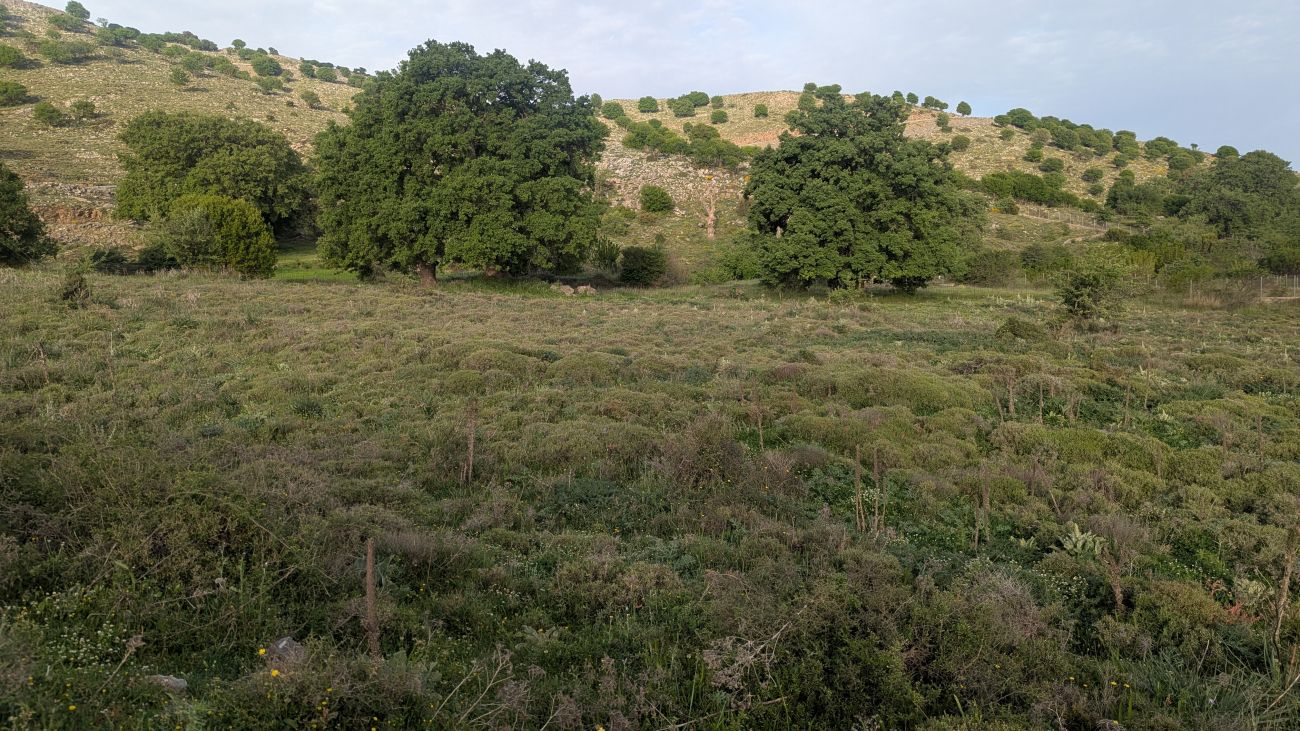
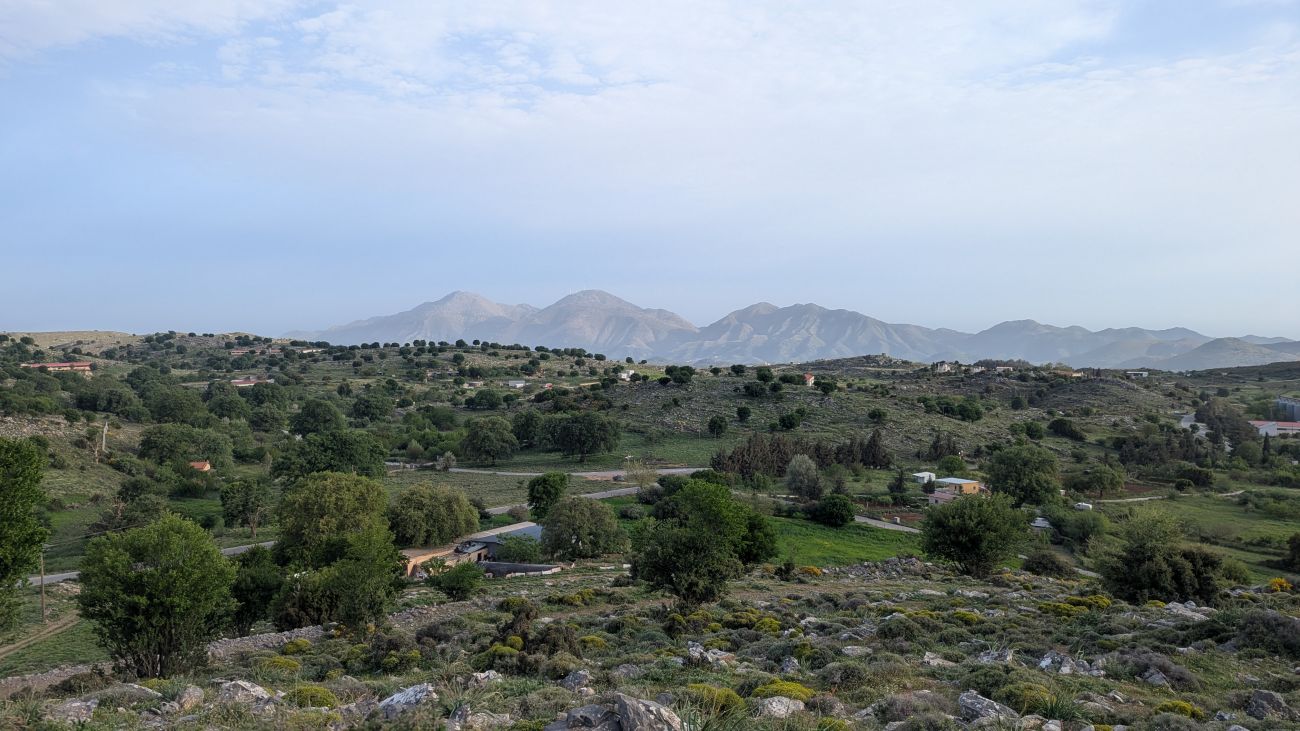
foothills / ruderal habitat
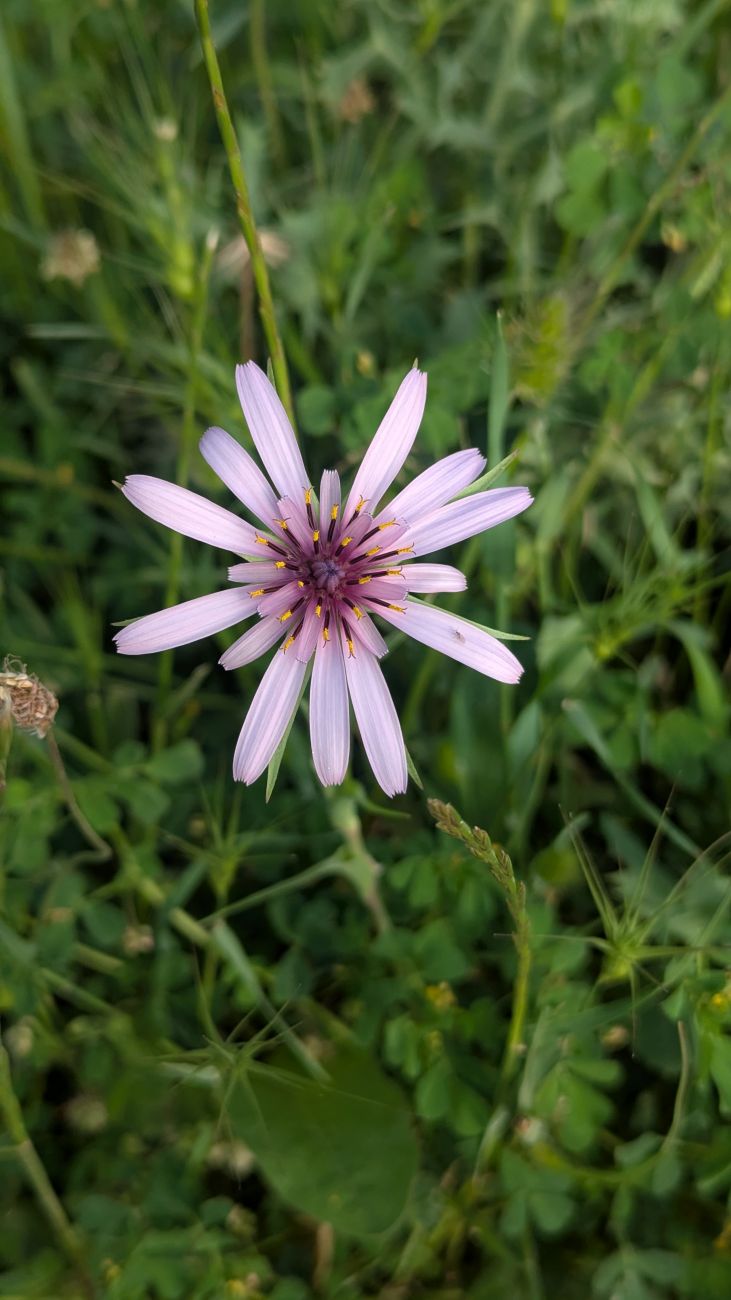
Tragopogon eriospermus
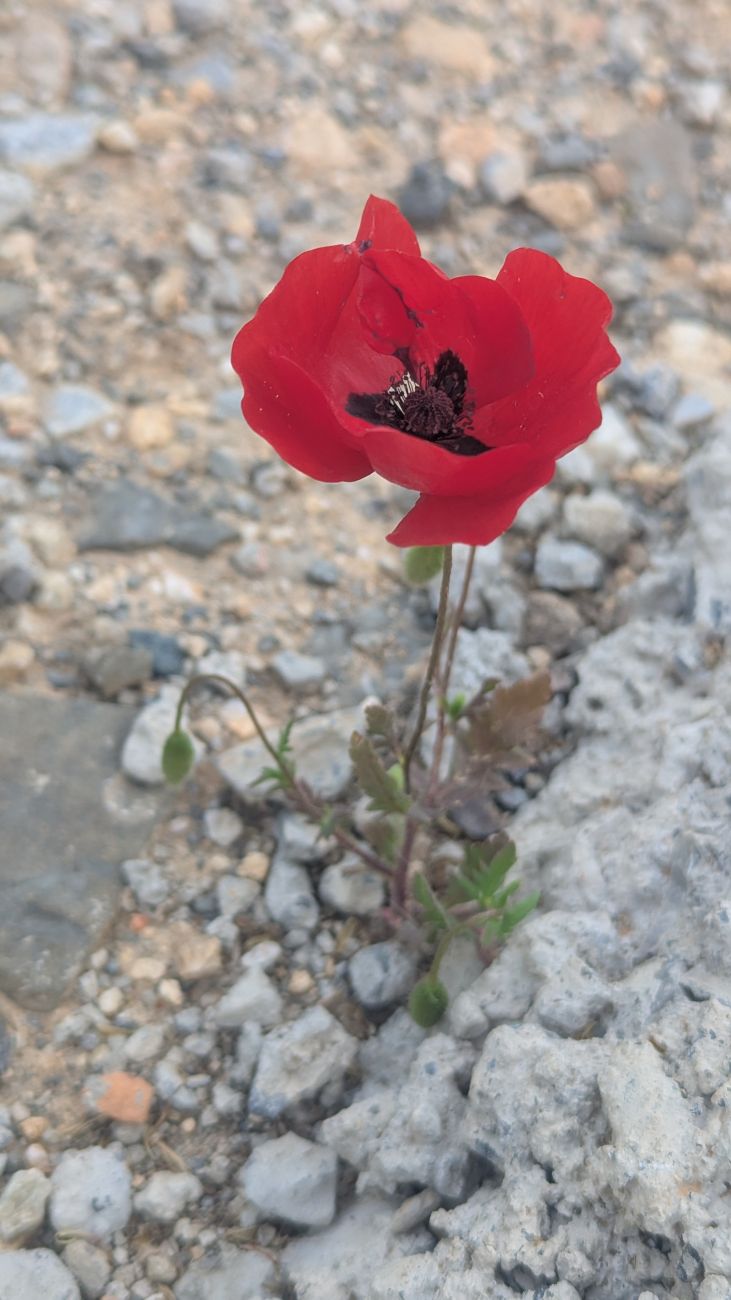
Papaver rhoeas
Heading to the hills there was a period of borderline-phrygana with some scattered trees such as Acer sempervirens and Quercus coccifera, before coming through to some proper phrygana on the way up the mountains, but here the phrygana became more cushion-form. At this point, familiar plants became pattern again, such as Sarcopoterium spinosum, Berberis cretica, Euphorbia acanthothamnos, with the also cushion-form herbaceous Trifolium uniflorum, as seen back in the Lekfa Ori. The herbaceous flora seen here included, but was not limited to: Gagea graeca, Selaginella denticulata, Knautia integrifolia, Sedum litoreum, Legousia pentagonia and Rumex tuberosus. Growing conditions here mostly echoed the lower elevations of a previously visited site, Kallergi, but here the elevation was less dramatic. The gentler sloping in these hills made for less microclimates, making the flora more consistent with less pockets of particular plants.
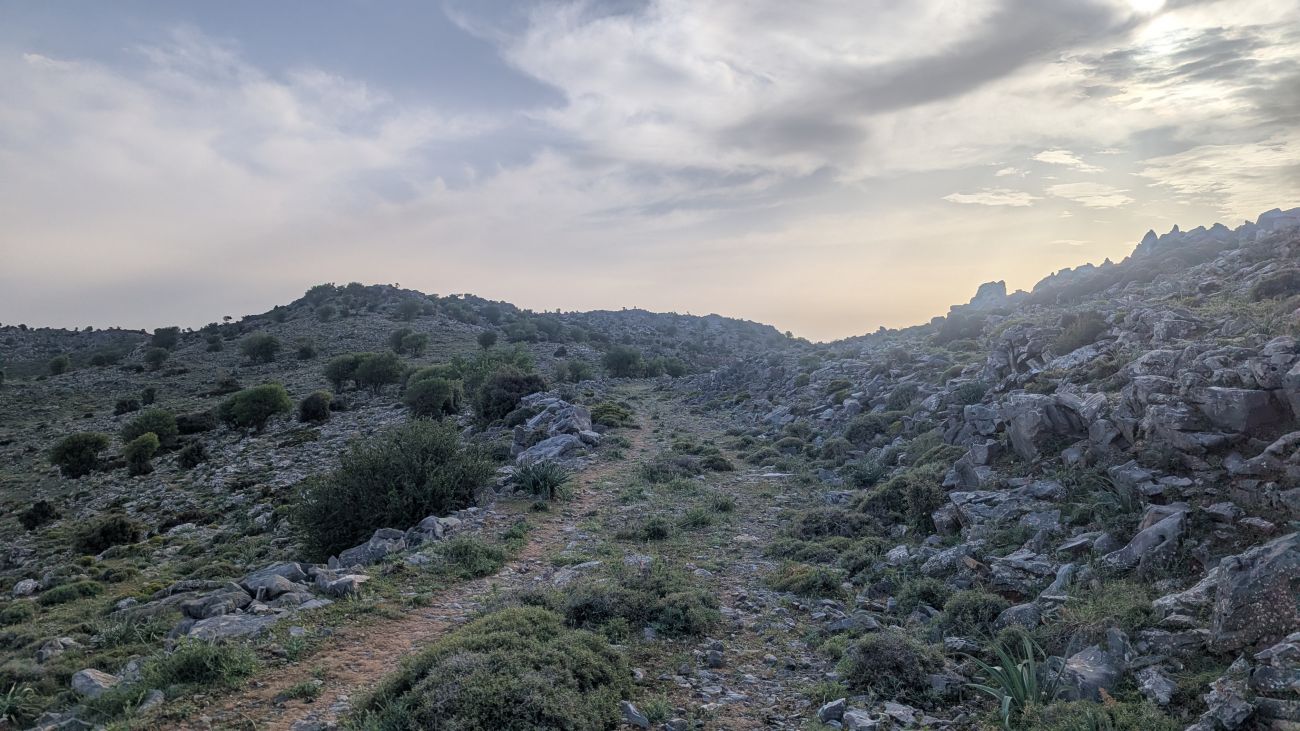
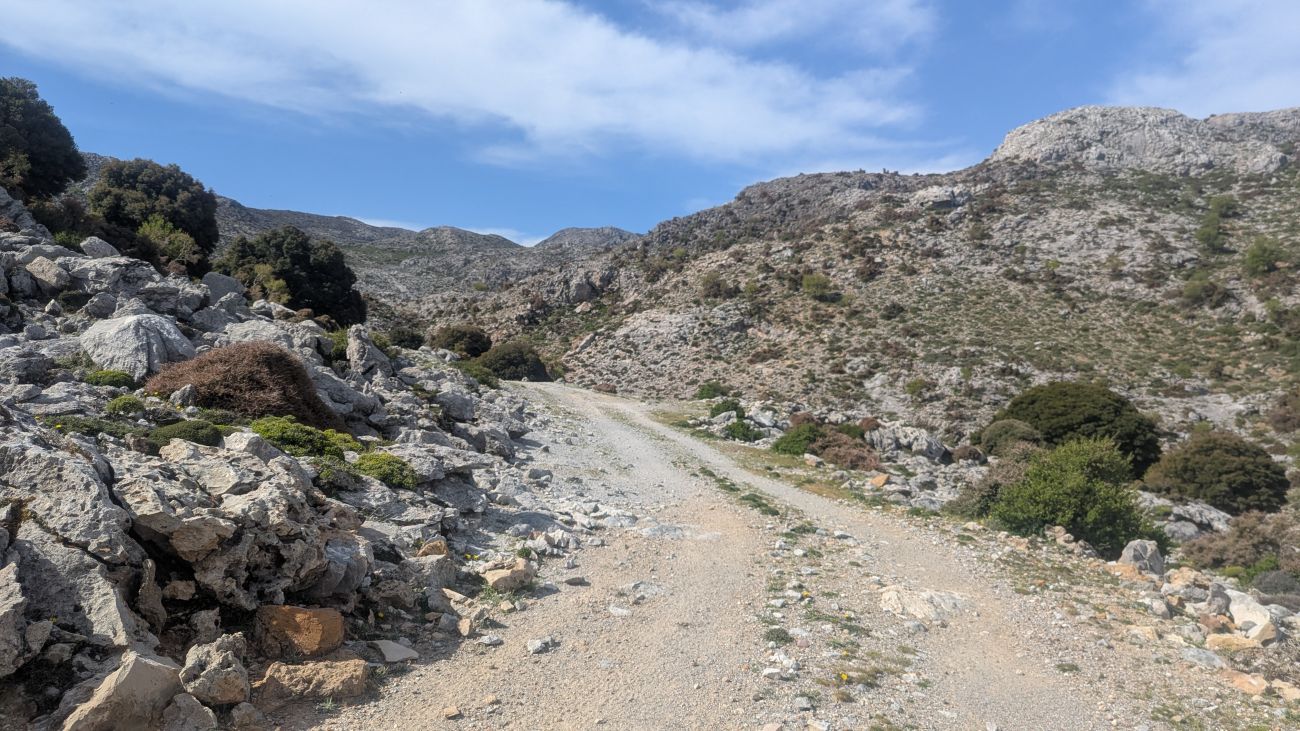
Foothill landscapes
A long walk through more farm / grazing land of similar vegetation patterns to previously described led to the base of the mountain on which Skinakas Observatory sits. Here I had managed to accidentally herd a flock of sheep away from their shepherds’ land, so was given an impromptu herding lesson by a local shepherd via shouts and hand signals in order to direct the flock back to his turf. After passing a church it was incline thereon. More Acer sempervirens, Quercus coccifera here, but with some lovely undergrowth of Arum creticum, Cyclamen creticum, Geranium spp and Ranunculus spp.
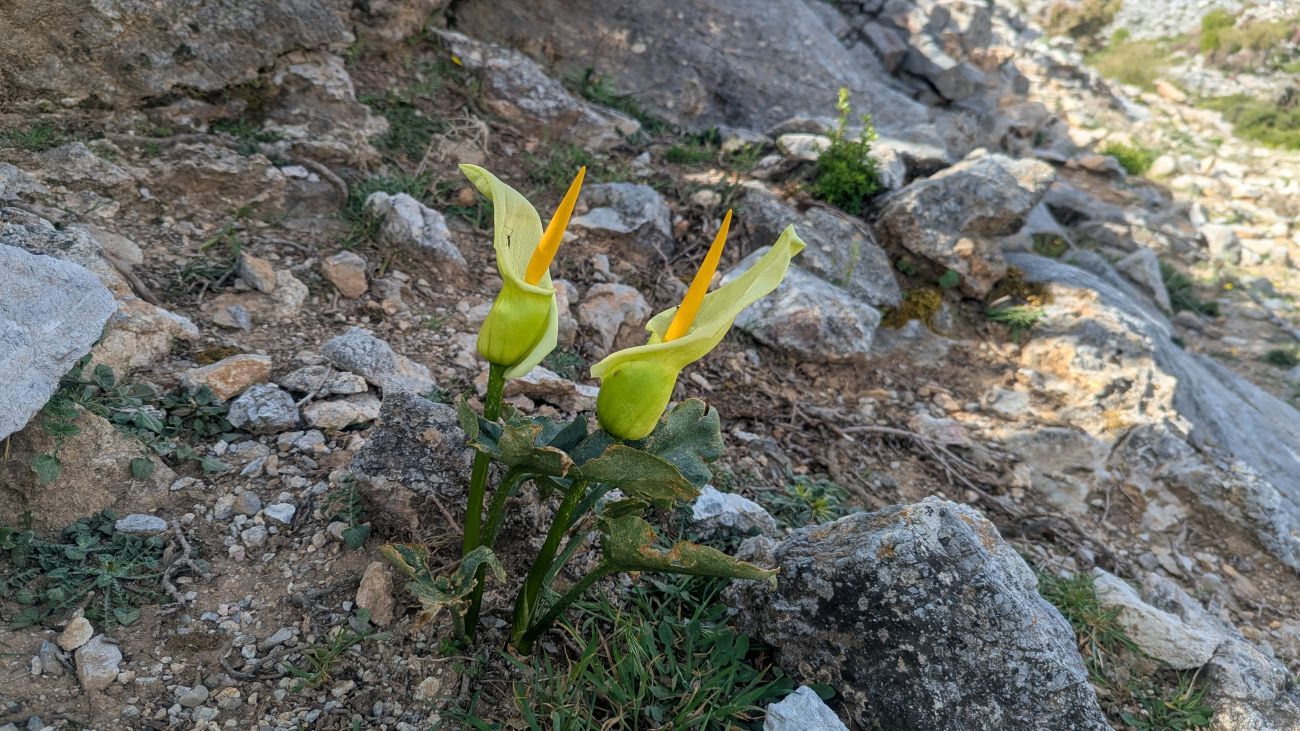
Arum creticum
Coming out of the sparse woodland I went onto a gentle scree. Here was a definite divide between the phrygana, ruderal and scrub communities. The Psiloritis range (Ida range) is primarily composed of limestone, dolomite and marble. From the scree to the observatory, the ground was primarily layered rock fragments with some trickling whisps of water running down tickled paths from the snow melt to the plateaus. Another water sacrifice revealed the obvious here: water drained almost immediately through the rocks, and when reaching the porous earth underneath the rocks, still drained incredibly quickly. Plants here are exposed to high winds, high fluctuations of temperature from below freezing to >30 ºC, intense sun / UV, and grazing. Simply put, the flora here must be tough as nails in order to survive. Thorn cushion communities here dwarf other flora in size in part due to their anti-herbivory morphology.
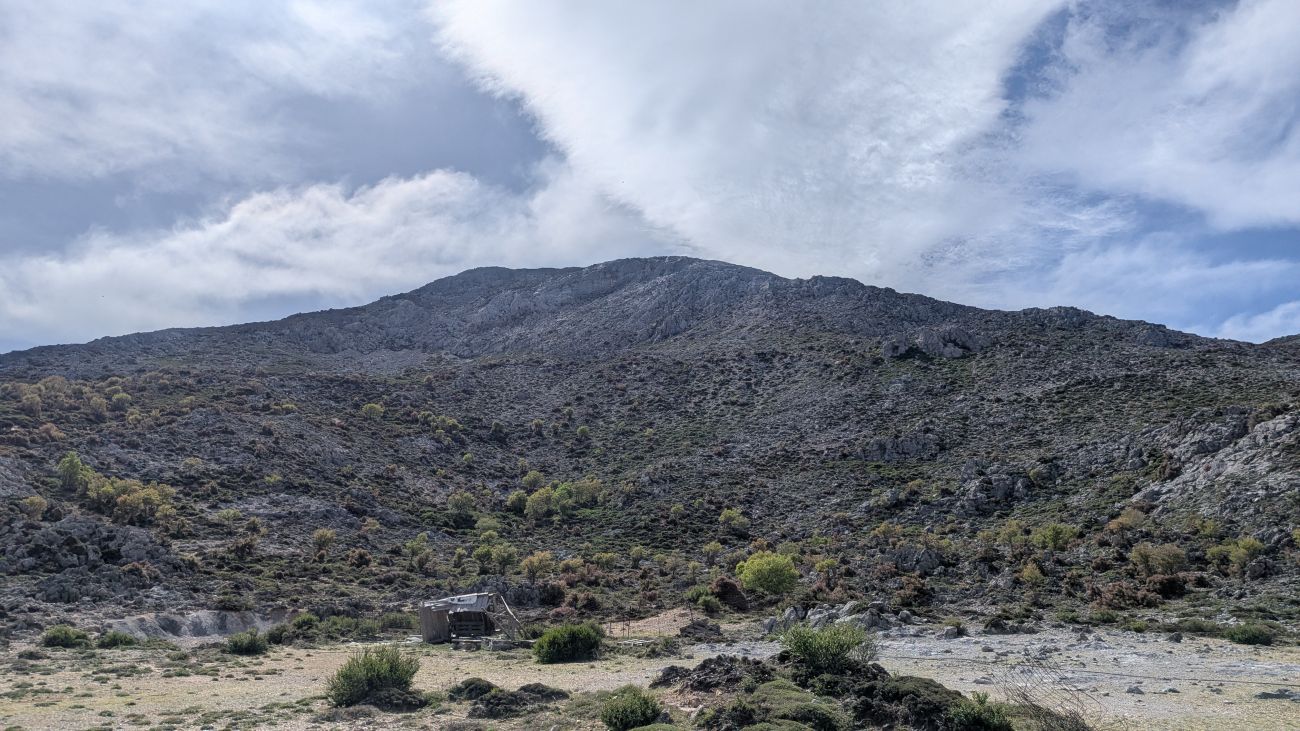

The climb ahead and scree
Admittedly, I’d been slightly running out of fuel at this point in the trip, likely due to the day’s breakfast of a coffee and cigarettes, paired with a couple slices of salami and cheese. Due to this I was searching for a nice point of botanical interest for some lunch and a refresh before the next incline to the observatory. I required no further sign than that of an almost glowing Tulipa cretica. I’d been warned I may be too late for the bulbous flora here but wanted to give the mountains a shot just in case, and here we were. Lunch could wait, I thought. I got all the short-term energy required from the endorphin rush of the tiny tulips, so began exploring the vicinity. More Tulipa cretica, many in fact. Then, Iris unguicularis subsp. cretensis, both of which endemic to Crete. Buglossoides incrassata also made an appearance. I was in a little piece of heaven here; thorn-cushion-scrub all around, bulbs dotted between, bryophytes and lichens galore in the wet micro-refugia of the alcoves of the rocks, the occasional Arum creticum and A. idaeum, and to top it off, the scenery of the Ida range encircling. Walking up this scree became a game of options. Either suffer the thorn-scrubs’ wrath on the legs or crush the lovely bulbs. So, I ventured on with sorry-but-alive legs, still stopping at each Iris and Tulipa, as it did not get old. I stopped for lunch when the scree met the winding road leading to the observatory, with a lunch-time view I will not forget.


Tulipa cretica (endemic)
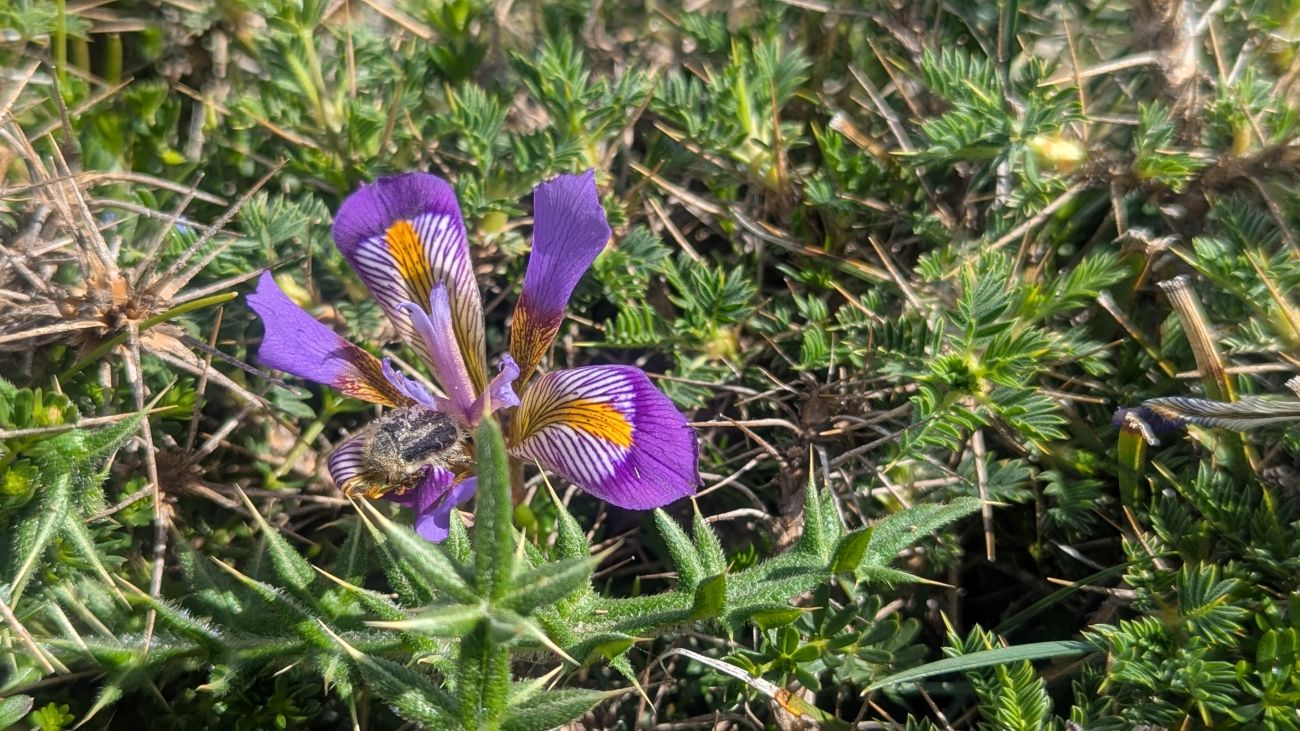
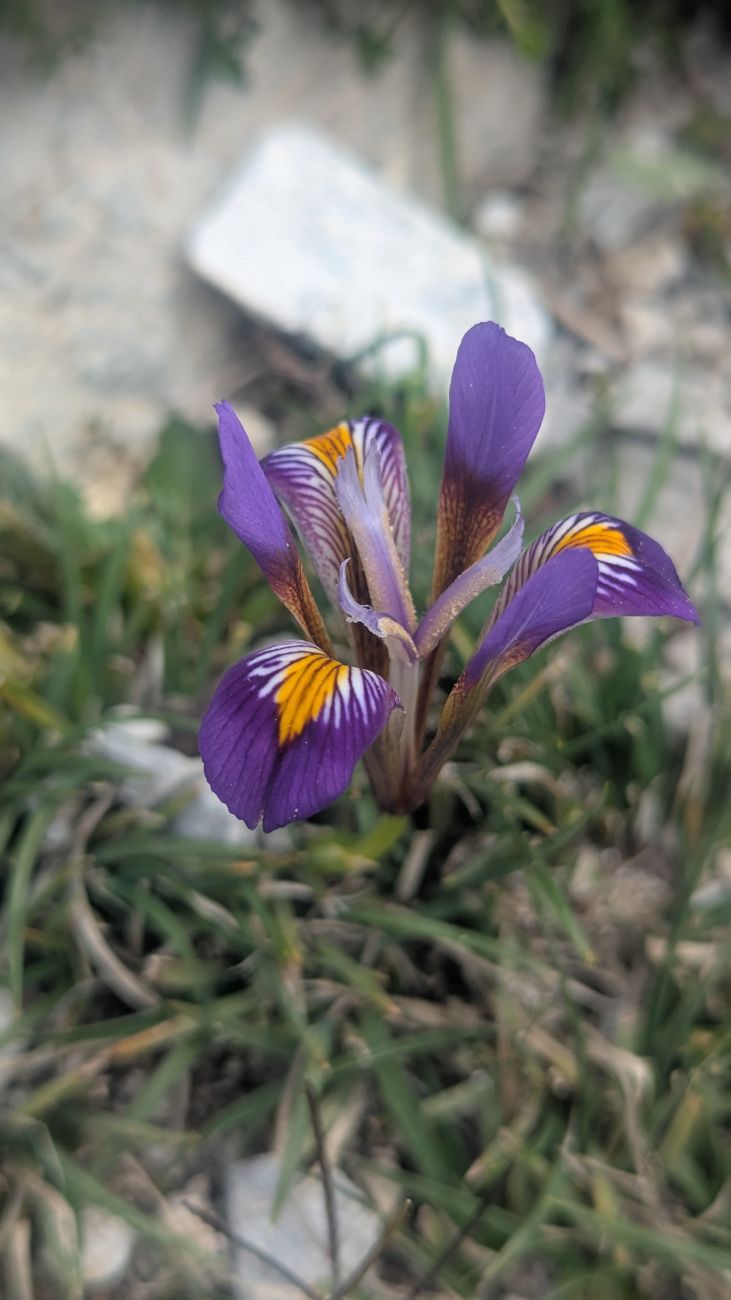
Iris unguicularis subsp. cretensis, protected by the thorn-cushion community
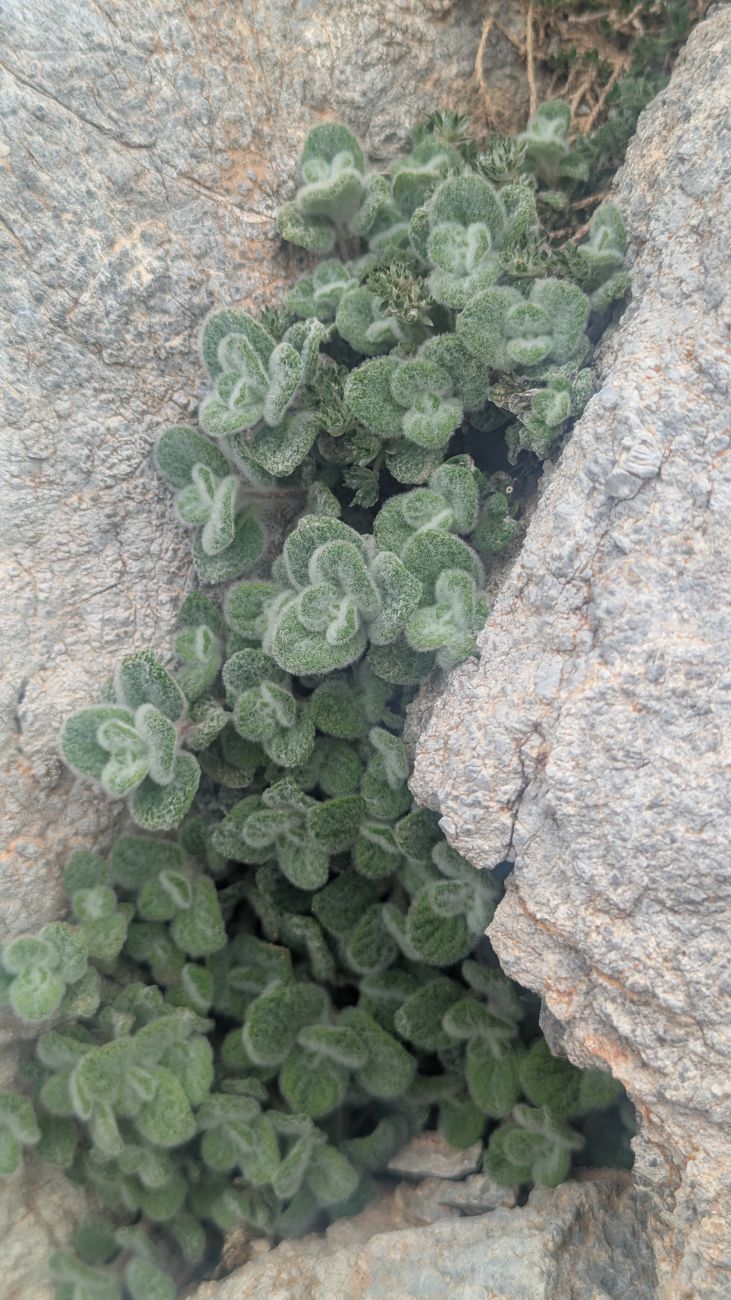
Origanum Dictamnus, or the Dittany of Crete (endemic)
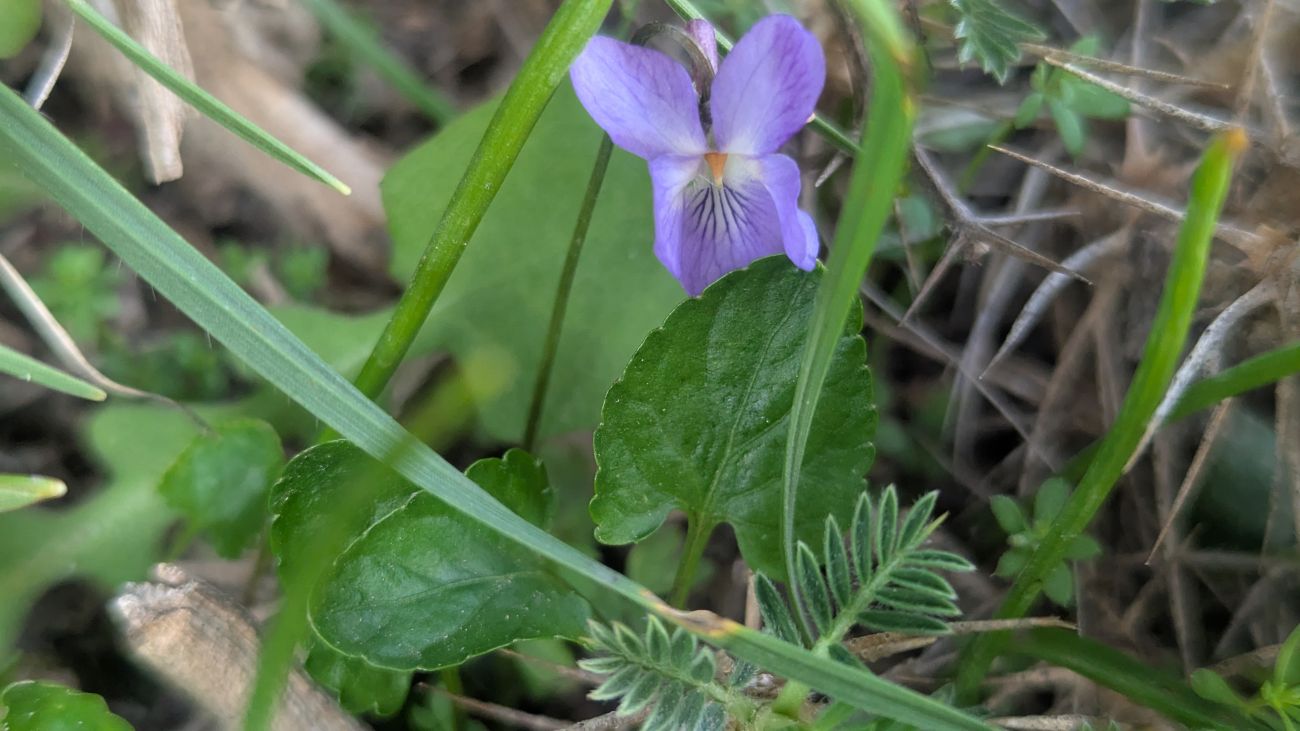
Viola alba subsp. cretica (endemic)

My best friend at this point, Euphorbia acanthothamnos
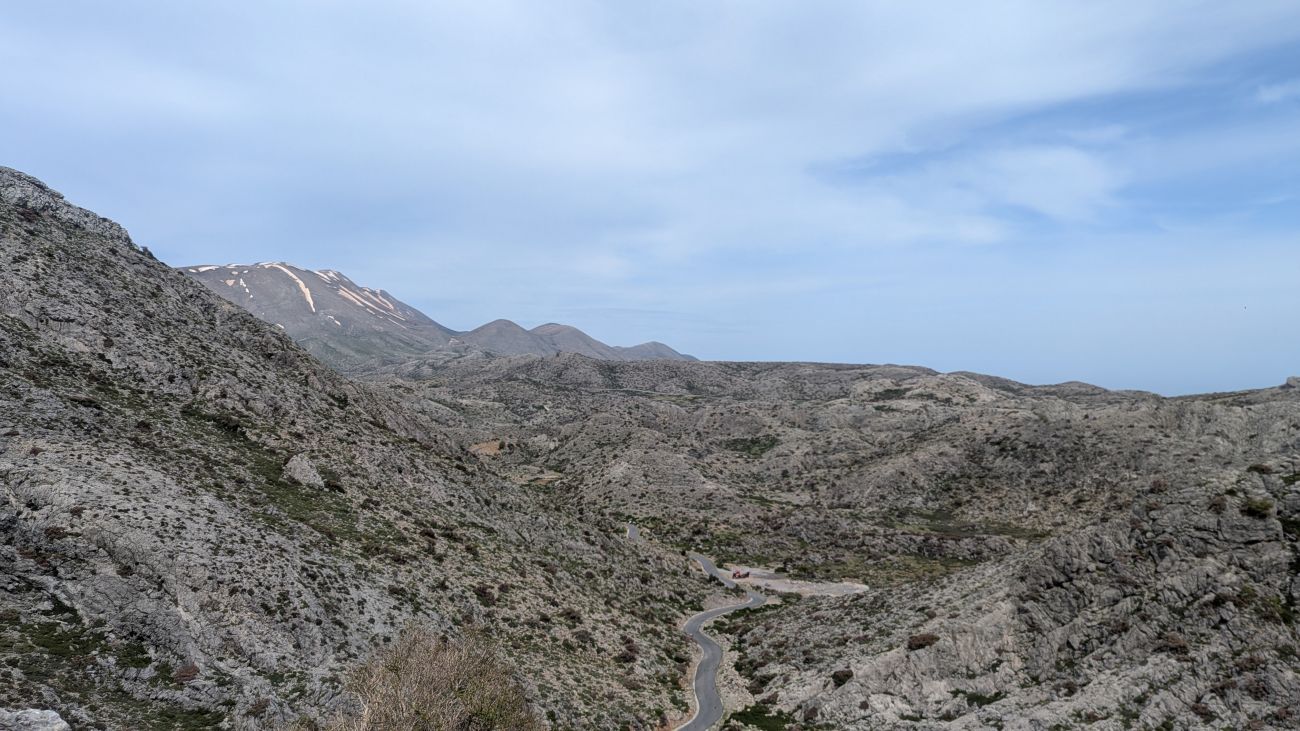
My lunch spot for the day
At around 1750m – 1800m the observatory may seem a barren landscape until you look down and closer, with some hardcore and rare flora such as Paronychia macrosepala, Euphorbia herniariifolia, Acantholimon androsaceum and Aethionema saxatile subps. creticum. The thorn-cushion trio seen earlier on this hike also made appearance, along with Trifolium uniflorum, but in a much sparser pattern. Tulipa cretica, Iris unguicularis subsp. cretensis, and the glaucous midribbed leaves remaining of some Crocus sieberi although their flowering period had come and gone. This was as high as I would venture on this day, and I was satisfied and thrilled with the day’s gift of nature.
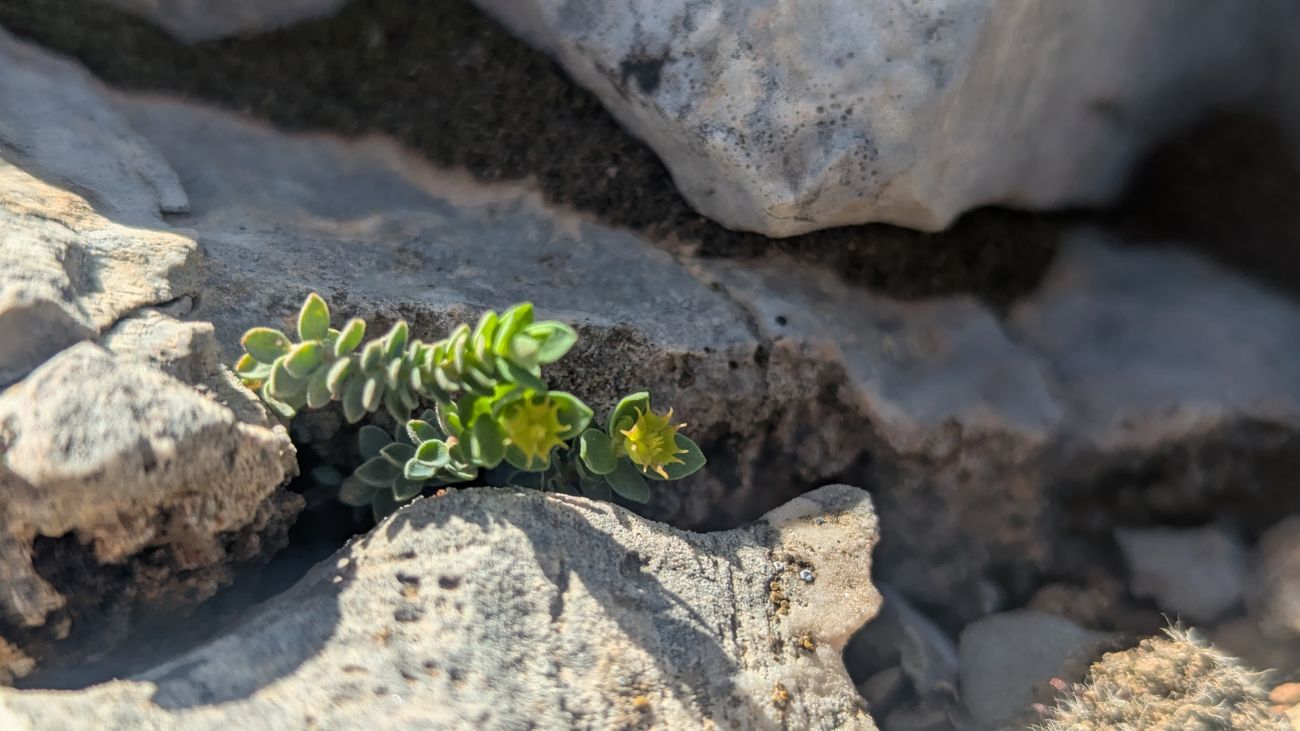
The sparse and rocky habitat at 1750 m
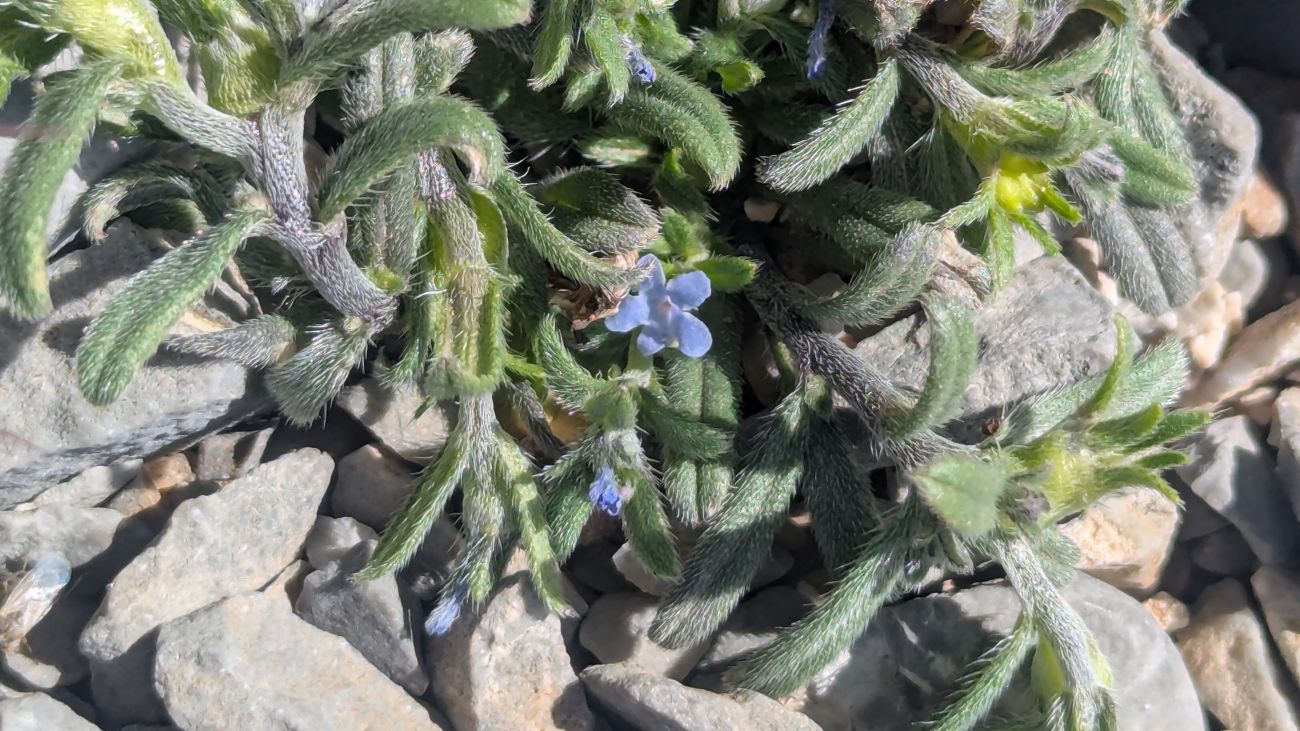
Buglossoides incrassate
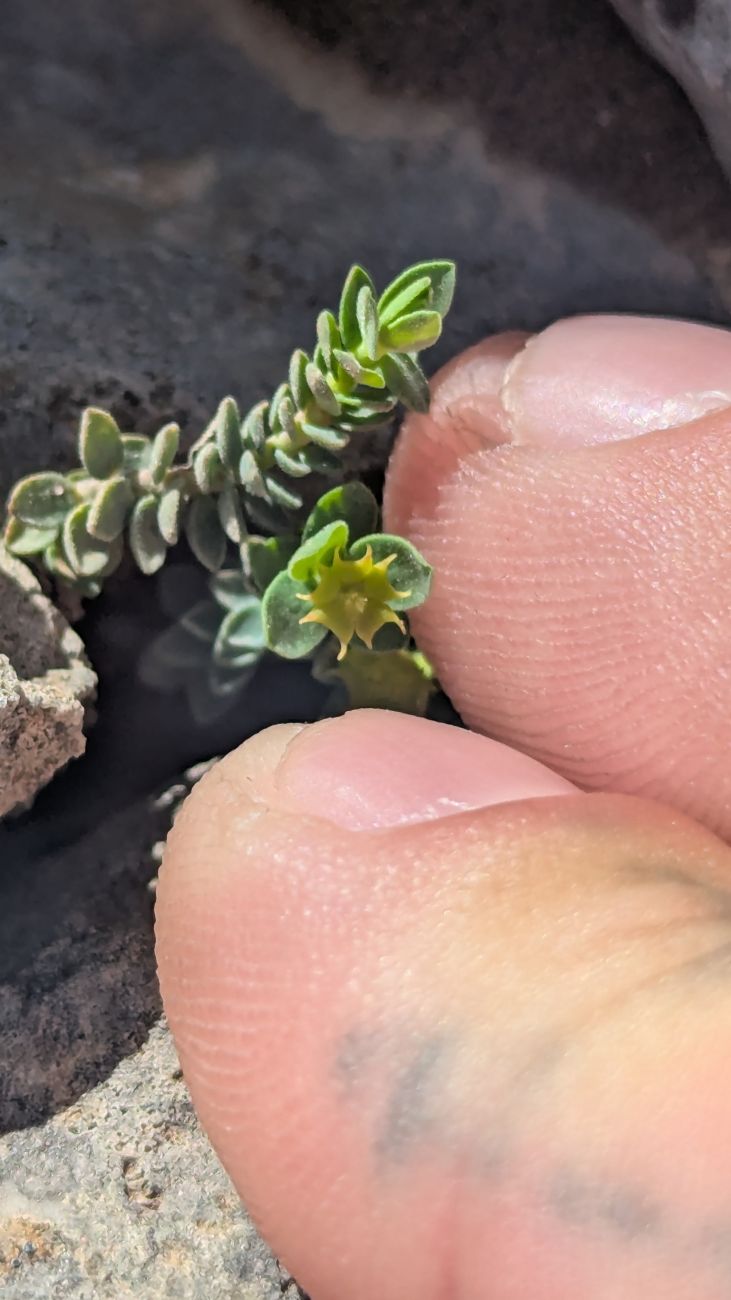
Potentially Euphorbia herniariifolia, ID pending
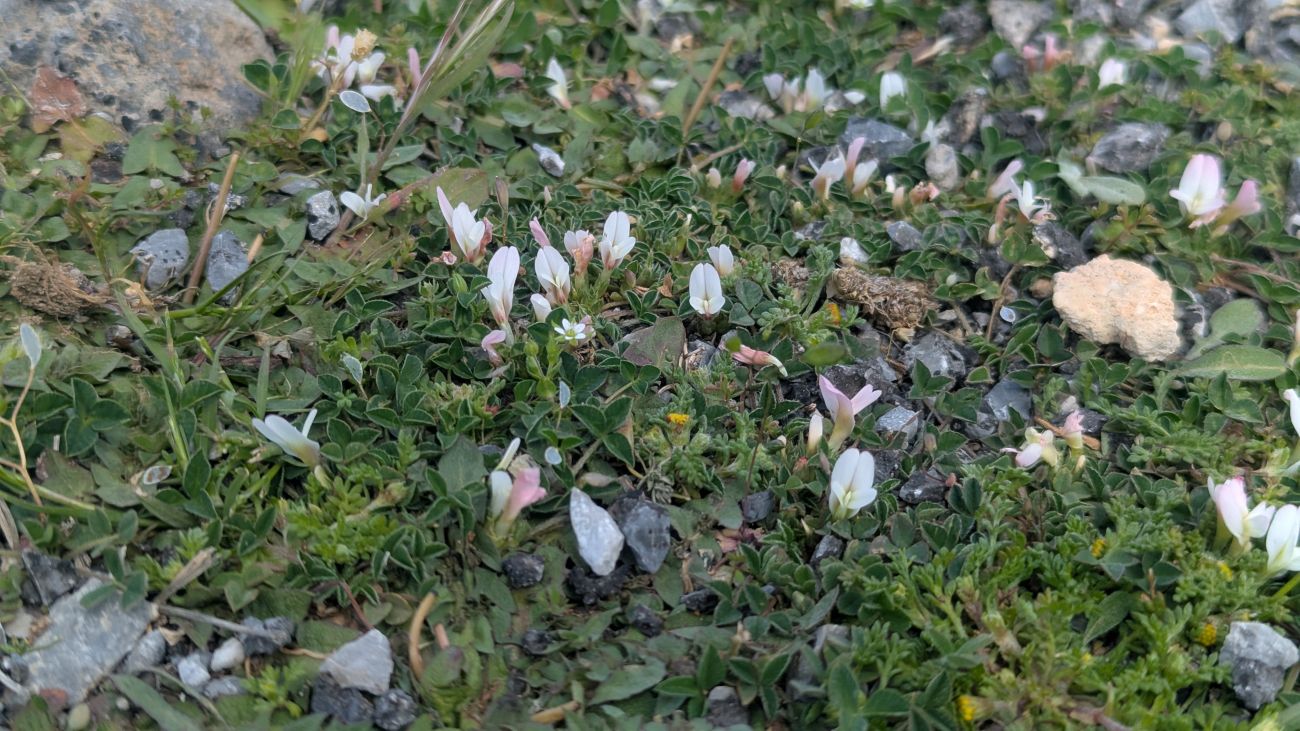
Trifolium uniflorum
After lingering by the observatory for a while, enjoying the views and welcoming the winds hitting my face like a dog out of a car window, I began to head back to Anogeia to find a taverna. On my way down I noticed a small plant growing out of a nook of some rocks in the scree. I recognised it as a Linum and after a bit of botanical detective work, it turns out this was Linum caespitosum. This Cretan endemic has not been recorded since 2009. I hope that I have identified this plant correctly, as it would be fantastic if correct that this plant is still growing here. I observed two populations of this plant on the way down the mountain. I ended the evening with some good food and wine at a taverna in a picturesque square in Anogeia.
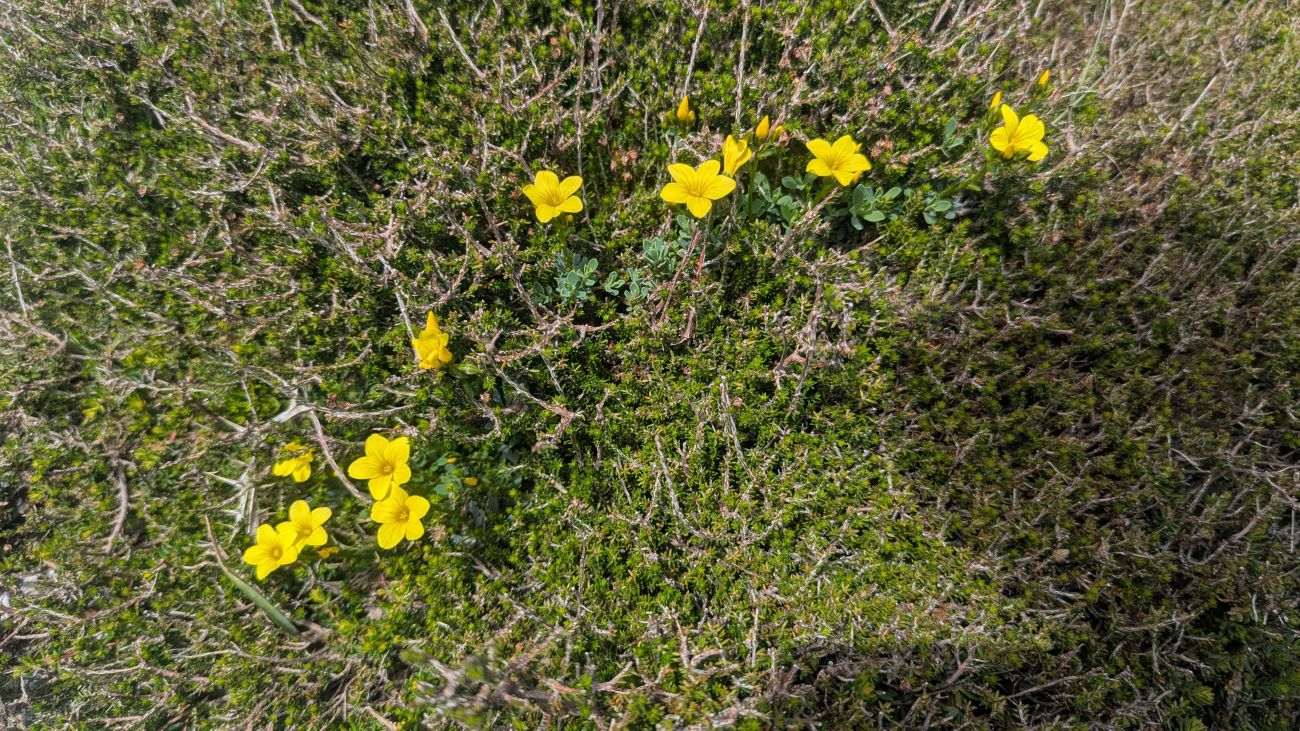
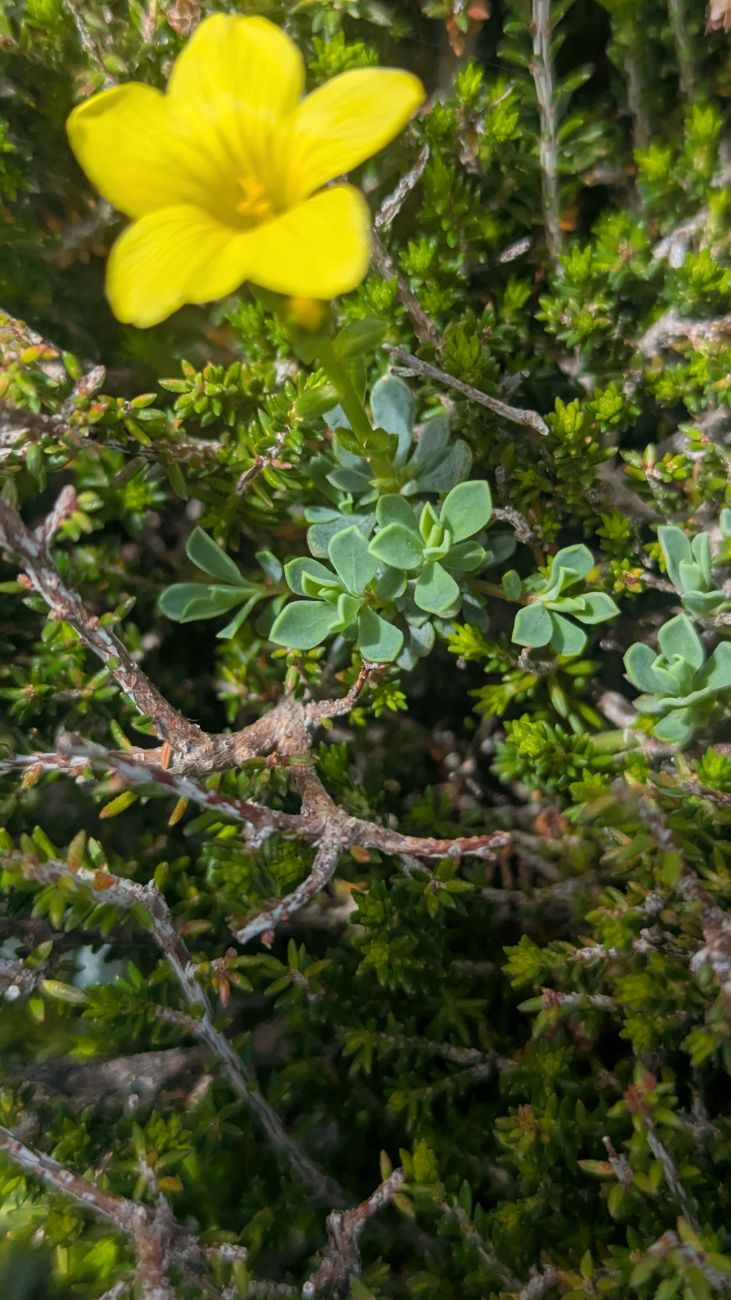
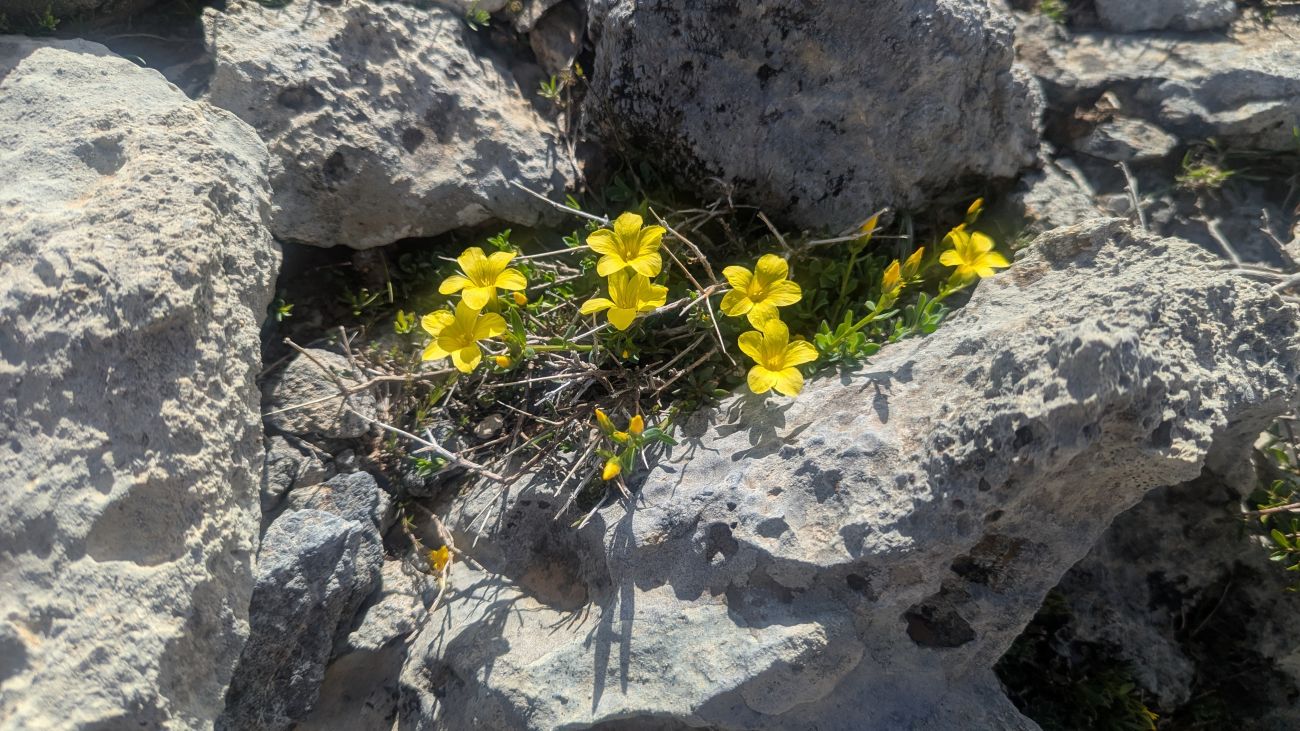
Linum caespitosum, two separate populations found between the church and observatory at Skinakas
Weary readers, you may find peace in that this is the last section of the botanising scrawl. As previously mentioned, hiking options were limited in the Ida range due to my lack of driving licence. With the previous day proving hitchhiking here was not a guarantee, my plan was to hike to the Nida Plateau, a similar-distance hike to the previous day. I thought before heading up into the hills again, I’d pop by the Geopark visitor centre to let them know the bulbs are still flowering. Here I met Chara again, and after sharing my previous days findings, we decided to head up into the mountains together once she finished her shift. I took this time to have a little rest in town before we headed up into the mountains.
“I’ll teach you about the mountains, you teach me about the tiny plants” was the rough handshake, so Chara drove us both to the Nida Plateau to our starting point. Chara pointed out the imperial eagle (Aquila heliacal) and Eurasian griffon (Gyps fulvus) effortlessly whilst driving us up the hills. We parked up around 1400m and had a relatively chilled hike up to 2000m(ish).
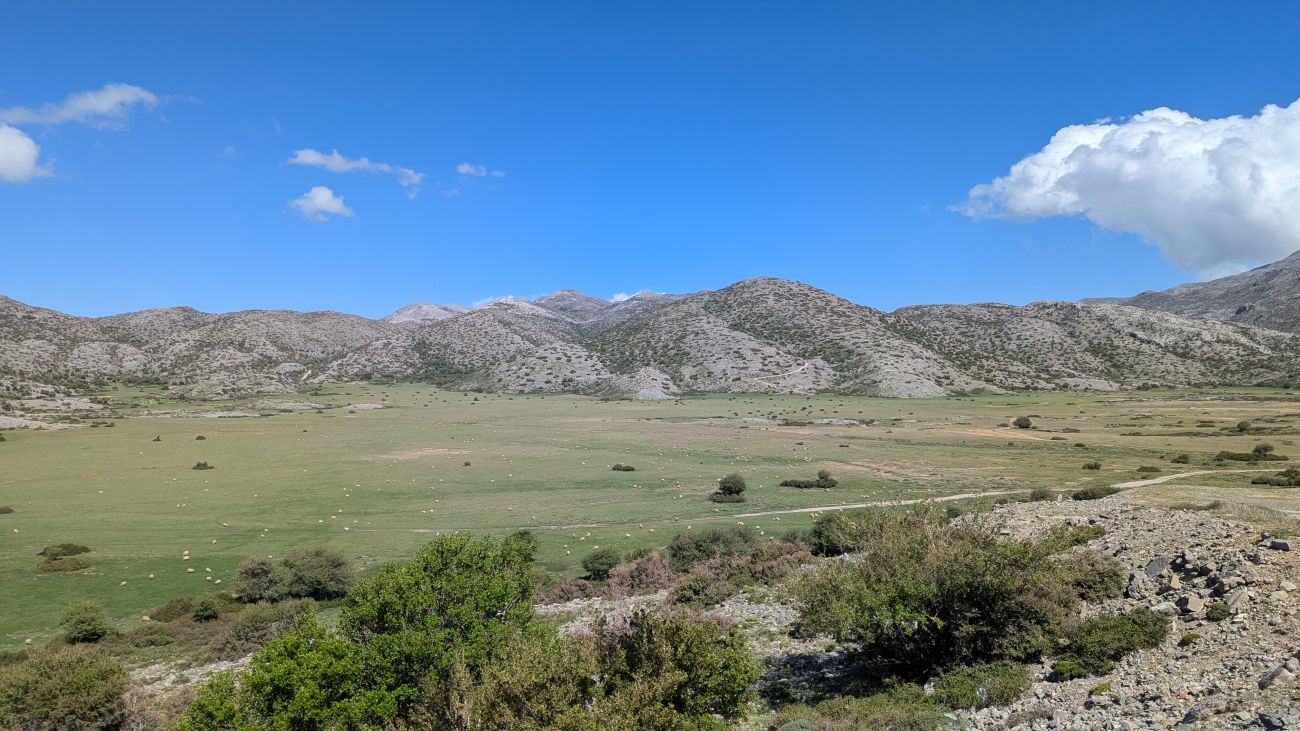
Nida Plateau
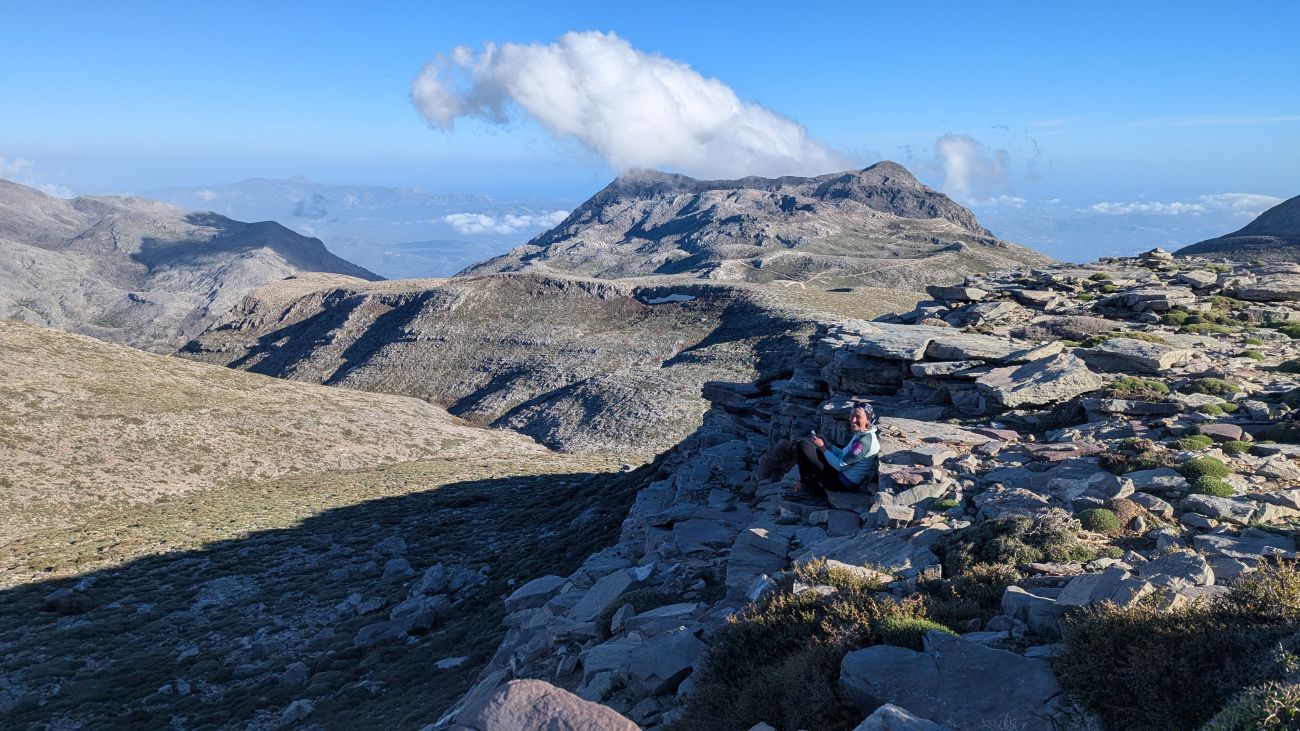
Sometimes pictures do no justice for the beautiful scenes they capture – Looking out over Psiloritis with my new friend
Flora here was as rugged as the terrain. More echoes of thorn-cushion. We found some beautiful swathes of Scilla nana (syn. Chionodoxa cretica), populations of Corydalis uniflora, Tulipa cretica, Iris unguicularis subsp. cretensis, Aethionema saxatile subps. creticum, Gagea spp., Acantholimon androsaceum, Ornithogalum spp., Lithodora hispidula, amongst much more. Prunus prostrata, or the mountain cherry, hugged the rocks, sprawling in a prostrate and sturdy habit. Trifolium uniflorum, ever-present, growing lower and more compact with altitude. Wind up here was high-speed, plants growing up through the rocks on exposed slopes both UV and temperature-wise. Repeating patterns existed here of extremes of weather. We ended the trip with a couple of beers in a cosy taverna courtyard.

Thorn-cushion around 1750m –1850m


Scilla nana
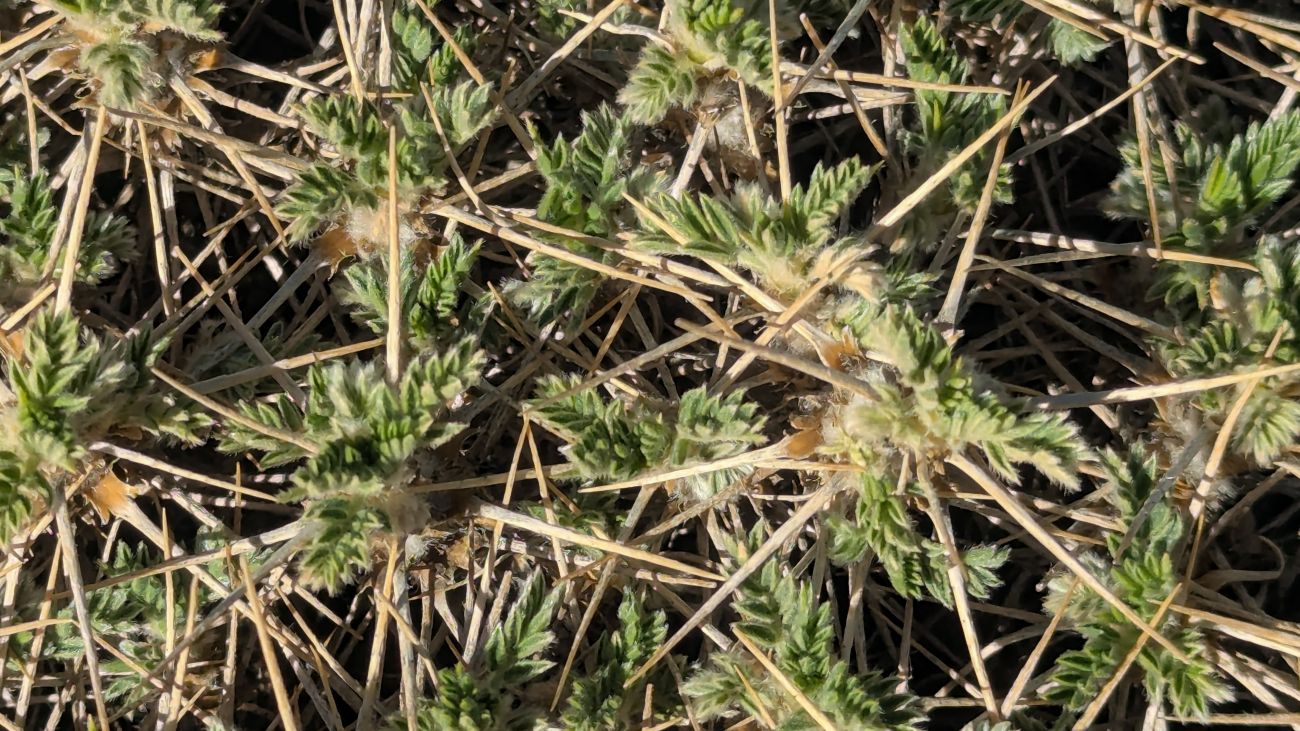
Astragalus creticus
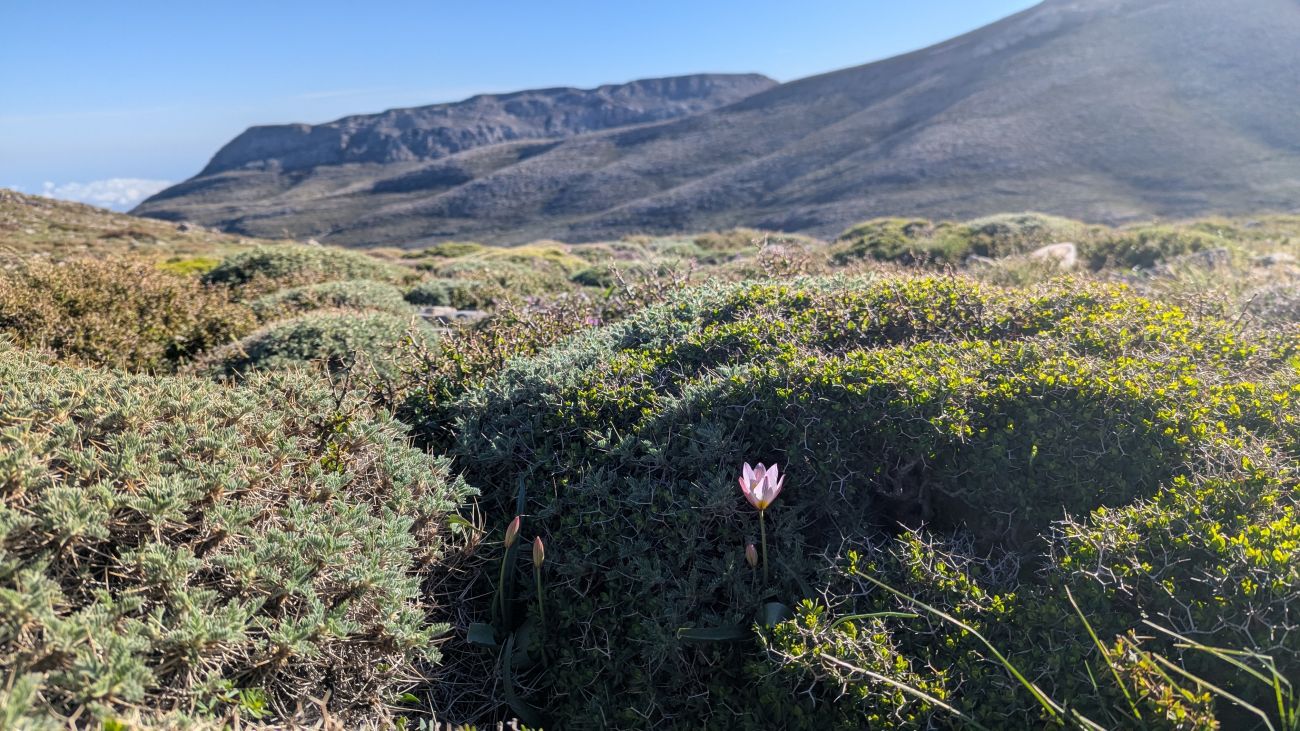
Tulipa cretica protected by the thorn-cushion

Arum idaeum

Corydalis uniflora
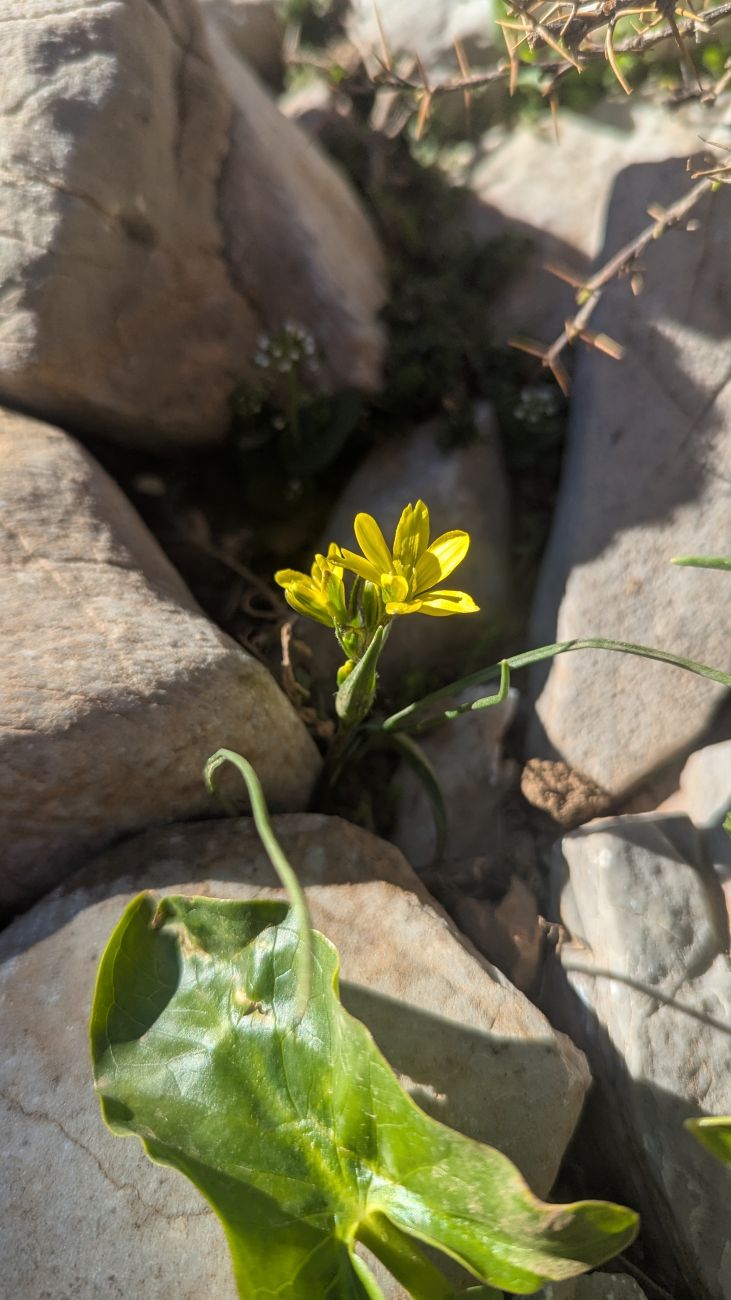
Gagea peduncularis
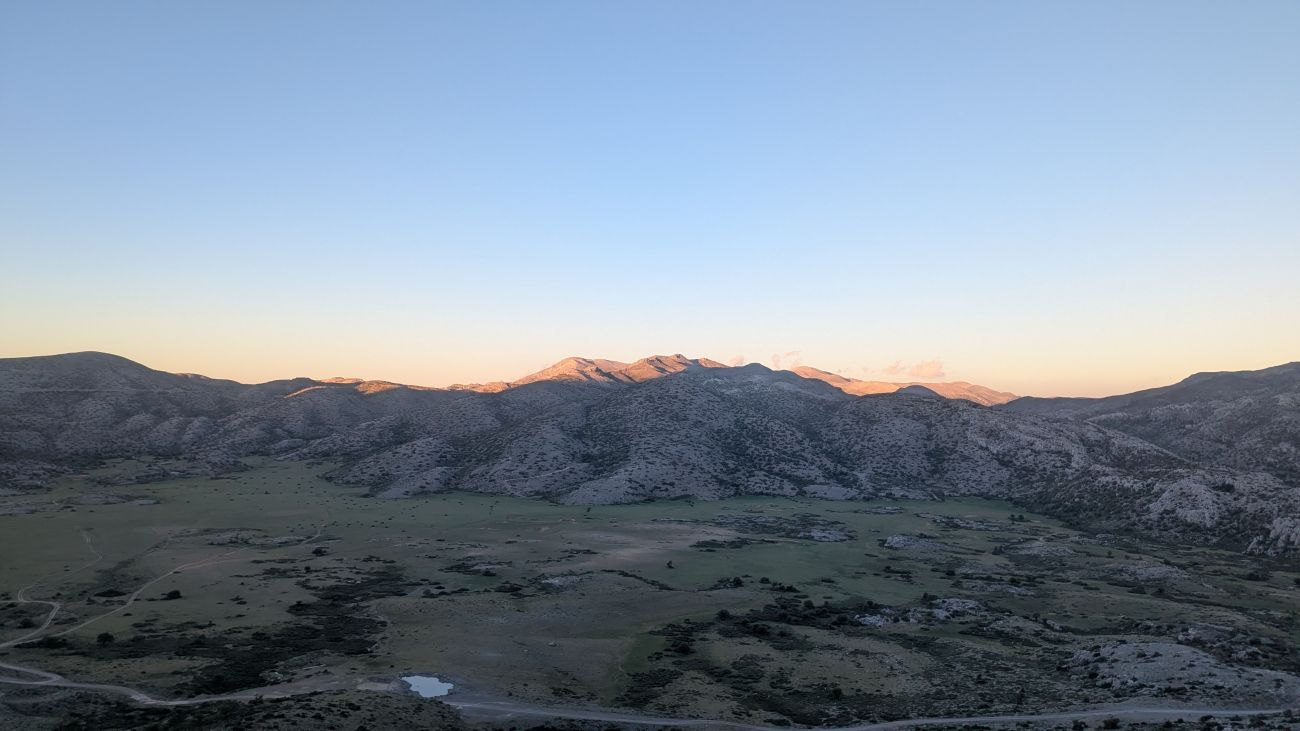
The sun sets to the west, showering rays on the eastern faces of Psiloritis towards Skinakas observatory
Full list of observations identified as of 06/26
| Family | Binomial | Subspecies |
| Amaranthaceae | Salicornia perennis | |
| Amaryllidaceae | Allium subhirsutum | |
| Amaryllidaceae | Pancratium maritimum | |
| Anacardiaceae | Pistacia lentiscus | |
| Apiaceae | Crithmum maritimum | |
| Apiaceae | Daucus pumilus | |
| Apiaceae | Eryngium maritimum | |
| Apiaceae | Orlaya daucoides | |
| Apiaceae | Scandix pecten-veneris | |
| Apocynaceae | Nerium oleander | |
| Araceae | Arum concinnatum | |
| Araceae | Arum creticum | |
| Araceae | Arum idaeum | |
| Araceae | Dracunculus vulgaris | |
| Arecaceae | Phoenix theophrasti | |
| Asparagaceae | Muscari comosum | |
| Asparagaceae | Muscari heldreichii | |
| Asparagaceae | Muscari spreitzenhoferi | |
| Asparagaceae | Ornithogalum divergens | |
| Asparagaceae | Ornithogalum narbonense | |
| Asparagaceae | Scilla nana | |
| Asphodelaceae | Asphodeline lutea | |
| Asphodelaceae | Asphodelus ramosus | |
| Aspleniaceae | Asplenium ceterach | |
| Asteraceae | Achillea maritima | |
| Asteraceae | Anthemis chia | |
| Asteraceae | Anthemis rigida | |
| Asteraceae | Atractylis cancellata | |
| Asteraceae | Bellis sylvestris | |
| Asteraceae | Carduus pycnocephalus | |
| Asteraceae | Carthamus tenuis | |
| Asteraceae | Centaurea argentea | |
| Asteraceae | Centaurea raphanina | |
| Asteraceae | Crocodilium pumilio | |
| Asteraceae | Cynara cornigera | |
| Asteraceae | Galactites tomentosus | |
| Asteraceae | Hyoseris lucida | |
| Asteraceae | Lamyropsis cynaroides | |
| Asteraceae | Limbarda crithmoides | |
| Asteraceae | Notobasis syriaca | |
| Asteraceae | Onopordum bracteatum | |
| Asteraceae | Pallenis spinosa | |
| Asteraceae | Phagnalon graecum | |
| Asteraceae | Tragopogon eriospermus | |
| Aytoniaceae | Reboulia hemisphaerica | |
| Berberidaceae | Berberis cretica | |
| Boraginaceae | Alkanna sieberi | |
| Boraginaceae | Anchusa cespitosa | |
| Boraginaceae | Buglossoides incrassata | |
| Boraginaceae | Cynoglossum columnae | |
| Boraginaceae | Echium italicum | |
| Boraginaceae | Lithodora hispidula | |
| Boraginaceae | Myosotis incrassata | |
| Boraginaceae | Myosotis ramosissima | |
| Boraginaceae | Myosotis refracta | |
| Boraginaceae | Onosma graeca | |
| Brassicaceae | Aethionema saxatile | creticum |
| Brassicaceae | Arabis caucasica | |
| Brassicaceae | Aubrieta deltoidea | |
| Brassicaceae | Biscutella didyma | |
| Brassicaceae | Cakile maritima | |
| Brassicaceae | Cardamine graeca | |
| Brassicaceae | Malcolmia flexuosa | |
| Brassicaceae | Noccaea perfoliata | |
| Brassicaceae | Sisymbrium officinale | |
| Campanulaceae | Legousia pentagonia | |
| Campanulaceae | Petromarula pinnata | |
| Campanulaceae | Solenopsis minuta | |
| Capparaceae | Capparis orientalis | |
| Caprifoliaceae | Centranthus calcitrapae | |
| Caprifoliaceae | Knautia integrifolia | |
| Caryophyllaceae | Cerastium comatum | |
| Caryophyllaceae | Cerastium glomeratum | |
| Caryophyllaceae | Cerastium scaposum | |
| Caryophyllaceae | Paronychia macrosepala | |
| Caryophyllaceae | Silene cretica | |
| Caryophyllaceae | Silene sedoides | |
| Caryophyllaceae | Silene succulenta | |
| Caryophyllaceae | Spergularia bocconei | |
| Cistaceae | Cistus creticus | |
| Cistaceae | Cistus parviflorus | |
| Cistaceae | Fumana laevis | |
| Crassulaceae | Rosularia serrata | |
| Crassulaceae | Sedum album | |
| Crassulaceae | Sedum litoreum | |
| Crassulaceae | Sedum tristriatum | |
| Crassulaceae | Umbilicus horizontalis | |
| Crassulaceae | Umbilicus parviflorus | |
| Cucurbitaceae | Bryonia cretica | |
| Cupressaceae | Cupressus sempervirens | |
| Cupressaceae | Juniperus deltoides | |
| Cupressaceae | Juniperus macrocarpa | |
| Dioscoreaceae | Dioscorea communis | |
| Ephedraceae | Ephedra foeminea | |
| Ericaceae | Erica manipuliflora | |
| Euphorbiaceae | Euphorbia acanthothamnos | |
| Euphorbiaceae | Euphorbia characias | |
| Euphorbiaceae | Euphorbia dendroides | |
| Euphorbiaceae | Euphorbia herniariifolia | |
| Euphorbiaceae | Euphorbia paralias | |
| Euphorbiaceae | Mercurialis annua | |
| Fabaceae | Anthyllis hermanniae | |
| Fabaceae | Anthyllis vulneraria | rubriflora |
| Fabaceae | Astragalus angustifolius | echinoides |
| Fabaceae | Astragalus angustifolius | |
| Fabaceae | Bituminaria bituminosa | |
| Fabaceae | Calicotome villosa | |
| Fabaceae | Ceratonia siliqua | |
| Fabaceae | Ebenus cretica | |
| Fabaceae | Lotus cytisoides | |
| Fabaceae | Lupinus pilosus | |
| Fabaceae | Medicago marina | |
| Fabaceae | Ononis reclinata | |
| Fabaceae | Securigera cretica | |
| Fabaceae | Trifolium campestre | |
| Fabaceae | Trifolium scabrum | |
| Fabaceae | Trifolium uniflorum | |
| Fabaceae | Tripodion tetraphyllum | |
| Fagaceae | Quercus coccifera | |
| Fagaceae | Quercus coccifera | coccifera |
| Gentianaceae | Centaurium tenuiflorum | |
| Geraniaceae | Erodium laciniatum | |
| Geraniaceae | Geranium lucidum | |
| Geraniaceae | Geranium purpureum | |
| Iridaceae | Iris unguicularis | cretensis |
| Iridaceae | Moraea mediterranea | |
| Lamiaceae | Lamium amplexicaule | |
| Lamiaceae | Lamium garganicum | |
| Lamiaceae | Lamium purpureum | |
| Lamiaceae | Micromeria nervosa | |
| Lamiaceae | Origanum dictamnus | |
| Lamiaceae | Phlomis fruticosa | |
| Lamiaceae | Phlomis lanata | |
| Lamiaceae | Prasium majus | |
| Lamiaceae | Pseudodictamnus mediterraneus | |
| Lamiaceae | Satureja thymbra | |
| Lamiaceae | Scutellaria sieberi | |
| Lamiaceae | Sideritis romana | |
| Lamiaceae | Stachys cretica | |
| Lamiaceae | Stachys cretica | |
| Lamiaceae | Teucrium alpestre | |
| Lamiaceae | Teucrium capitatum | |
| Lamiaceae | Teucrium divaricatum | |
| Lamiaceae | Thymbra capitata | |
| Lamiaceae | Vitex agnus-castus | |
| Liliaceae | Gagea graeca | |
| Liliaceae | Gagea peduncularis | |
| Liliaceae | Tulipa cretica | |
| Linaceae | Linum bienne | |
| Linaceae | Linum caespitosum | |
| Linaceae | Linum strictum | spicatum |
| Linaceae | Linum strictum | |
| Lythraceae | Lythrum hyssopifolia | |
| Malvaceae | Malva sylvestris | |
| Moraceae | Ficus carica | |
| Oleaceae | Olea europaea | |
| Oleaceae | Phillyrea latifolia | |
| Orchidaceae | Orchis quadripunctata | |
| Orchidaceae | Serapias orientalis | |
| Orobanchaceae | Orobanche pubescens | |
| Orobanchaceae | Orobanche sanguinea | |
| Orobanchaceae | Parentucellia latifolia | |
| Papaveraceae | Corydalis uniflora | |
| Papaveraceae | Papaver rhoeas | |
| Pinaceae | Pinus brutia | |
| Plantaginaceae | Plantago coronopus | |
| Plantaginaceae | Veronica cymbalaria | |
| Platanaceae | Platanus orientalis | |
| Plumbaginaceae | Acantholimon androsaceum | |
| Plumbaginaceae | Limoniastrum monopetalum | |
| Plumbaginaceae | Limonium virgatum | |
| Poaceae | Calamagrostis arenaria | |
| Poaceae | Lagurus ovatus | |
| Polygonaceae | Rumex tuberosus | |
| Posidoniaceae | Posidonia oceanica | |
| Primulaceae | Cyclamen creticum | |
| Primulaceae | Cyclamen graecum | |
| Primulaceae | Lysimachia loeflingii | |
| Pteridaceae | Oeosporangium acrosticum | |
| Ranunculaceae | Anemone hortensis | |
| Ranunculaceae | Nigella arvensis | |
| Ranunculaceae | Ranunculus asiaticus | |
| Ranunculaceae | Ranunculus paludosus | |
| Rhamnaceae | Rhamnus oleoides | |
| Rosaceae | Crataegus monogyna | |
| Rosaceae | Prunus prostrata | |
| Rosaceae | Sarcopoterium spinosum | |
| Rubiaceae | Valantia hispida | |
| Rutaceae | Ruta chalepensis | |
| Sapindaceae | Acer sempervirens | |
| Saxifragaceae | Saxifraga rotundifolia | |
| Scrophulariaceae | Verbascum arcturus | |
| Scrophulariaceae | Verbascum macrurum | |
| Selaginellaceae | Selaginella denticulata | |
| Solanaceae | Mandragora officinarum | |
| Thymelaeaceae | Daphne sericea | |
| Urticaceae | Parietaria judaica | |
| Urticaceae | Urtica pilulifera | |
| Violaceae | Viola alba | cretica |
| Violaceae | Viola fragrans |
Summary
I am incredibly grateful to the funders of this trip, along with the people met along the way. It was an amazing opportunity to develop my botanical and horticultural skillset, as well as see such a beautiful part of the world.
Finding and identifying flora from a (personally) new region has expanded my pattern recognition and keying / identification skills of unfamiliar flora.
Observing how these plants grow in their natural habitats has been of great importance to developing my future career as a plantsman. I hope and intend this will have a knock-on effect, which I can pass on to fellow plantspeople.
The planning and execution of trips such as these have given me experience to put towards being somebody who can potentially organise group tours one day, to share the love of our nature with others.
The finding of taxa not observed in over 15 years has added to my preexisting hope that some flora believed currently extinct in the wild may not yet be.
Unavoidable obstacles preventing me from sticking to my initially planned itinerary (pre and during trip) has added to my ability to adapt plans with the resources available.
And, of course, with each botanising trip I undertake, I am further reminded that if I do not get myself a driving licence, I am incredibly limiting the possibilities of these trips.
I will be taking many things with me from this trip along my future career path in the world of plants and will be sure to return to Crete over different seasons, and to visit the eastern side of Crete and islets surrounding.
Thanks everyone for reading this report, I hope I have convinced those who haven’t yet been to go and visit Crete and take in the beauty of its nature, people, food and climate.
Charlie Hunt (RBG Kew)