

Celebrating Delos
By Jackie Hunt
On 4 June 2026 Sissinghurst Castle Gardens in Kent, southern England, officially opened their Mediterranean garden ‘Delos’, with a celebratory event, to which MPG representatives were invited. I was delighted to attend along with fellow members Lesley Jones and Alice Riches. We very much enjoyed talks about the garden’s creation by landscape architect Dan Pearson OBE and Sissinghurst Senior Gardener and Delos’ Curator Richard Gravett, along with Nigel Froggatt, who led construction of the garden.
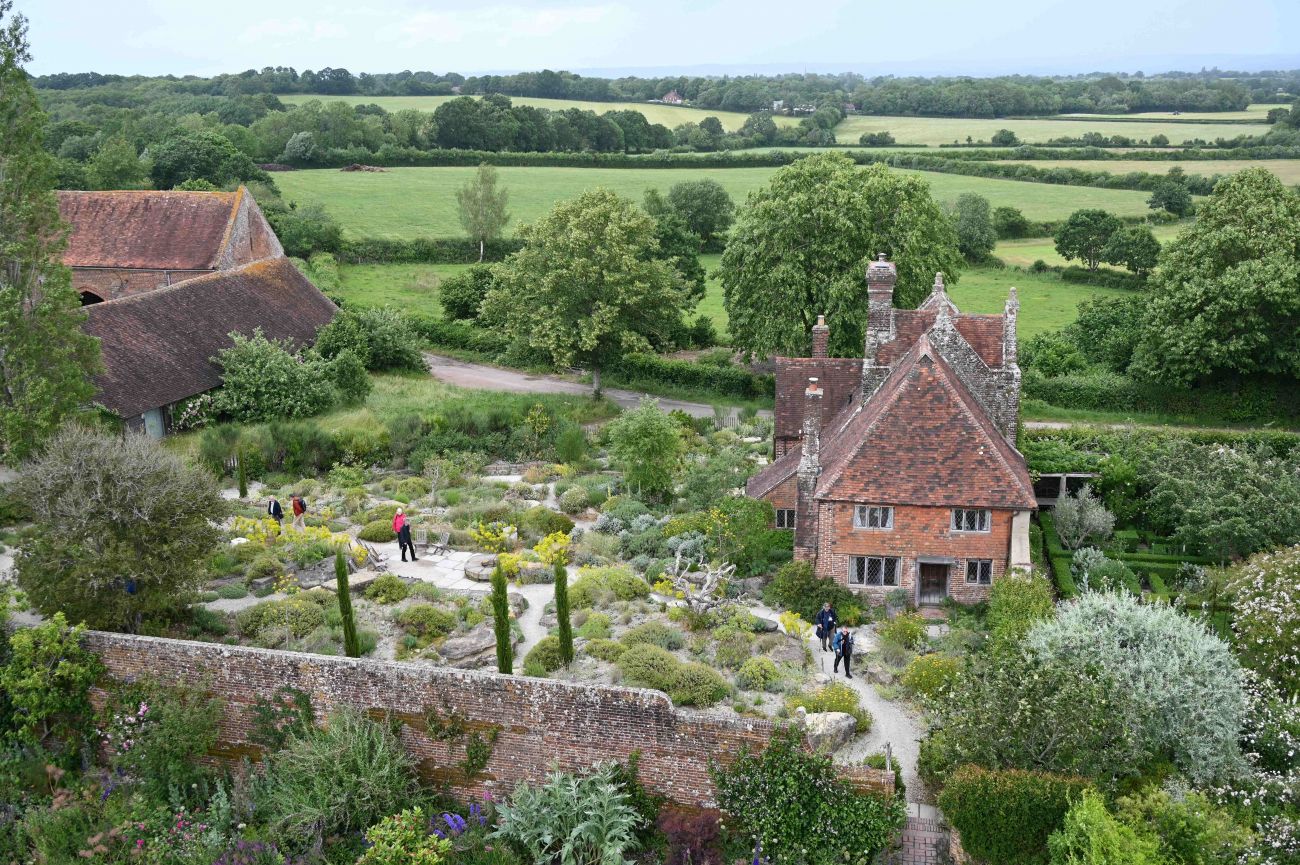
Looking down over Delos from Sissinghurst’s tower
The Delos project is part of Sissinghurst’s long-term plans to evolve the gardens in consideration of declining biodiversity and climate change. Objectives include providing more diverse habitats and making the gardens more resilient so they can continue to be enjoyed by visitors into the future. This evolution aims to respect and embrace the experimentation and romantic vision of Sissinghurst’s creators, poet and writer Vita Sackville-West and her diplomat and author husband Harold Nicolson.
Whilst travelling abroad in 1935 Vita and Harold were particularly moved by a visit to the tiny Greek island of Delos in the Cyclades archipelago, one of Greece’s most important sacred, archaeological and mythological sites. Legend says it was the birthplace of Greek gods Artemis and Apollo and today it is a Unesco World Heritage site. Vita and Harold were enchanted by the stepped terraces, emerging bedrock and ancient monuments colonised by wild plants. On their return to Sissinghurst they wanted to capture the essence of the island. They introduced Grecian altars previously acquired by Harold’s family and used stones from demolished medieval and Elizabethan buildings on the estate to create terraces. Within these they planted Mediterranean species such as Quercus coccifera (Kermes oak) and Arbutus unedo (strawberry tree).
Creating a naturalistic landscape was radical in gardening in the 1930s. However the heavy, moisture-retentive Wealden clay, a north-facing site shaded by trees, limited availability of Mediterranean plants, as well as the couple’s experience as amateur gardeners, meant that the garden never fulfilled their vision. With the Second World War approaching, many of the garden staff were called up. By 1953 Vita wrote “This has not been a success so far, but perhaps someday it will come right”.
Dan Pearson has been an advisor to Sissinghurst since 2014, collaborating with the team to regenerate the gardens. Phase One of the Delos project began in 2018, creating the main area of the garden. Phase Two involved demolishing a modern garage adjoining the Priest’s House and creating a rocky, “ravine-like portal” to connect the main garden to the Little North Garden. In Delos they wanted to create a sense of place, evoking the atmosphere and wonder which Harold and Vita experienced when they visited the Greek island. They also wanted to create a feeling of layers of history, so characteristic of Sissinghurst.
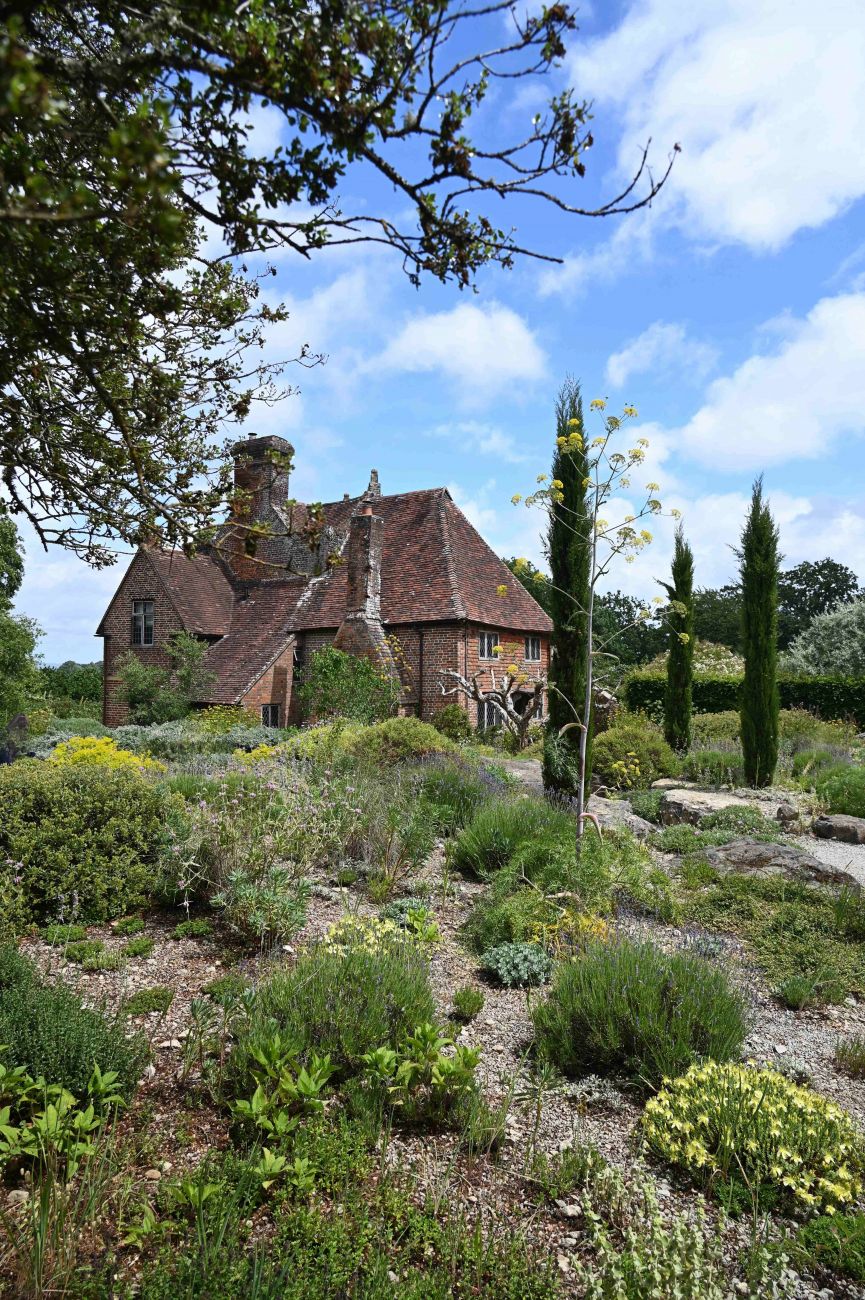
View towards the Priest’s House, with narrow Cupressus sempervirens on the right
To help understand this atmosphere, Richard Gravett and, earlier, former Assistant Gardener Joshua Sparkes, have both visited Delos island, observing how vegetation has colonised the ruins. Plants follow contours to seek shelter and seed into path edges. The vegetation is phrygana, a thorny scrub typical of the Mediterranean that is influenced by climate, fire, grazing and storms. Fire clears shrubs to make way for areas of bulbs and annuals. Grazing animals nibble plants into low mounds that spill over drystone walls and trees appear almost topiarised. The garden seeks to evoke the character of this vegetation in plant selection and also management, such as selective clearing and shearing over plants after flowering to replicate ‘goat pruning’ .
The Delos project has involved major landscaping to overcome the factors that limited its original creation. Dan explained how he used cut and folded cardboard to mock up the new terrain for the garden, angling newly created terraces towards the light and creating varied planting environments. Nigel Froggat personally selected 80 tonnes of rough-cut ragstone rocks from a quarry 15 miles away, locating these first before installing drainage, which is wrapped in geotextile to prevent silting up. A new free-draining soil mix was made of crushed brick, crushed local ragstone and just 25 per cent nutrient-poor topsoil, topped with local stone gravel. The centre of the garden is a “street” and an agora (a square or meeting-place) with a well, reminiscent of the ruins Vita and Harold saw. Antiquities are dotted throughout, including stone pillars that came from a loggia at High Wall in Oxford, built by architect and garden designer Harold Peto.
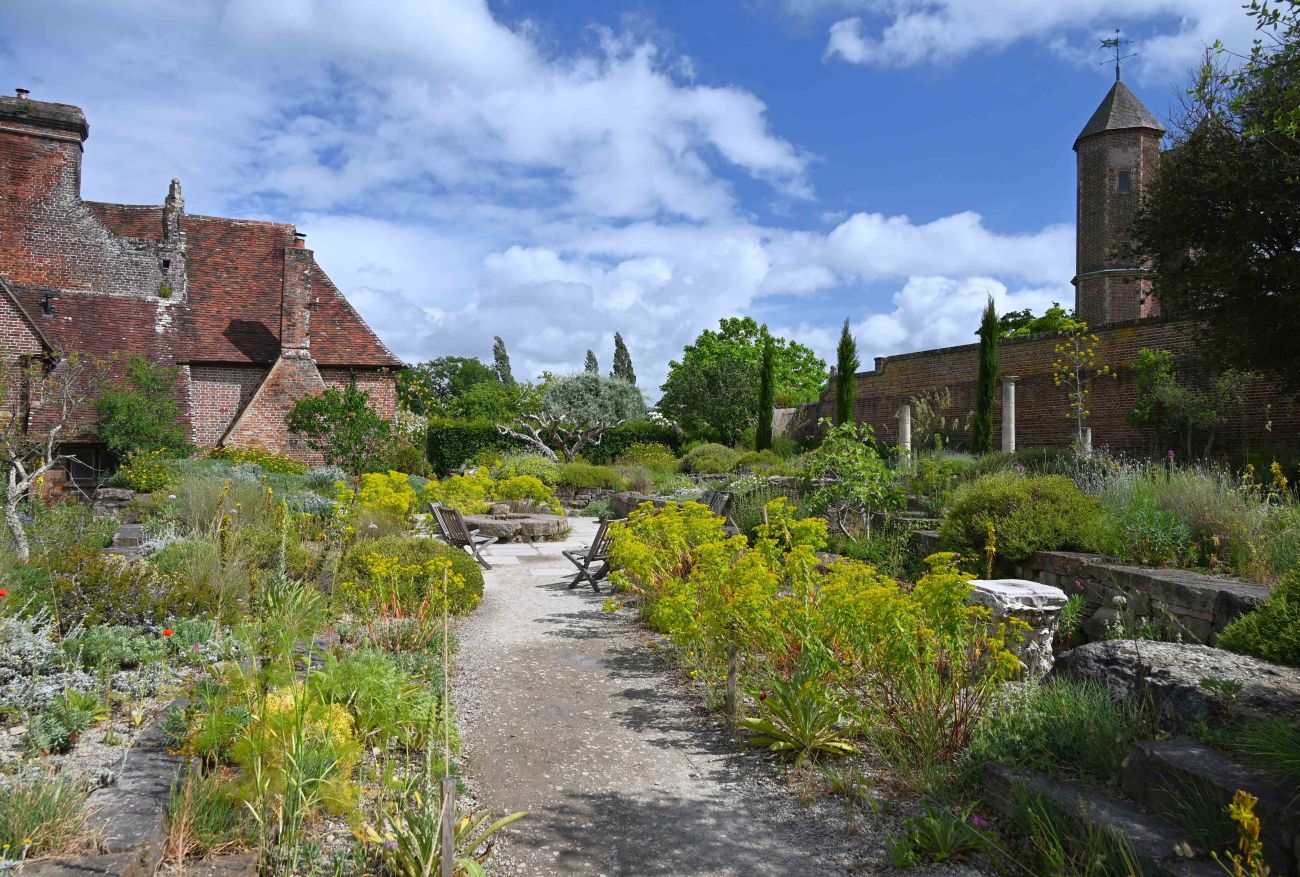
The “street”, lined by green-yellow Euphorbia ceratocarpa
With the UK climate predicted to change to warmer, wetter winters and hotter, drier summers, plant selection is designed as an experiment and potential example of how we might garden in the future. Dan explained how the majority of pre-existing trees were removed apart from a sculptural Quercus coccifera, to allow light in. Dan hopes that new tree and shrub planting such as pomegranate, cork, Judas trees and cypress, along with trees of the wider estate, will frame views out from the garden, to try to create a sense of a Greek hillside looking toward the distant blue of the Aegean sea. He hopes it doesn’t seem like theatre, but rather a feeling of being taken to elsewhere. The garden is rich with botanical treasures – over 6000 plants typical of Greece and the Mediterranean basin have been used. Most are rare in UK cultivation, but there are several familiar garden genus like Cistus and Acanthus. Planting in the new ravine-like portal was inspired by species growing in deep gorges, the cool shade of drystone walls and under tree canopies on Greek islands.
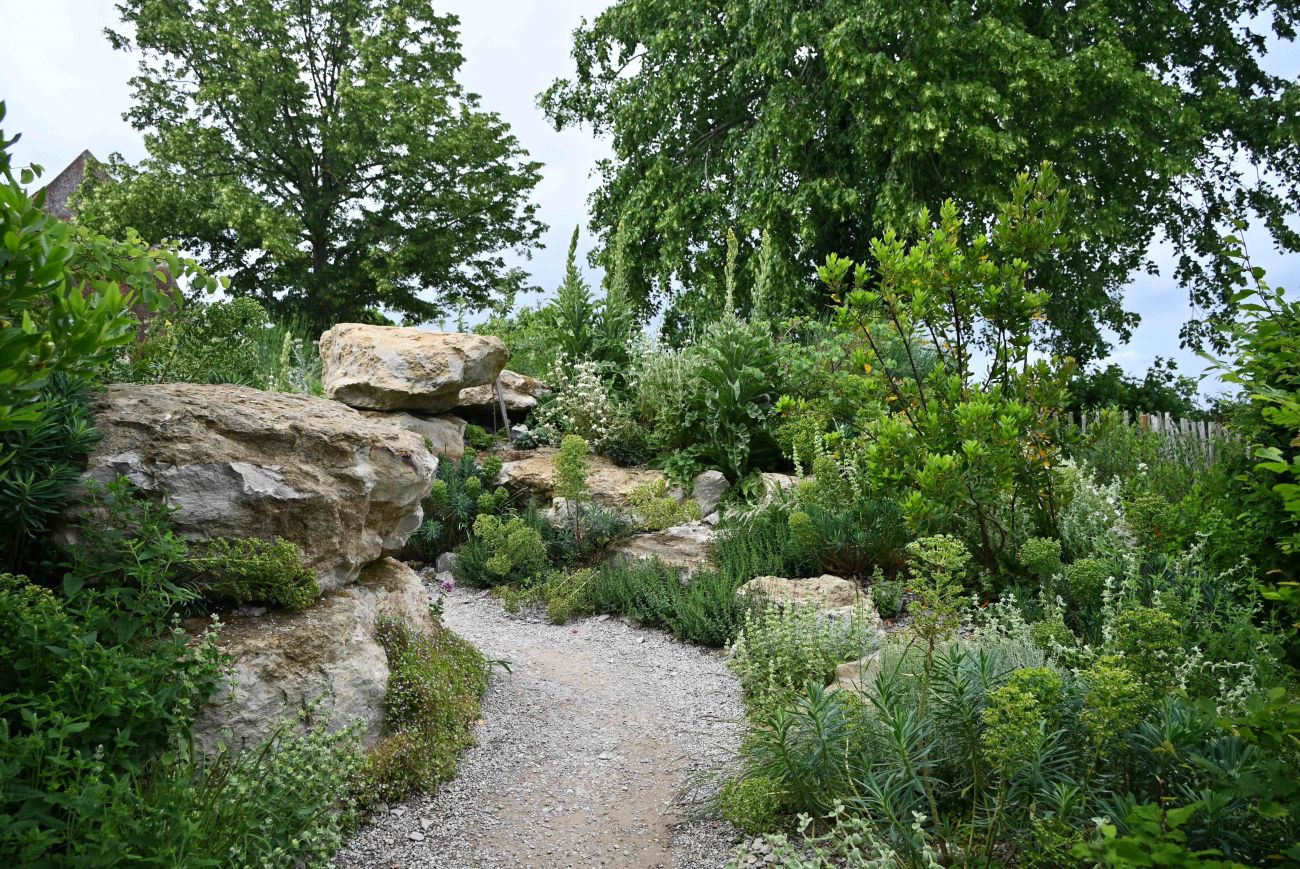
The new ravine
Most plants were sourced from the expert on drought tolerant planting, Olivier Filippi, from his nursery Pépinière Filippi in southern France. He helped select some particular subspecies that nod to Sissinghurst’s renowned gardens, such as white Phlomis purpurea ‘Alba’, referencing the adjacent White Garden. Olivier Filippi’s plants are grown in tall, thin pots, so they started with nice long roots. Dan created the original planting mix but, once the garden was built, plants were individually sited in appropriate locations. Richard has since been given autonomy to adapt and fine tune. Planting took place in autumn to utilise the warm soil and winter wet and no irrigation is planned once plants are established.
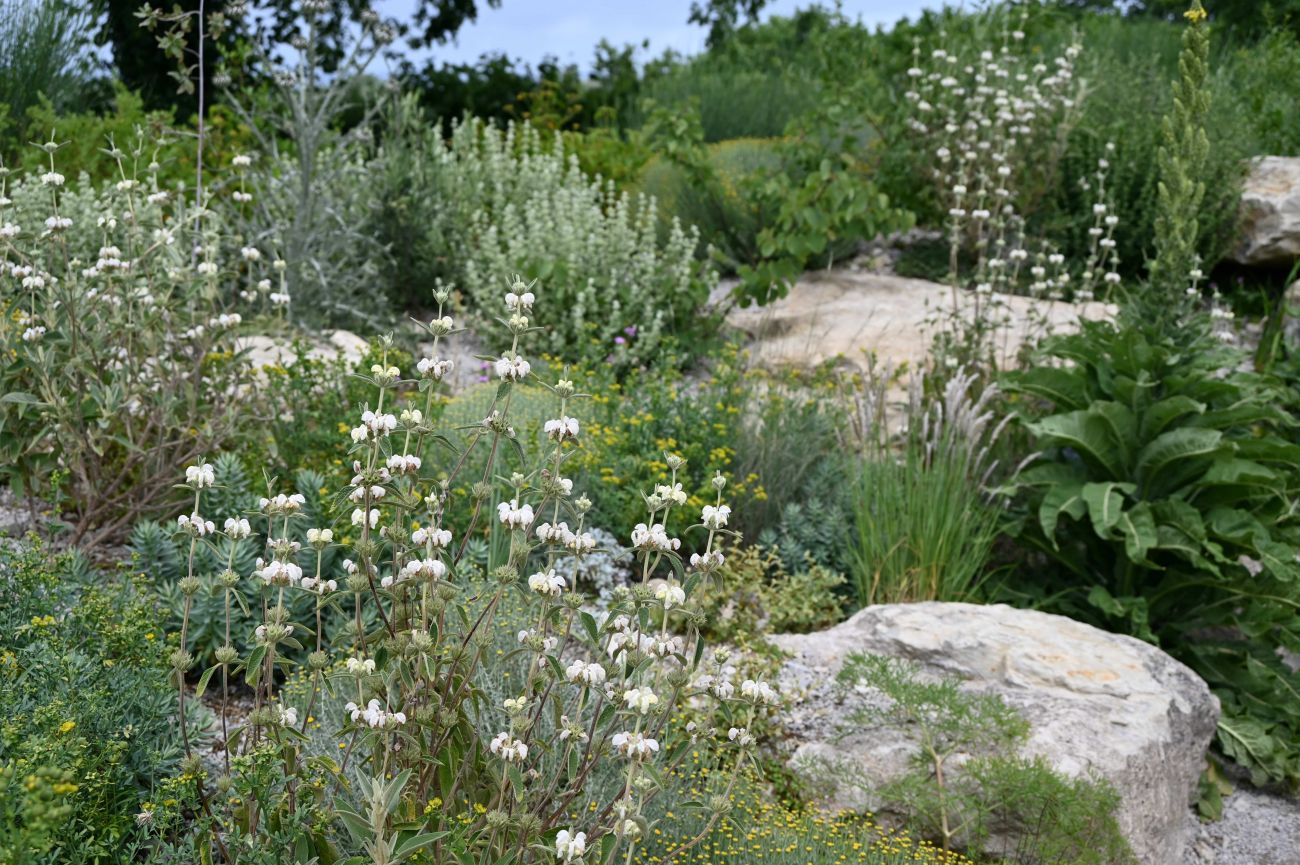
Phlomis purpurea ‘Alba’ in front left, grass Melica ciliata behind right
Other garden “rooms” at Sissinghurst are showing stress in hot dry weather, but this garden has been designed to address such challenges. Richard says Delos’ plants just adapt, such as dropping some leaves before regrowing in more favourable conditions. Cold shouldn’t be an issue, as Richard explained this is another form of drought. The challenge instead for this flora is winter wet, so he clears away mushy, decomposing plant material but retains seed heads for interest and self-seeding. He also prunes to maintain good airflow.
I had volunteered for a day in the Delos garden with Richard last April, learning his sensitive and deeply informed management of the garden. I helped with the spring cut back of shrubs to replicate grazing animals, removed dead leaves on plants such as Iris lazica and trimmed back enthusiastic spreaders such as Centaurea bella. We planted in gaps, including Salvia lavandulifolia subsp. vellerea and Thymus saturejoides. The nursery keeps some mother plants for cuttings in case of winter losses. Richard said Head Gardener Troy Scott Smith calls this ‘gardening on the edge’. He also said whilst this naturalistic style of garden may appear low maintenance it needs careful curation to recreate the stresses that would occur in the wild. It was a delight to return a year later to hear about the garden’s origins and its creation, see the completion of Phase Two and enjoy increasingly diversity and maturity of the plantings.
Richard says caring for Delos is an immersive experience. He and his colleagues aim to mimic the dynamic and spontaneous natural processes of phrygana to evoke that sense of place. He is ably supported by enthusiastic volunteers who love to share the story of this unusual and special garden with visitors. Initially many visitors weren’t enamoured with this very different style of garden room. But, as it matures, there is increasing enthusiasm. On a warm June day, with rocks baked by the sun, insects humming, flowers glowing and a blue-green haze in the distance, it does indeed feel as if you’re taken to another place.
Some plants of interest
With its pale yellow flowers, compact Hypericum olympicum f. uniflorum ‘Citrinum’ makes a striking display, whilst deep-golden yellow Phlomis longifolia brings warm tones. Teucrium flavum has tactile, soft foliage. Typifying adaptation to dry conditions, Dorycnium hirsutum ‘Frejorgue’ has hairy silver leaves that reflect light and trap moisture. It has been quick to establish and seeds around freely. The boundary hedge contains yellow pea-flowered Spartium junceum, Phillyrea angustifolia with olive-like foliage and Pistacia lentiscus, a shrub that I much admired on the MPG 2024 trip to Corfu. The main street is lined with Euphorbia ceratocarpa, which can produce flowers year round in mild conditions. Diminutive and sculptural Euphorbia rigida has fleshy blue-green leaves arranged spirally on upright stems, whilst familiar Euphorbia characias subsp. wulfenii bears huge heads of chartreuse-green flowers and is easy to grow in light free-draining soil in sun. Cistus creticus bears crinkled-paper like flowers that can vary from deep to pale pink. Richard says the cultivar Cistus x lenis ‘Grayswood Pink’ is a well known, reliable alternative. A new experiment is annual Malabaila aurea which I saw growing wild in Corfu. It has dainty yellow umbel flowers but its flattened disc-like seeds in clusters are particularly striking.
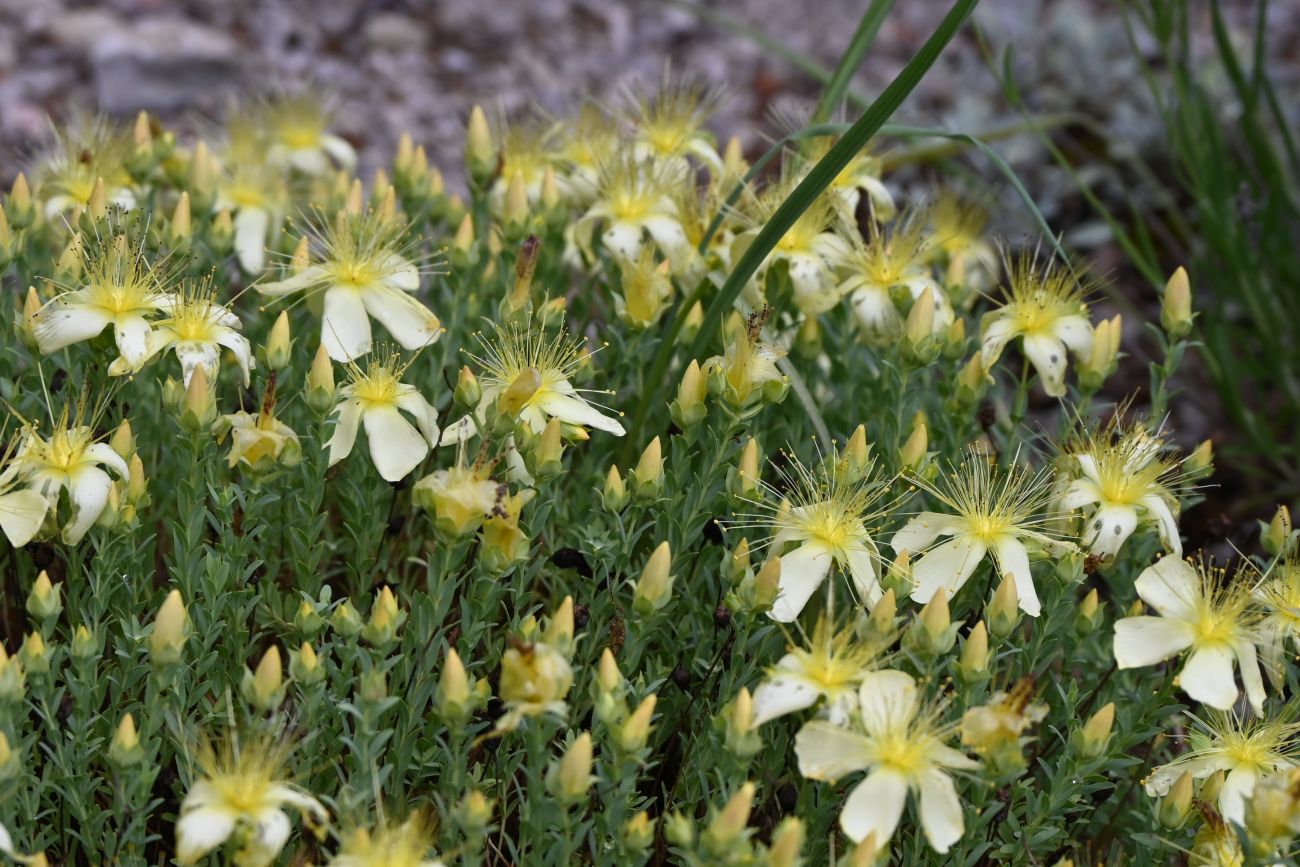
Hypericum olympicum f. uniflorum ‘Citrinum’
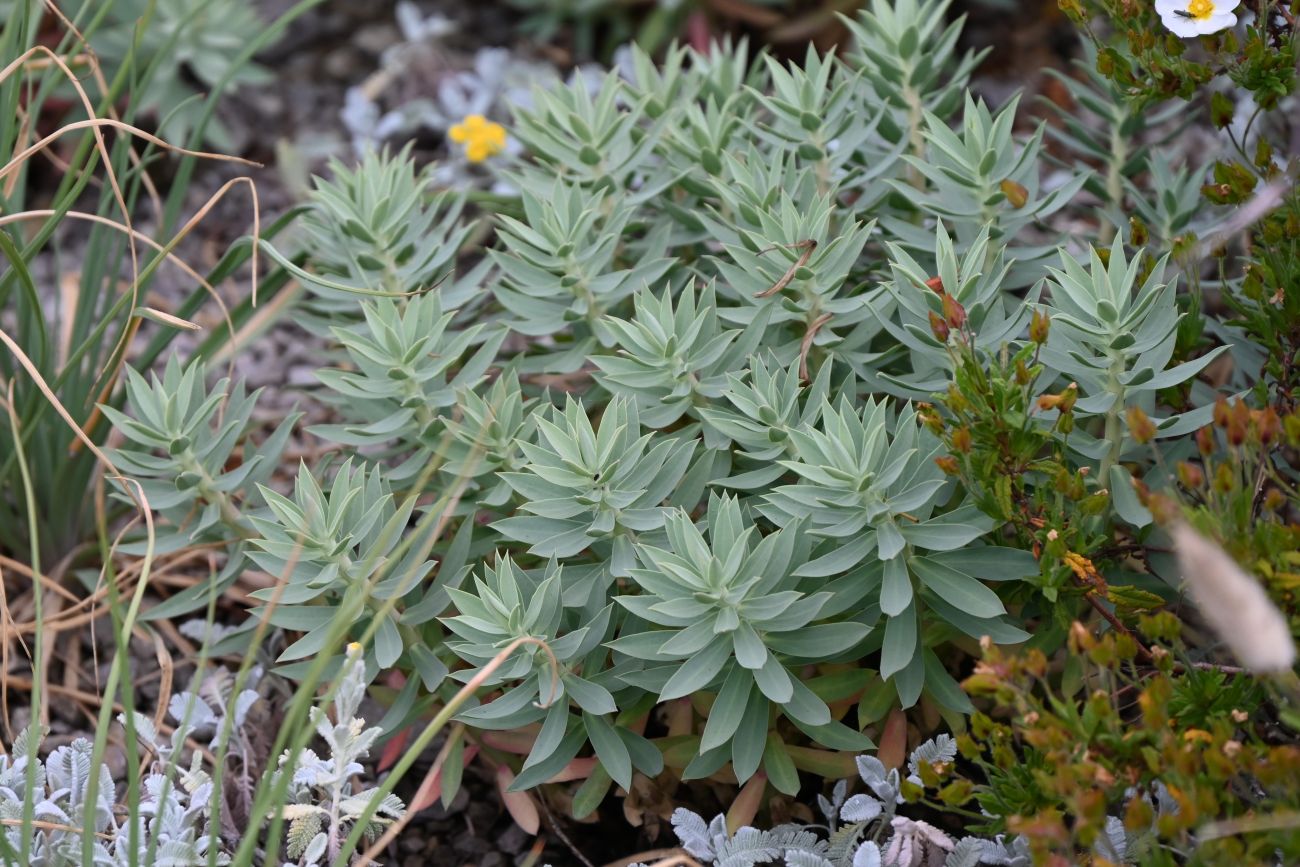
Euphorbia rigida has acidic-yellow flowers in spring
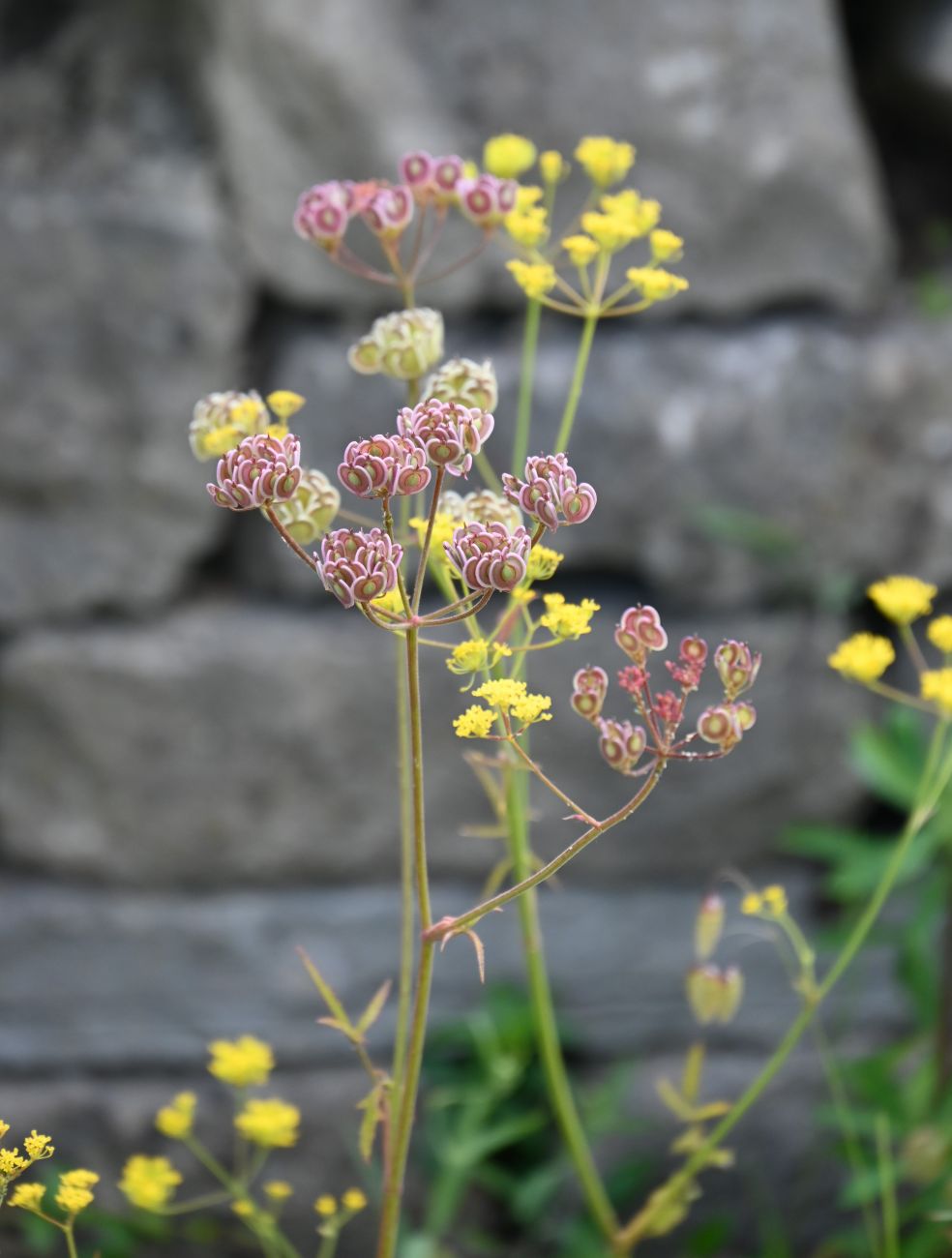
Richard is experimenting this year with annual Malabaila aurea
Find out more about Delos in these online articles and see the original plant list supplied to MPG following a lecture by Troy Scott Smith:
https://digdelve.com/delos-at-sissinghurst
https://www.medpag.org/the-delos-garden-at-sissinghurst
Many thanks to the team at Sissinghurst for their warm welcome to MPG. Particular thanks to Richard Gravett and Saffron Prentis, assistant head gardener, for sharing their knowledge and enabling my volunteering in Delos.
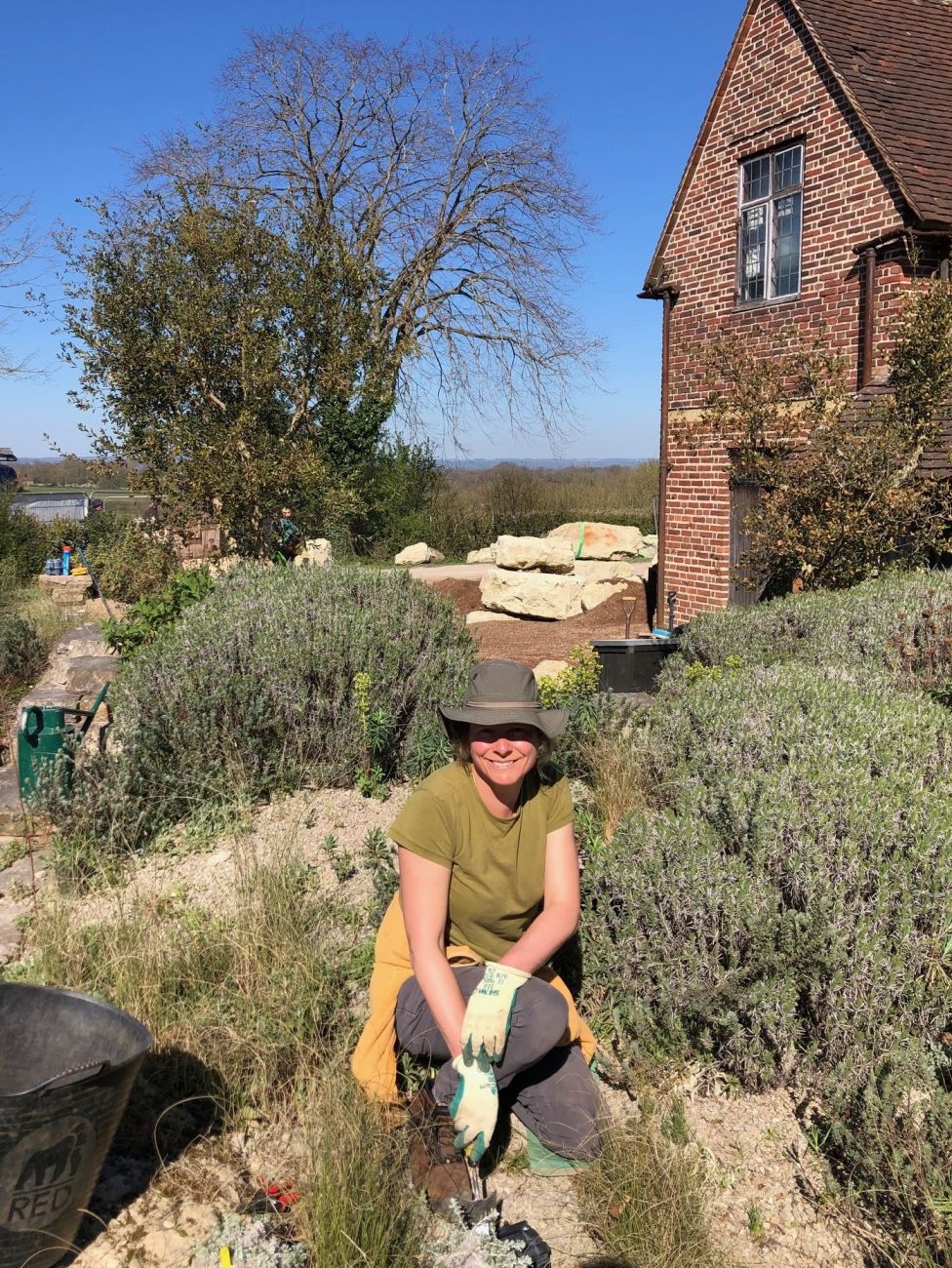
Jackie Hunt volunteering in Delos in spring 2025, with Phase 2 under construction behind