

Southern Gloucestershire summer garden tour
Sunday 28 June – Tuesday 2 July 2026
The gods were with us in Gloucestershire as the UK summer tour was blessed with ideal weather for garden visiting. There were extreme heatwave conditions locally the week before we met, and another heatwave hit the area the week after we returned home. We luckily experienced warm sunny weather, with some clouds.
On our first day we visited three private gardens located around Cirencester, not far from our hotel.
Cotswold Farm has been the home of the Birchall family for five generations. The 17th century house has been extended over the centuries. John and Sarah Birchall have inherited Cotswold Farm relatively recently and are gradually developing the planting within the historic framework. The Arts and Crafts terraced garden, overlooking a quiet unspoilt valley, was designed by Norman Jewson in the 1930s. Enclosed by Cotswold stone walls and yew hedges, the garden has year-round interest, including a snowdrop collection with over 80 varieties. The terraces, shrub garden, herbaceous borders and bog garden are full of scent and colour from spring to autumn. A characteristic stone Art and Crafts summerhouse is located in the lower garden, beyond which is a bog garden fed by a spring. The steps down to the summerhouse are flanked by borders packed with shrubs and perennials terminating in superb specimens of Cornus controversa ‘Variegata’ and Cercidiphyllum japonicum.
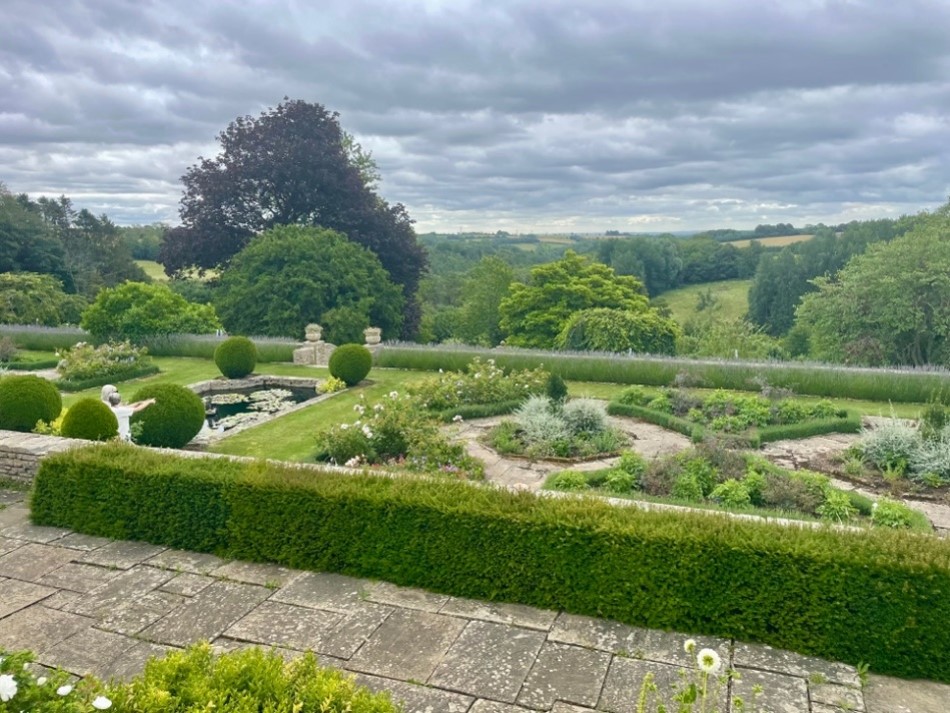
View from the upper terrace to the parterre and valley beyond.
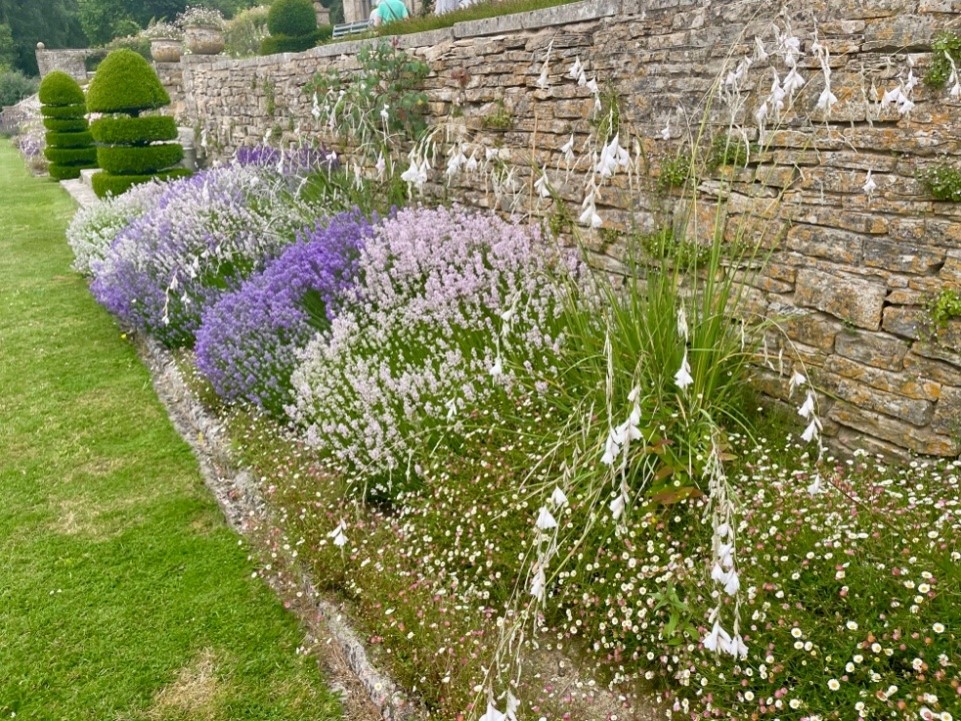
Lavenders, Dierama and Erigeron, a beautiful and unusual combination.
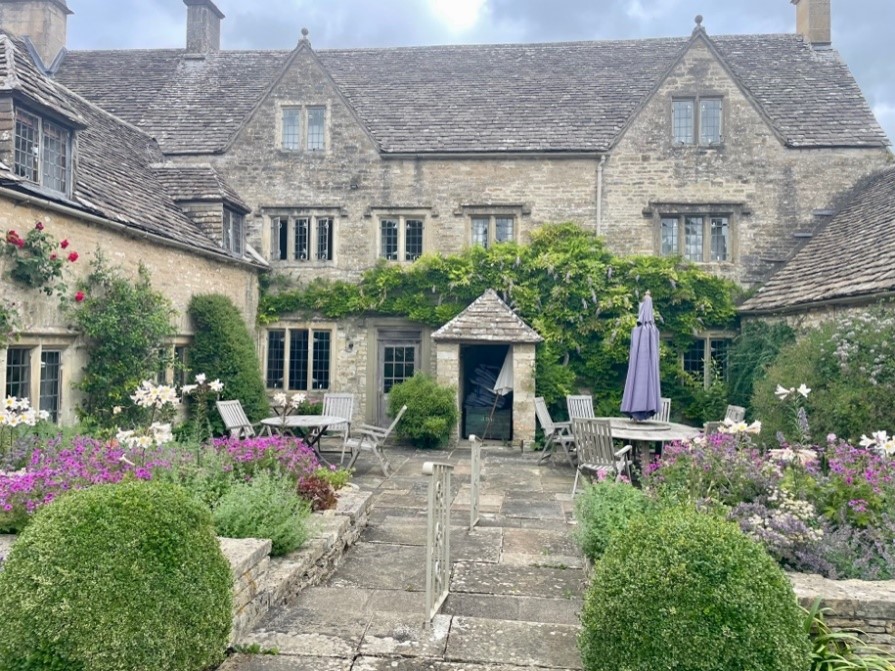
A sheltered terrace with raised beds of Nepeta, Geranium ‘Patricia’ and Lilium regale.
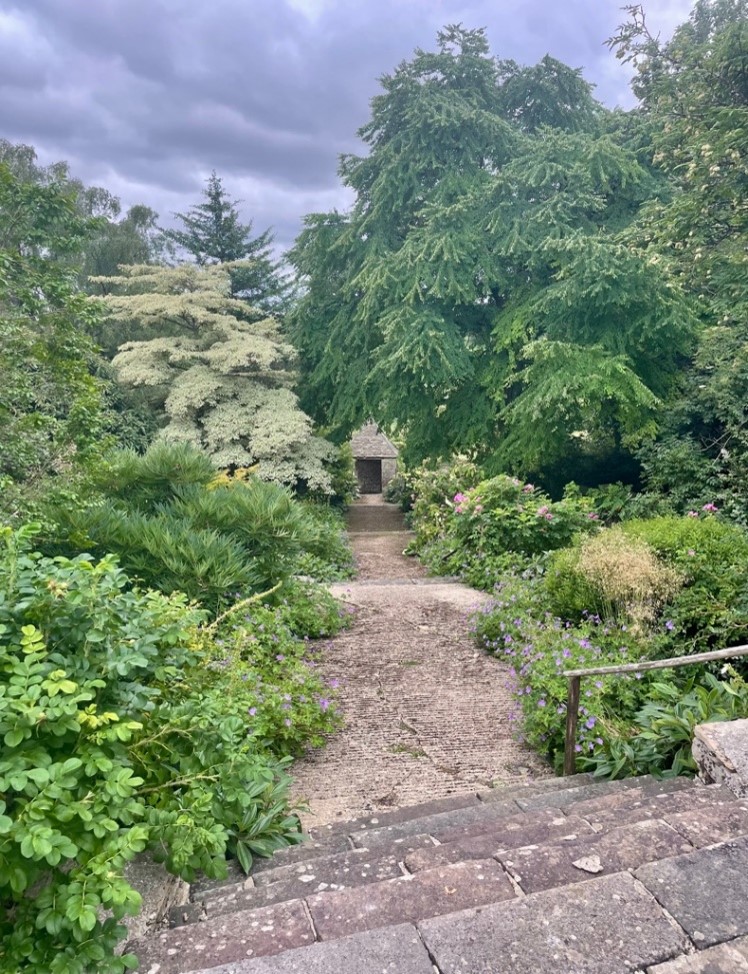
The steps down to the summerhouse.
We were welcomed to Moor Wood Farm by Henry Robinson to view his traditional Cotswold estate, home to four generations of his family. It is also home to the National Collection of Rambler Roses, with over 60 varieties, which bring the whole valley to life for about two weeks each year when they are in bloom. We were lucky enough to enjoy the last week of this spectacle. Roses of note included: ‘Hiawatha’ with bright crimson-red flowers with white centres and golden anthers, and ‘Minnehaha’ with rich pink flowers. Both these lesser-known roses are Wichurana ramblers, which sport glossy green, disease-resistant leaves and large clusters of flowers. The roses were named for the Indian hero of Longfellow’s narrative poem. Another interesting find was an enormous cedar tree believed to be over 500 years old, a magnificent specimen that is thought to have come from Cirencester House. The garden comprises two acres of shrubs, a rose garden, orchards and wildflowers, which the family mainly garden themselves. Henry told us that “We are passionate about the environment and believe this is reflected in our dedication to the roses, wildflowers and wildlife found throughout the garden and across the farm. Our vision for Moor Wood is to balance farming and nature. The guiding principle is to establish a productive ecosystem through active management that enables flora and fauna to thrive.”
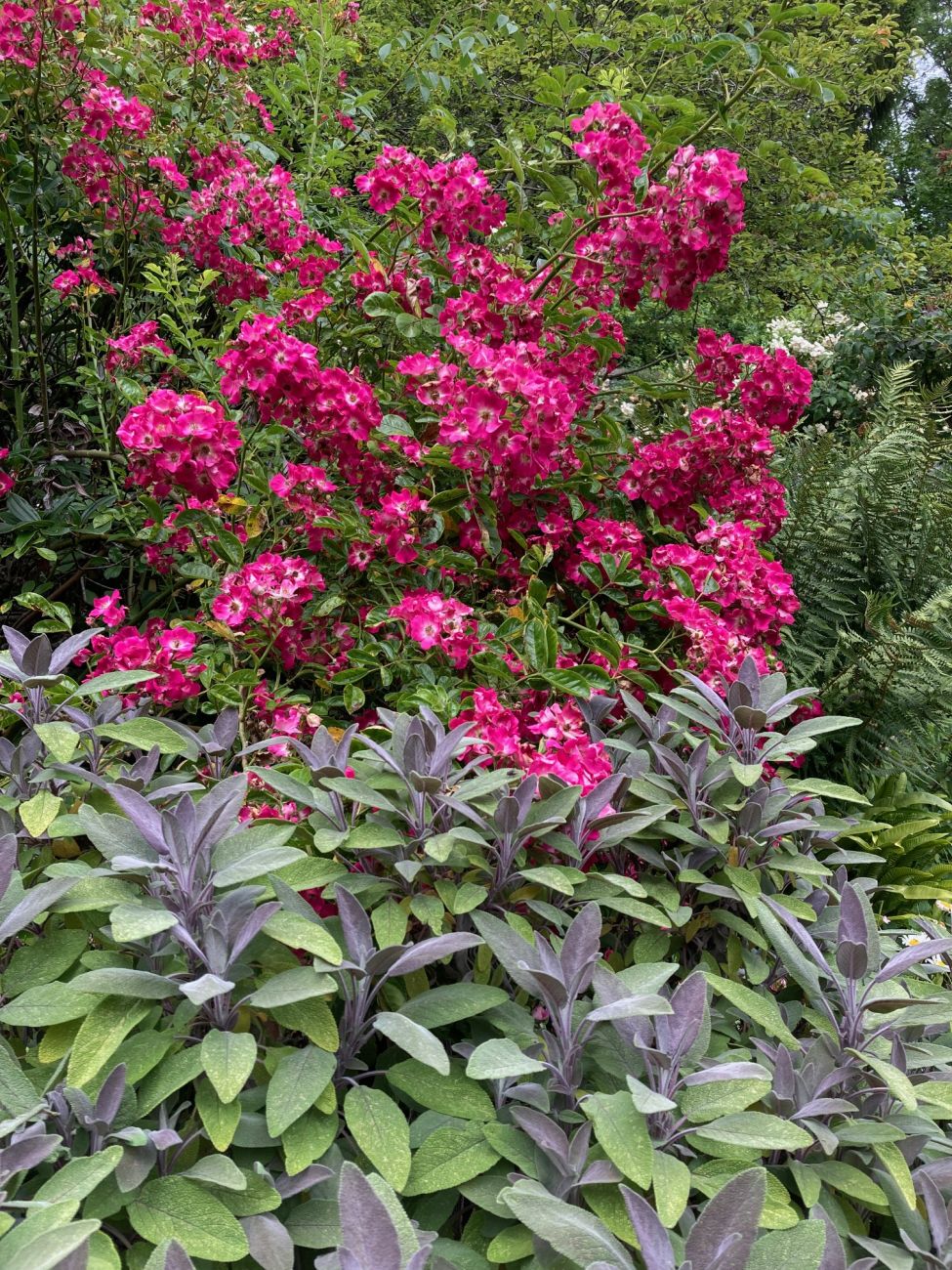
Rosa ‘Hiawatha’
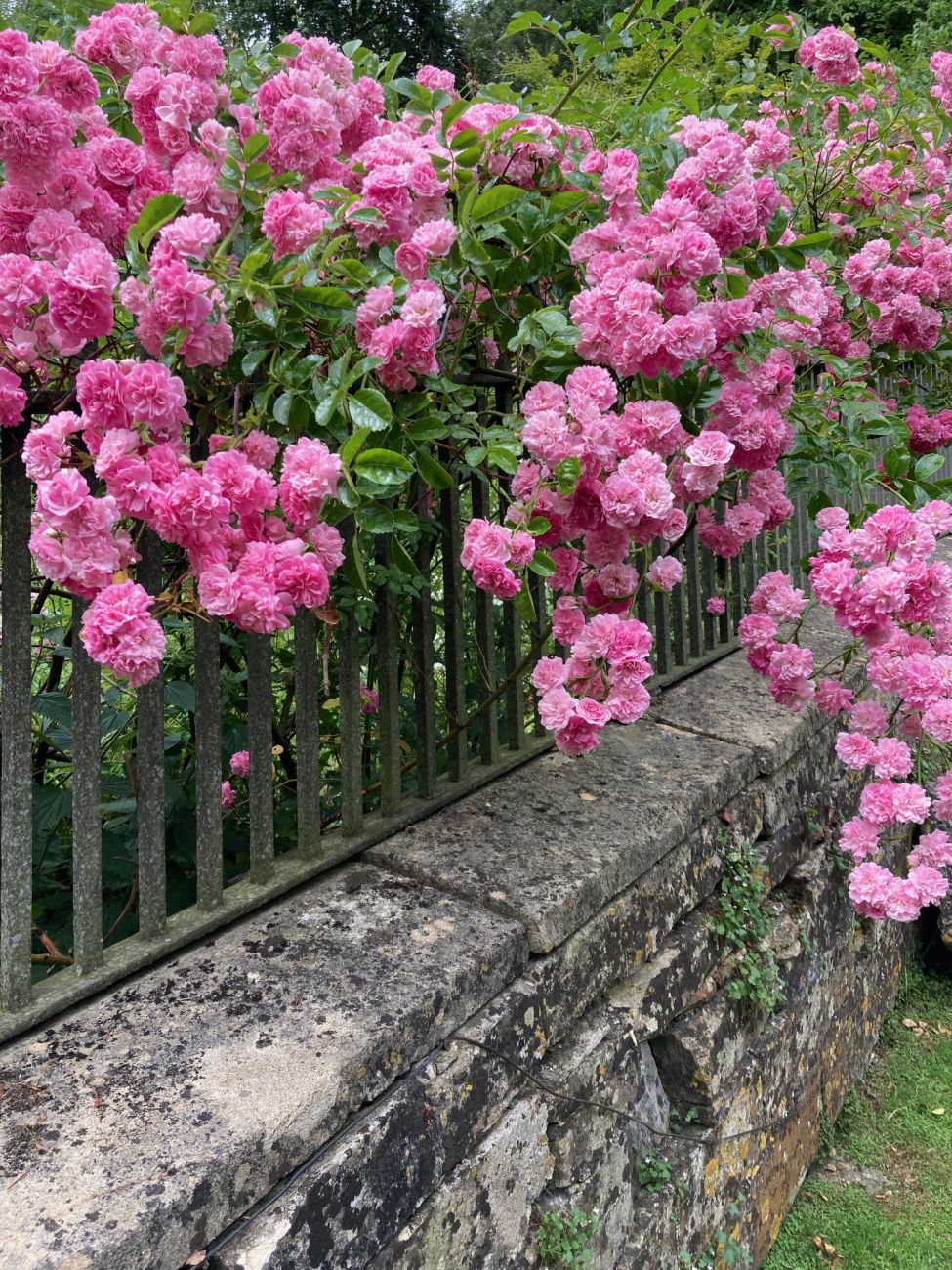
Rosa ‘Minnehaha’
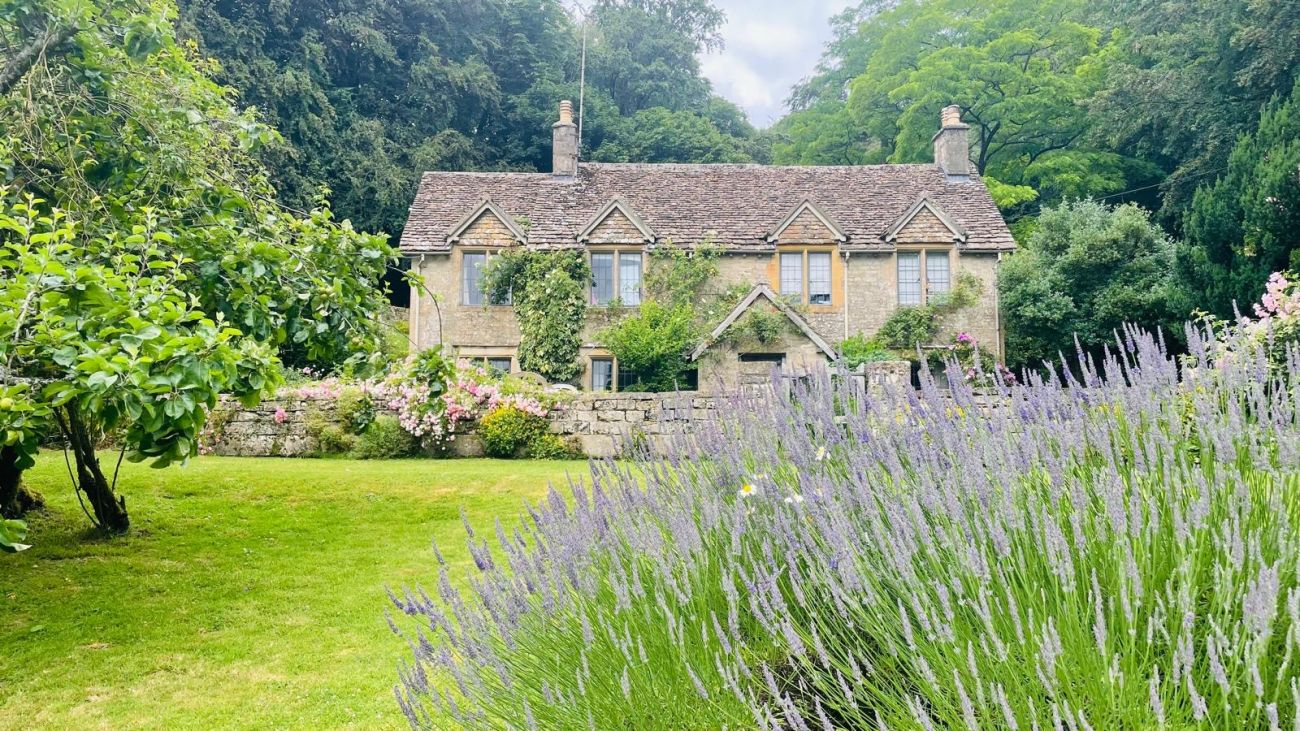
Moor Farm – Gardener’s Cottage.
At Daglingworth House our visit began in the pews of the Saxon church of the Holy Rood adjacent to the house and gardens. The church contains three quite exceptional early Saxon sculptures found in the Priory nearby, a Crucifixion, a Majesty and St Peter. David and Henrietta Howard, who conducted our tour, explained that over the last 30 years they have created a three-acre classical garden with a humorous contemporary twist. Extensive lawns lead through herbaceous borders, past a monkey puzzle tree, into a walled garden, to topiary, a grotto, a canal and reflective pool, woodland glades, and a temple for tea and other entertainment. There are views and vistas leading to tall yew hedges with windows onto the countryside. Within this varied classical structure are to be found humorous statuary and ornamental pieces: a huge spiders web, an owl, a crocodile, March hares, a leaf compost heap in the form of a giant tea pot, classic nymphs, Myanmar carved wood panels, and ‘Eileen’ in a niche. Work goes on inspired by the enthusiasm and creativity of the owners and their team.
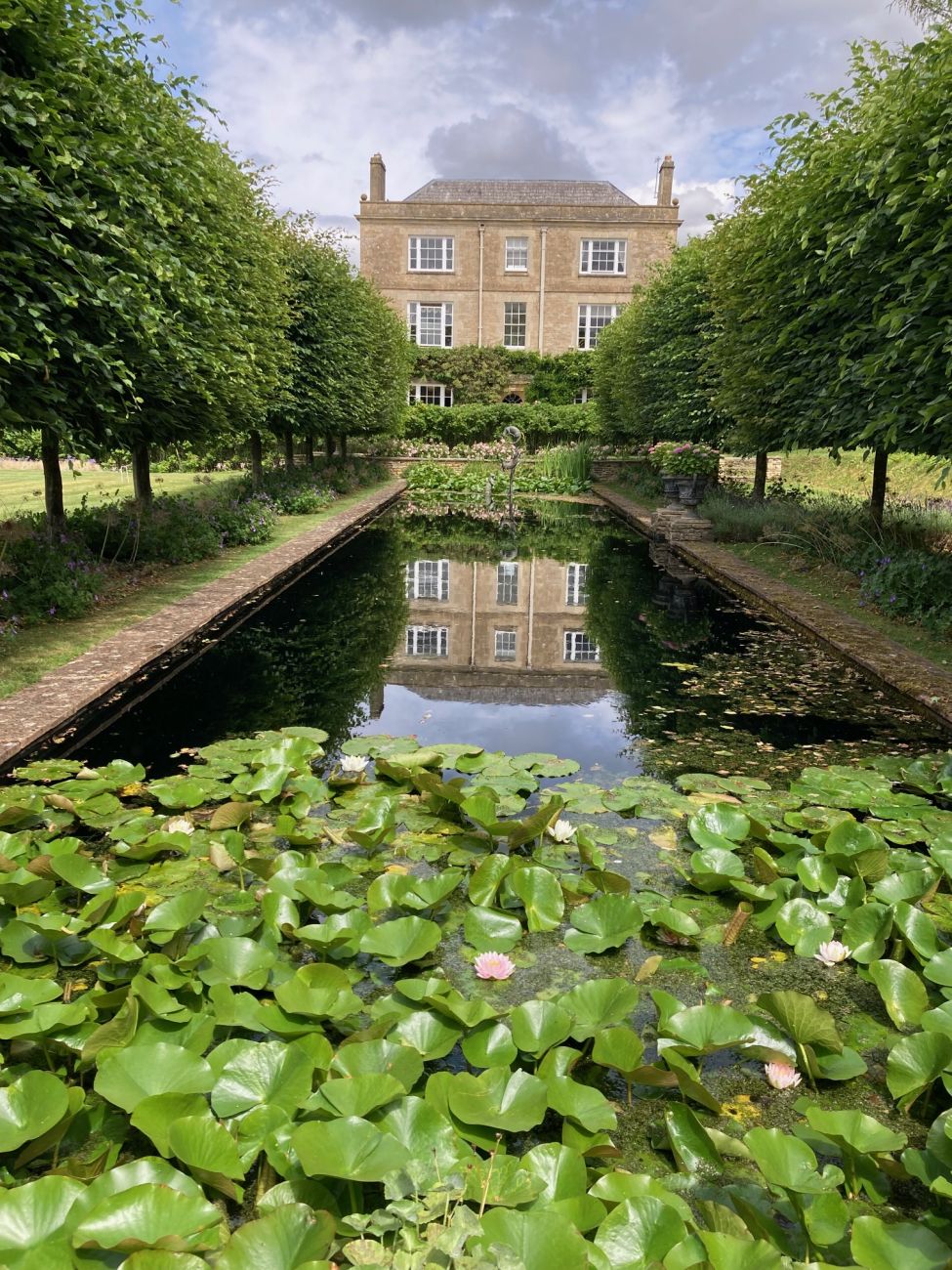
The canal with a framed view back to the house.
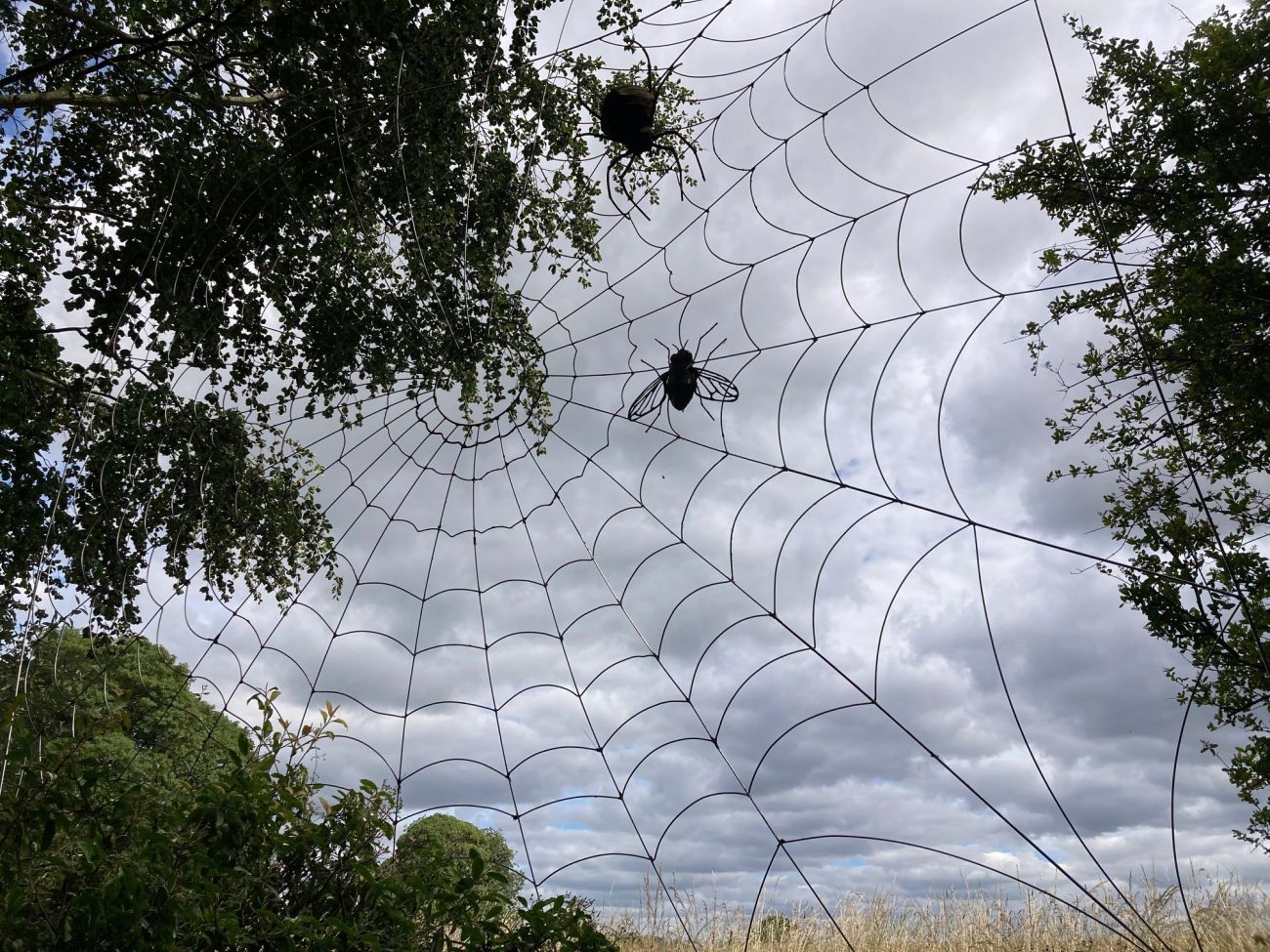
A giant spider’s web on the garden boundary.
On our second day we visited three gardens around Tetbury.
At the Tetbury Flower Company we were enthusiastically greeted by Rachel Golding Barrett, our host and owner of the company. While we were treated to home-made delights and refreshments, Rachel gave us an overview of her business, and then gave us a tour around the farm. Even though the business is very young, Rachel had already won three RHS show medals and at the time of our visit was working towards exhibiting at the RHS Badminton Show, a new garden show. Rachel is primarily a commercial producer with trial beds, cutting fields and a plant nursery area. Currently she grows 60 per cent perennials and 40 per cent annual plants but intends to move to 90 per cent perennials and 10 per cent annuals next year, as the annuals have a higher cost per stem. This year has been a particularly difficult one, as it has been for all growers, because of the unpredictable weather (wet, hot, dry conditions), poor germination results and increasing costs.
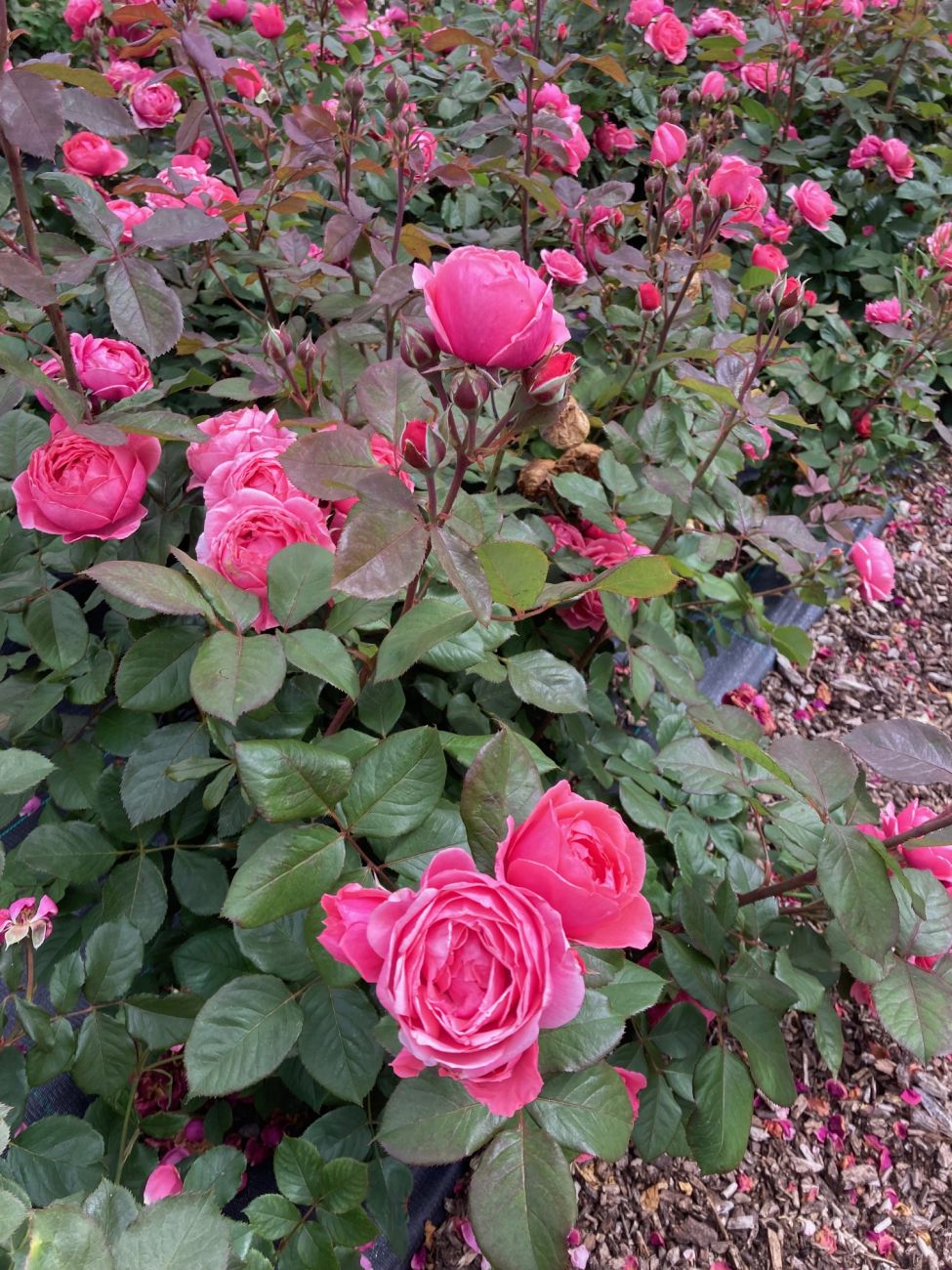
Rosa ‘Fruity Parfuma’ recommended for cutting and a strong fruity scent.
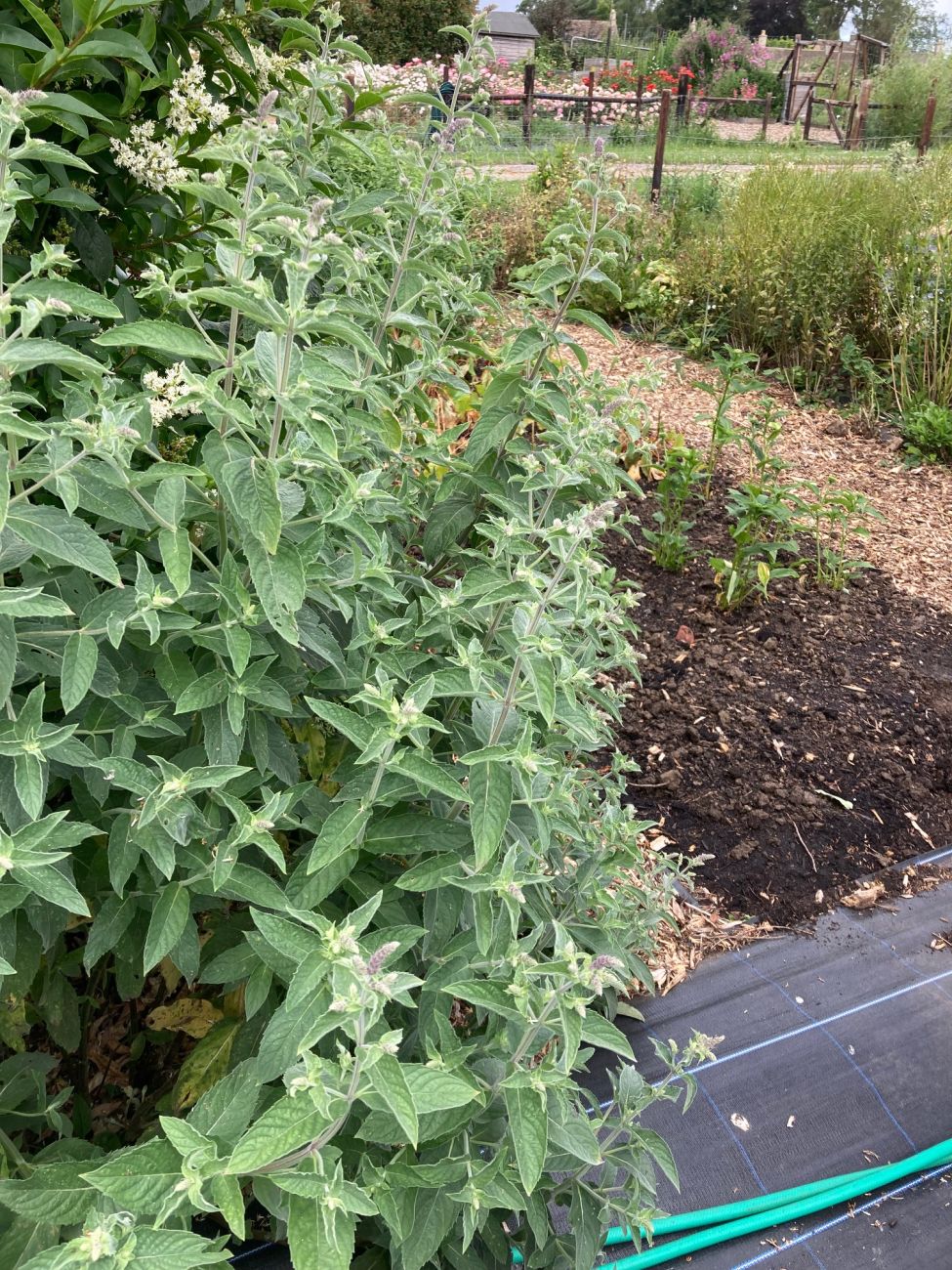
Mentha longifolia, the butterfly mint, recommended for cutting and to attract insects.
Hookshouse Garden and Pottery is owned by Christopher and Lise White, who have lived there since 1974. Their one and a half acres are planted in a cottage garden style, with the different areas flowing seamlessly. Christopher explained that areas of the garden had been developed in a way which provided solutions to problems they encountered. Digging out a sunken patio in front of the house and surrounding it with tall screening plants like Verbena bonariensis and Thalictrum has created a space to sit out, without being seen from the road. The failure of the septic tank soakaway led to an interesting way of managing the household grey water and sewage. The septic tank now empties into a series of attractive swirling cascades that oxygenate the water, before it moves into first one pool and then a second. By the time it reaches the final pool, the water is clean enough to drink and the pond is home to wildlife, including newts. A small woodland area has a summerhouse and hidden behind is a large composting area. The large productive vegetable and fruit garden is the domain of Christopher and, like the rest of the garden, is managed organically. Lise’s retirement from a teaching career allowed her to indulge her love of plants and her husband described her as “femina plantaholica”. This relaxing garden is packed full with a wonderful mixture of perennials, shrubs and climbers. Even spaces with no soil for planting are home to pots and containers, many created by Christopher, who runs a pottery on site. We heard more about the garden over tea and cake and several members were tempted to buy one of Christopher’s small vases, which are just the right size and shape for a small cottage garden posy.
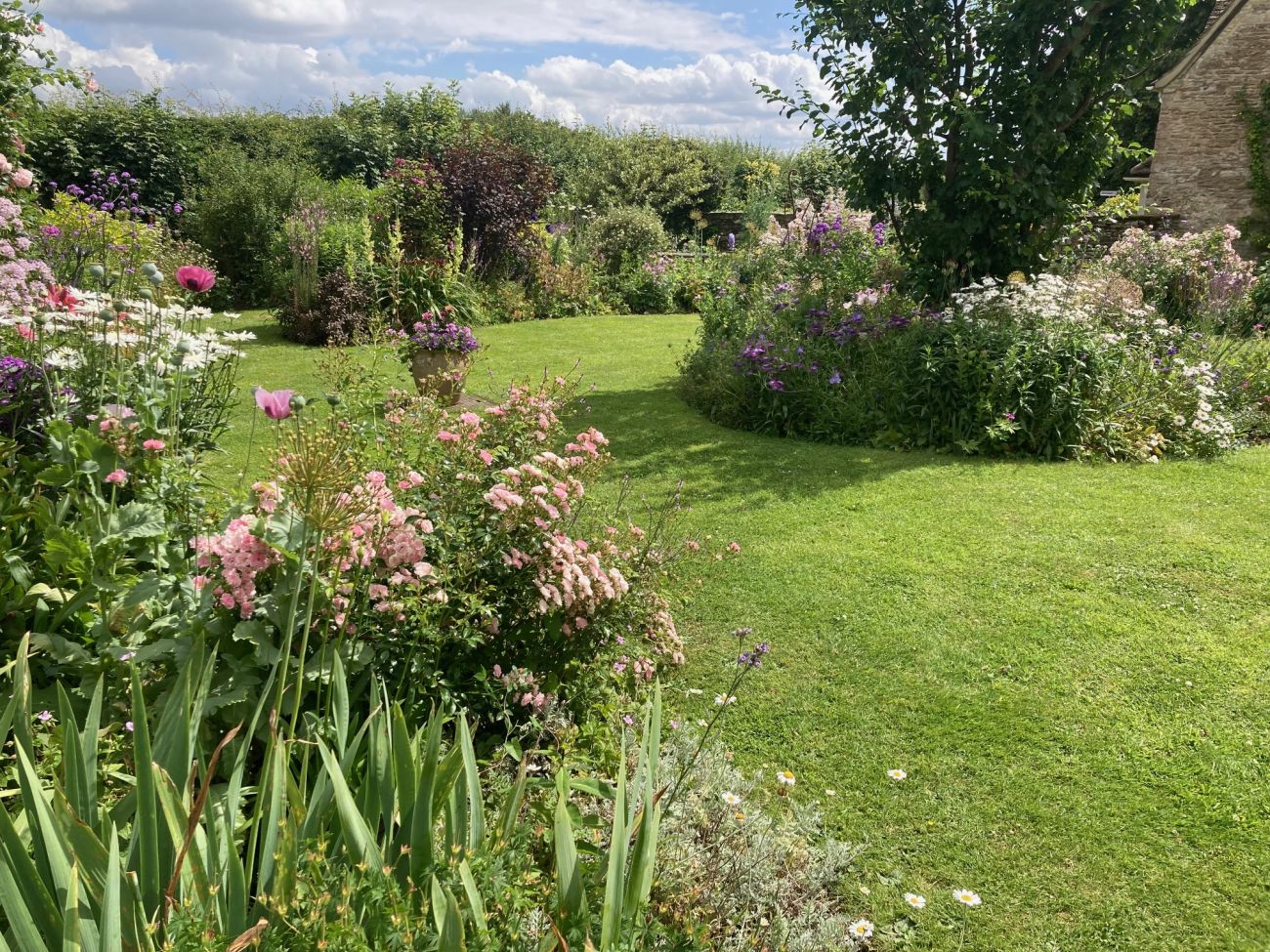
The cottage-style planting at Hookshouse.
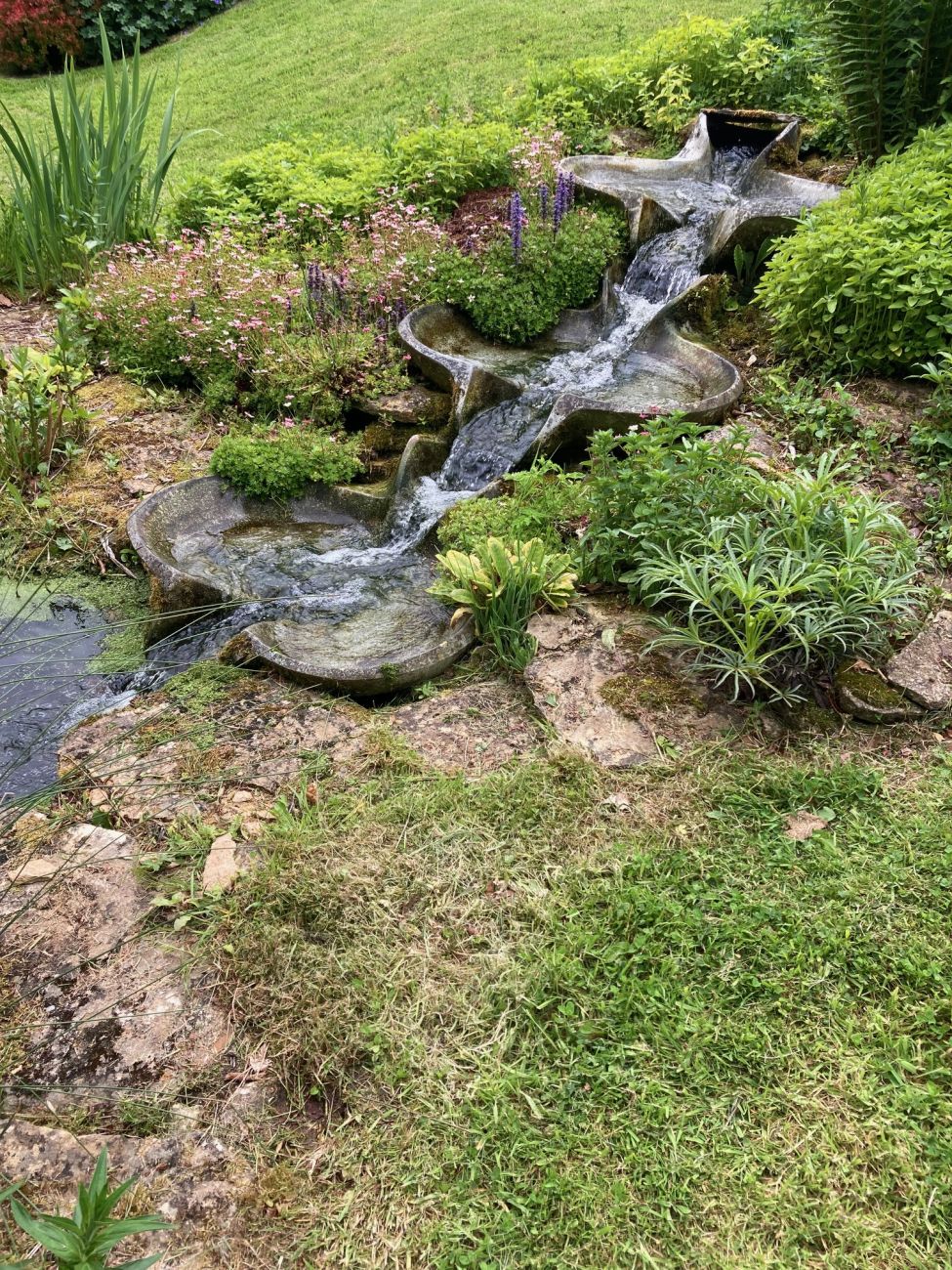
A swirling cascade that oxygenates waste water.
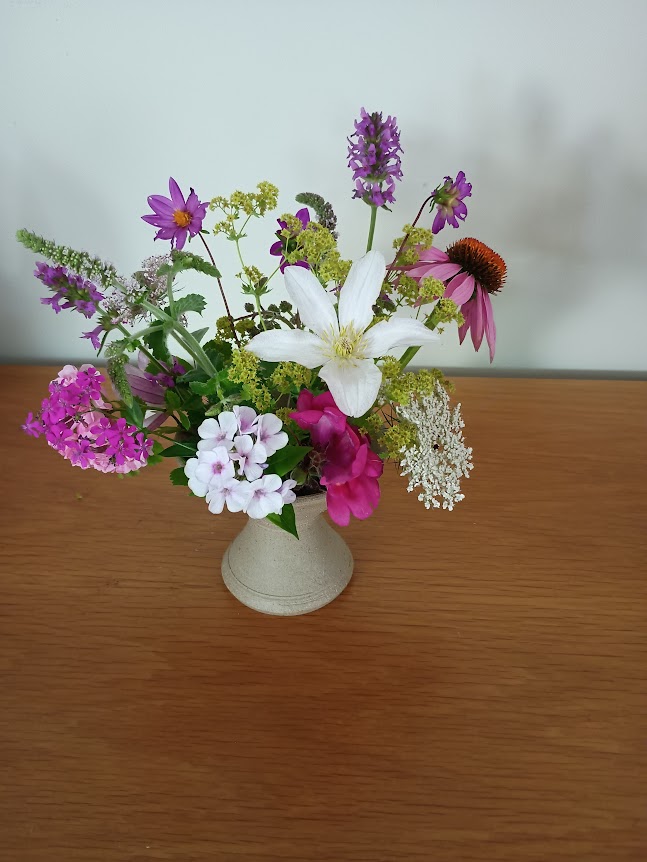
A Hookshouse posy pot in use.
The garden at Charlton Farm is young, it lies on the site of an old battery chicken farm. Sarah Rivett-Carnac and her late husband commenced work on developing the garden in 2011, and Sarah continues that work today. Due to planning conditions, only a relatively small area of the site can be ‘gardened’, so it was interesting to see how Sarah has extended the garden character informally in the wild areas, using only plants, landform, and water. The site is seven acres of wild and ornamental garden.
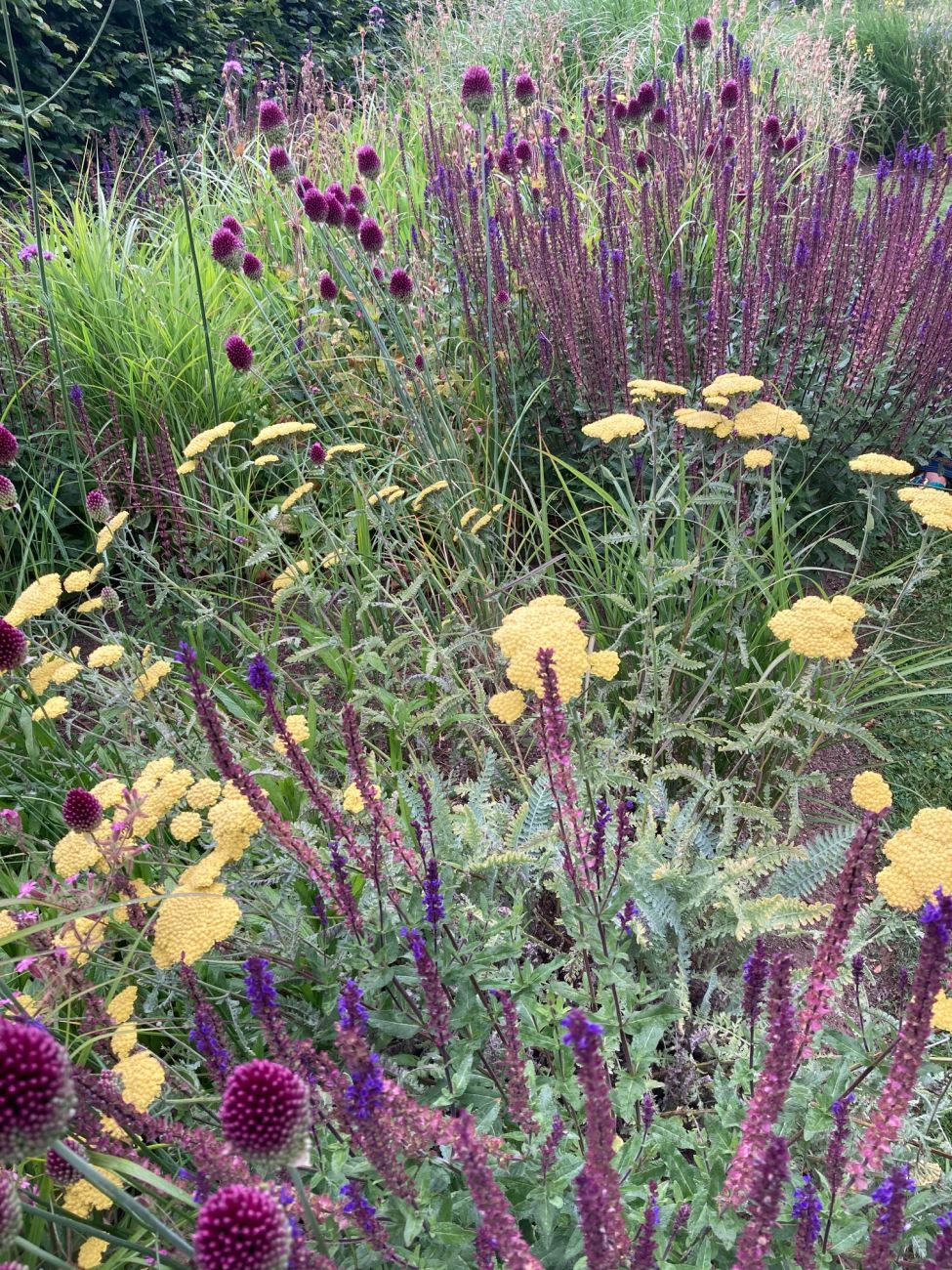
Naturalistic-style planting in complementary colours at Charlton Farm.
On our third day, we visited three gardens located along the southern scarp of the Cotswolds.
At Doynton House there were a variety of garden areas separated by old walls and hedges. Mixed borders, lawns, a parterre, a rill garden, a walled vegetable garden, cottage beds, a natural swimming pool, a dry garden and a peach house/greenhouse provided lots of interest. It was particularly interesting to see some recently rejuvenated planting, and to hear about the development of the garden generally from Frances Lindsey-Clark, and her very friendly and knowledgeable gardening team. Simple but very effective planting in pots adjacent to the front entrance door caught our eye – clipped silver variegated holly underplanted with Lagurus ovatus (hare’s tail grass), an annual grass from the Mediterranean basin.
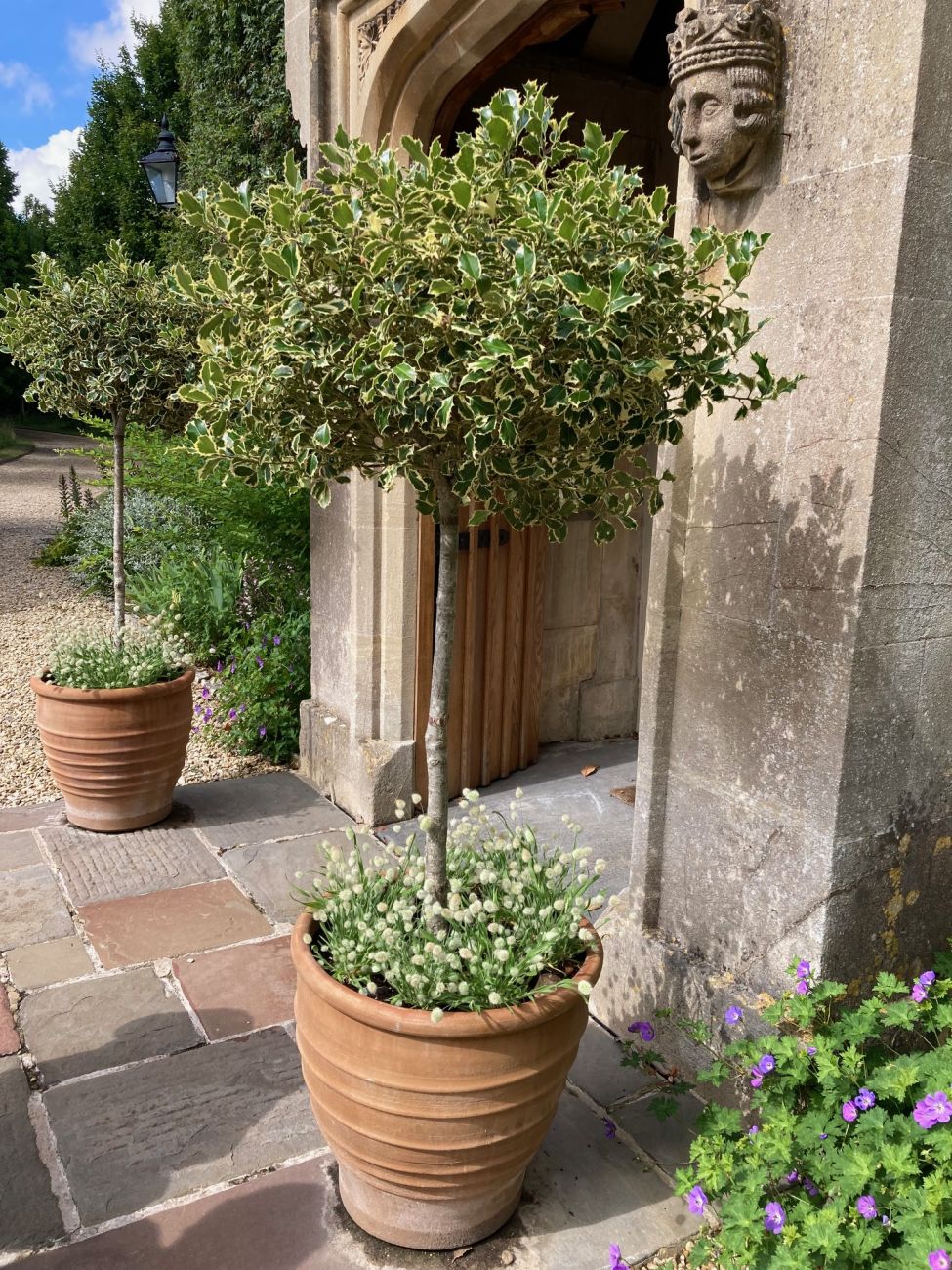
Holly underplanted with Lagurus ovatus.
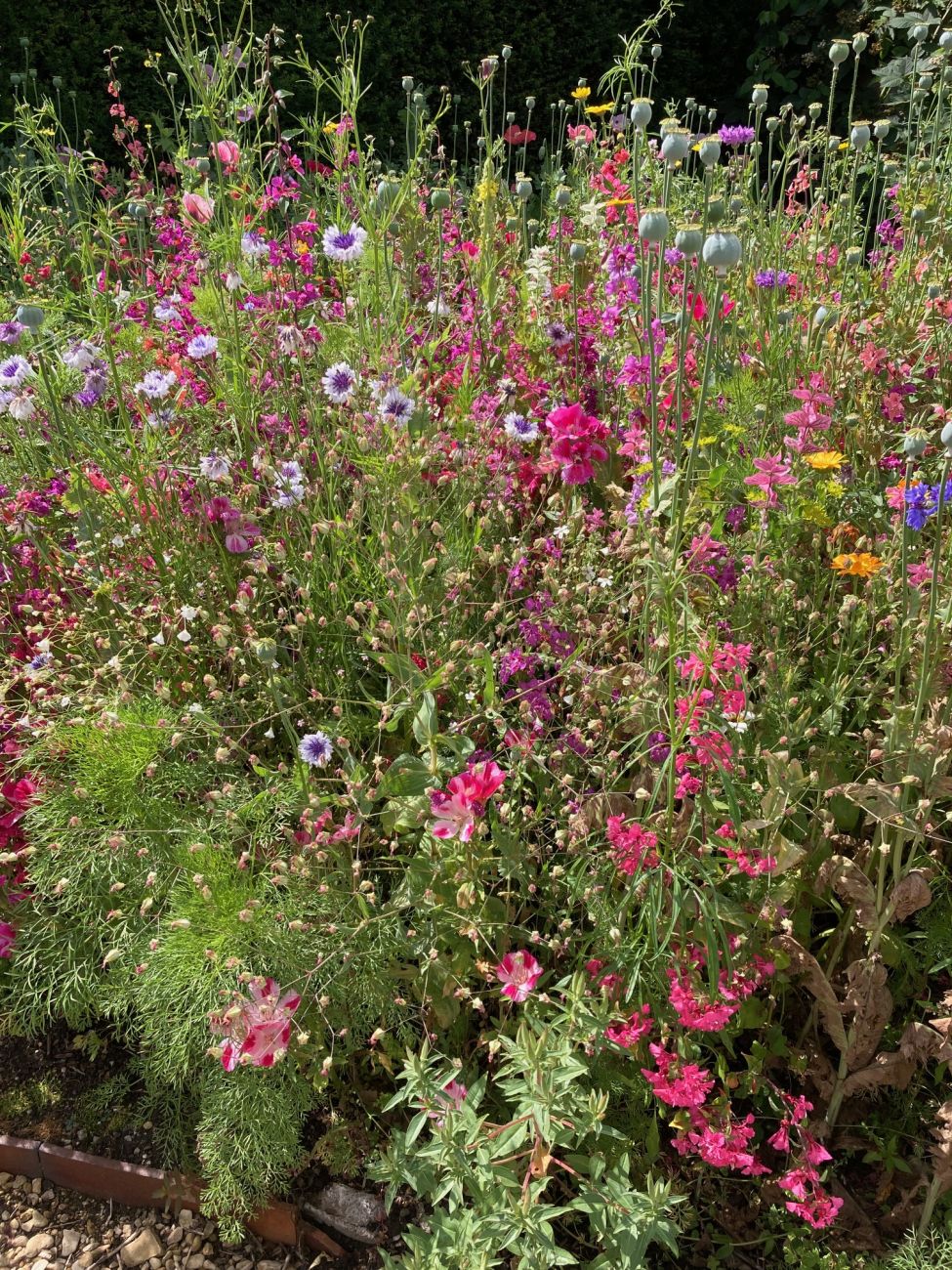
An annual seed mix grown in the productive garden.
Hanham Court is a 13th century estate that has been home to the Boissevain family since 2015. The gardens at Hanham Court have become a prominent feature of the estate only recently in relation to its long history. In 1993, the award-winning landscape designers Isabel and Julian Bannerman re-established and transformed the grounds into the gardens that visitors see today. Over 20 years, the Bannermans skilfully designed a sympathetic and deeply romantic garden. Today Julia Boissevain continues to honour their work, putting her passion for gardening into maintaining the haven, whilst creating and experimenting with new planting schemes and garden spaces to enjoy. Clipped purple beech domes had replaced some of the box, and plants are encouraged to self-seed in the gravel paths, particularly alongside the main lawn. The self-seeding had featured on BBC Gardeners’ World the week before our visit. The programme highlighted the garden’s clever balance between rigid structure—such as manicured topiary, hedges, and historic stone walls—and a relaxed approach to self-seeders. Instead of meticulously weeding out escapees, self-seeding varieties are allowed to “soften” the edges of the estate.
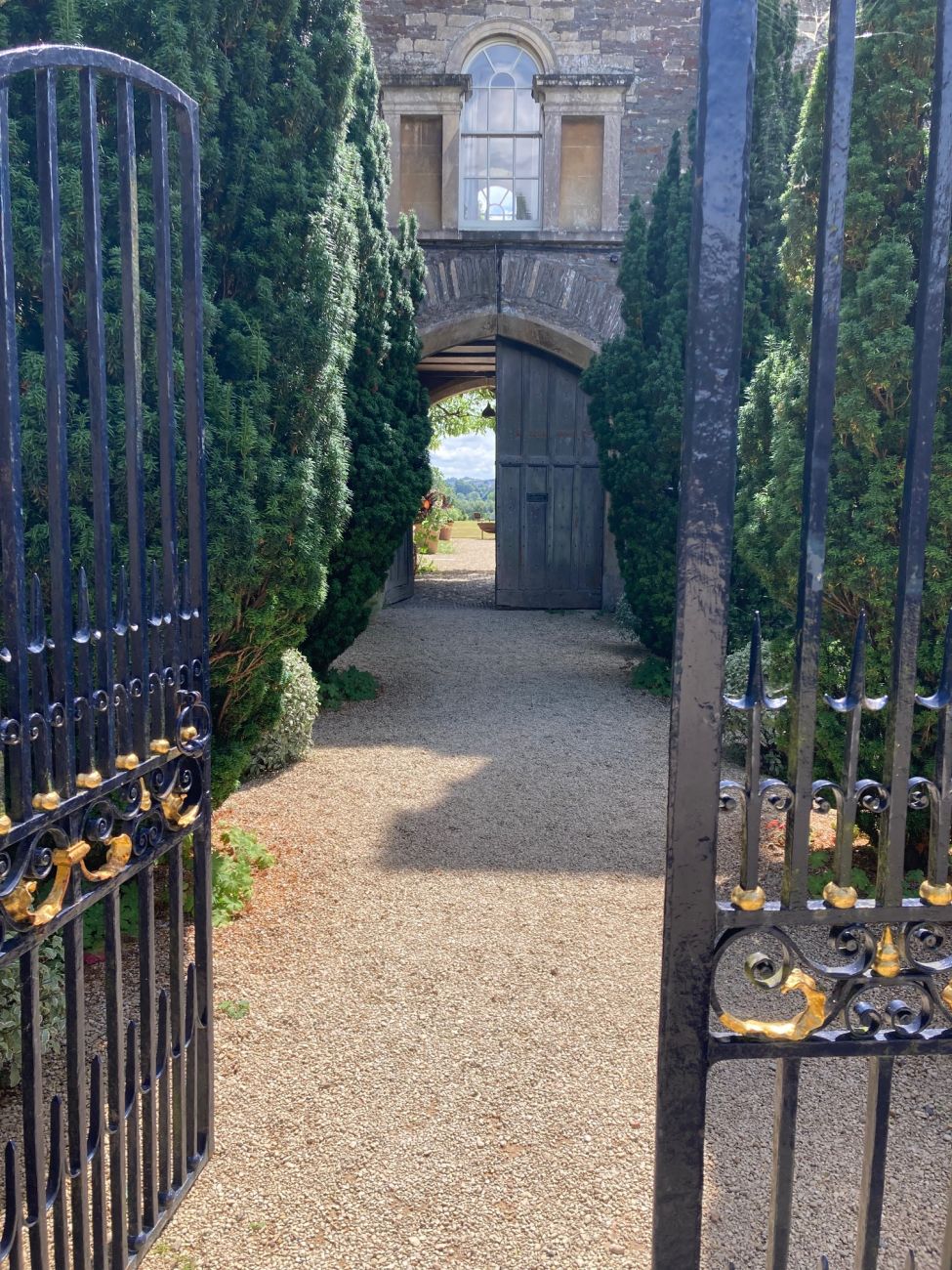
The entrance to the garden at Hanham Court.
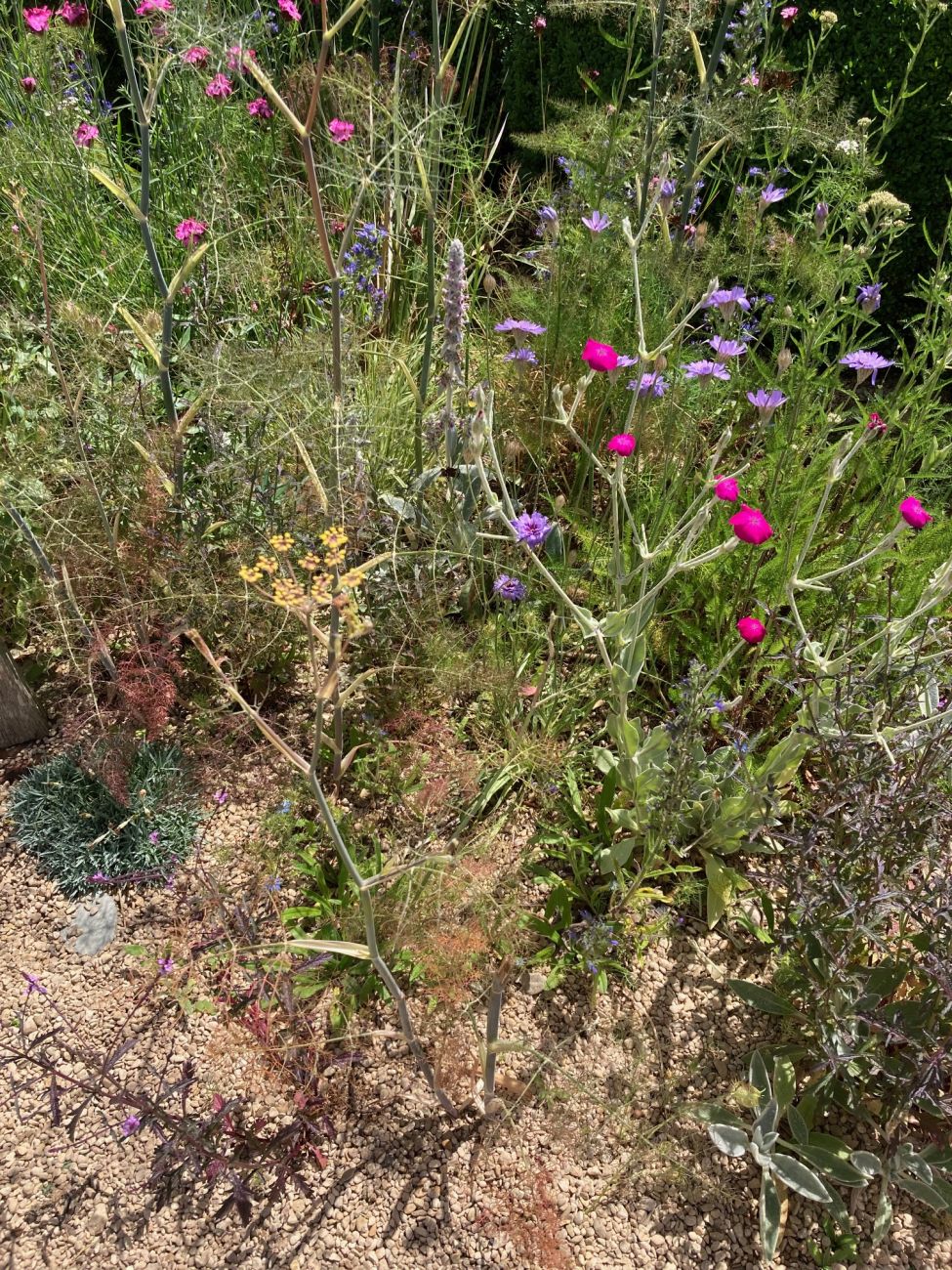
The edited self-seeding alongside the formal beds.
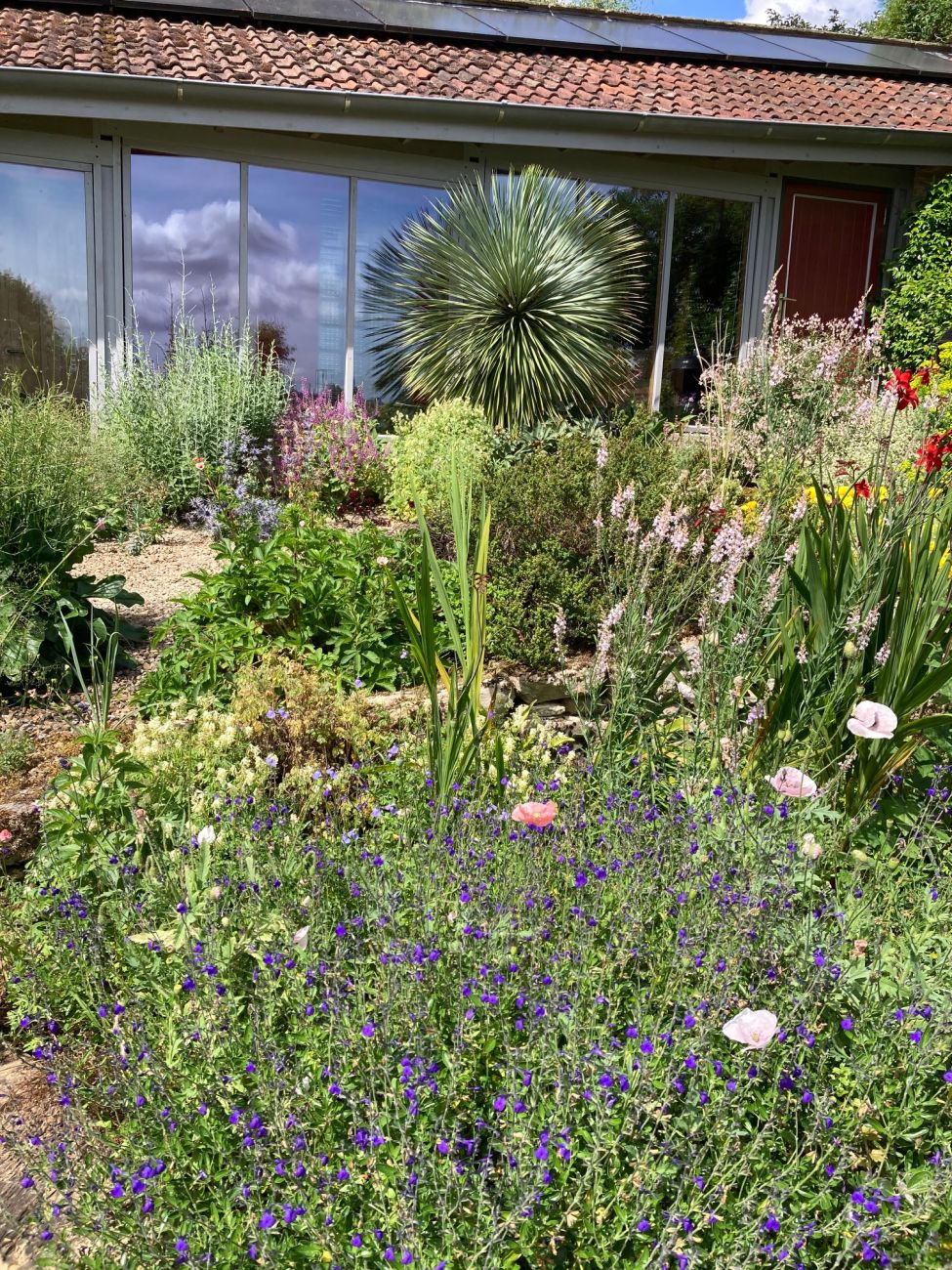
Derry’s gravel garden, including spherical Yucca rostrata ‘Sapphire Skies’.
Special Plants Garden and Nursery. Derry Watkin’s three-quarter-acre garden is architect-designed and located on a steep hillside with stunning views. It was started 30 years ago; Derry’s husband designed the garden, while Derry was busy developing her plant nursery. Derry has filled the garden with interesting planting, including exotics, with borderline hardy plants located in gravel gardens. Annual, biennial and tender plants are used for late summer colour. Derry explained to our group how she had constructed and planted her two areas of gravel garden, and she strongly recommended planting into a deep layer of gravel to reduce weed growth. A 10 cm depth of gravel results in very little weeding! Derry’s Specials Plants Nursery, “for passionate gardeners”, grows and sells unusual plants from all over the world, including hardy herbaceous and rockery plants, and many tender perennials for terraces and conservatories. Several of our members were delighted to purchase hard to source plants or seeds for their own gardens.
Our last visit was in south Gloucestershire, just north of Bristol.
Jekka McVicar’s Herb Farm is well-known for its huge collection of over 400 culinary and medicinal herbs. It features the ‘Herbetum’ (a living book of herbs planted in botanical families) and Jekka’s Gravel Garden. Jekka, who is known as the ‘Queen of Herbs’ led our tour. The organic herb farm is very much a family business with her son, daughter and husband all having key roles. Jekka was aware of our group’s interest in sustainable, waterwise planting. Her relatively new demonstration gravel garden was especially fascinating. It beautifully illustrates how herbs and other drought-tolerant plants can be grown successfully without artificial watering in our changing climate. Jekka generously shared her experiences and growing techniques, and also introduced us to some of her more unusual varieties of herbs. Phyla nodiflora was new to all our group – a dwarf, fast spreading, evergreen ground cover plant with small pink/white flowers, although tropical or sub-tropical it survives, without irrigation, all year in Jekka’s gravel garden. Jekka explained that she is re-inventing her herb farm, due to the lack of people wanting to work on the nursery. She is in the process of focusing more on education. Following a request from King Charles, Jekka, along with other master horticulturalists, is passing on horticultural skills to young people already working in horticulture. The scheme, called Hortistry, will help address critical skills shortages while preserving vital expertise for future generations. The Masterclasses are free to attend, but are open exclusively to practising horticultural professionals. Jekka will also continue to host open days for the general public, garden tours for groups, and courses related to herbs. In the nursery they will concentrate on growing the more unusual or hard to source herbs.
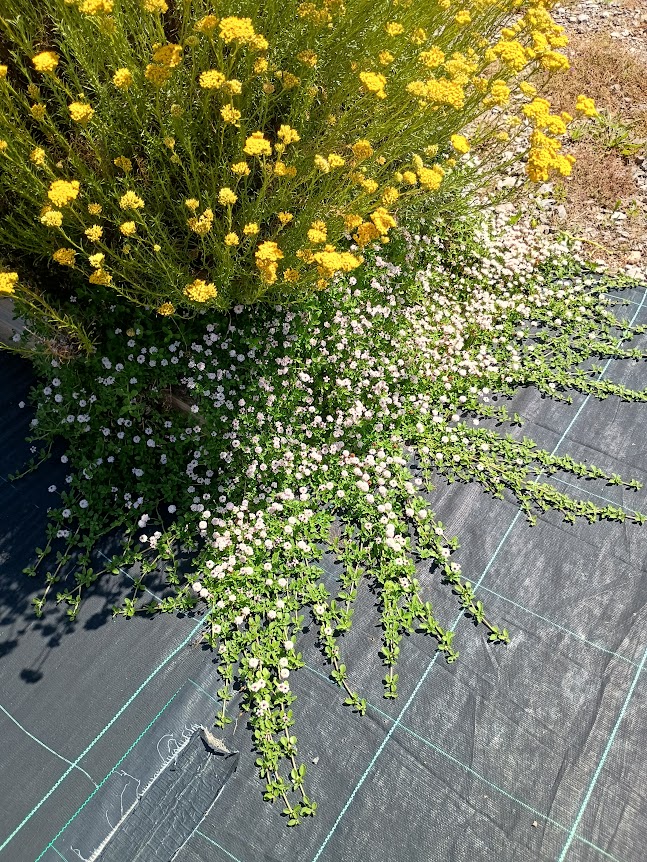
Phyla nodiflora under Teucrium at Jekka’s
Acknowledgements
Text by Anne Keenan, with thanks to Anne Curtis, David Foreman, Ann Linforth, Cathy Rollinson, Margaret Sax, Ann Twinn, Sue Tymon,
Images: David Foreman, Anne Keenan, Cathy Rollinson, Sue Tymon.